
How to Qualify Machine Shop Leads: An RFQ Scorecard and Follow-Up Playbook
An inbox full of quote requests can look like a healthy pipeline. It can also keep an estimator busy with work the shop cannot produce, undefined projects, and repeat requests that never become orders. RFQ volume alone does not tell you whether inquiries match your equipment, quality system, capacity, or business goals.
To qualify machine shop leads, decide what happens next: quote, clarify, route, hold for capacity, or decline with an explanation. The process should support consistent responses without making buyers complete a long application.
This guide gives shop owners and sales teams a practical way to separate hard fit requirements from judgment calls, score viable opportunities, and follow up after a quote. The scorecard is a starting template. Adapt its weights and thresholds to your own equipment, margins, capacity, and customer mix.

What makes a machine shop lead qualified?
A qualified lead is an opportunity your shop has reason to pursue, not merely an inquiry with complete contact fields. At minimum, there should be a real project, a reachable person, and enough information to decide whether a useful next conversation is possible. For a quote-ready RFQ, you also need a workable technical definition and commercial context.
Qualification is shop-specific. A prototype that fits a five-axis job shop may be poor work for a high-volume turning operation. A 10,000-part request may be attractive to one shop and impossible for another. Fit depends on the operation receiving it.
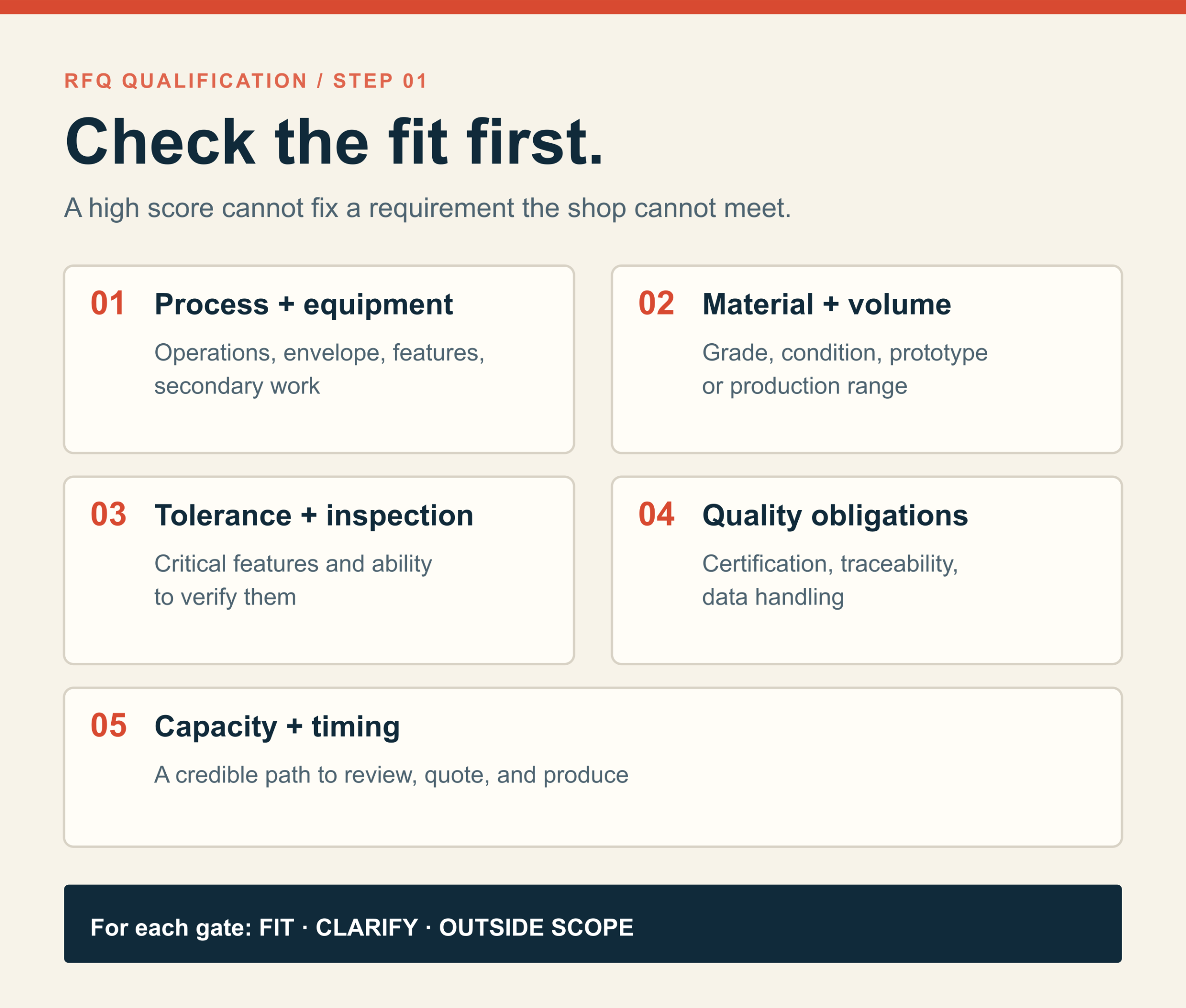
Use two decisions in order. First, test for nonnegotiable fit: process, part envelope, material, quality obligations, and any confidentiality or compliance requirement you must be able to meet. Second, prioritize the opportunities that pass using a flexible score. This prevents a high dollar estimate from masking a job you cannot safely deliver.

Start with five fit gates
- Process and equipment. Can your current machines and partners perform the required operations? Record axis needs, part envelope, features, and required secondary processes. A broad label such as “CNC machining” is not enough to answer this.
- Material and production range. Can you source and machine the specified material, in the stated condition, at the intended prototype or production volume? Ask whether alternate materials or lot sizes are permitted rather than assuming they are.
- Tolerance and inspection. Can you verify the critical characteristics with your equipment, methods, and staff? If a requirement is unclear, route it for engineering review before promising a result.
- Quality and contractual obligations. Does the project require a certification, traceability package, controlled data handling, first article inspection, or customer approval process your shop can actually provide? Never imply a certification you do not hold.
- Capacity and timing. Can you review, quote, and—if awarded—produce within a credible schedule? A date is a constraint to discuss, not a number to accept automatically.
A gate can have three outcomes: fit, needs clarification, or outside current scope. “Needs clarification” deserves an owner and a question, not an automatic rejection. For example, a tight tolerance may apply to only one feature. A short call can resolve whether your inspection plan is adequate.
Use a scorecard only after the gates
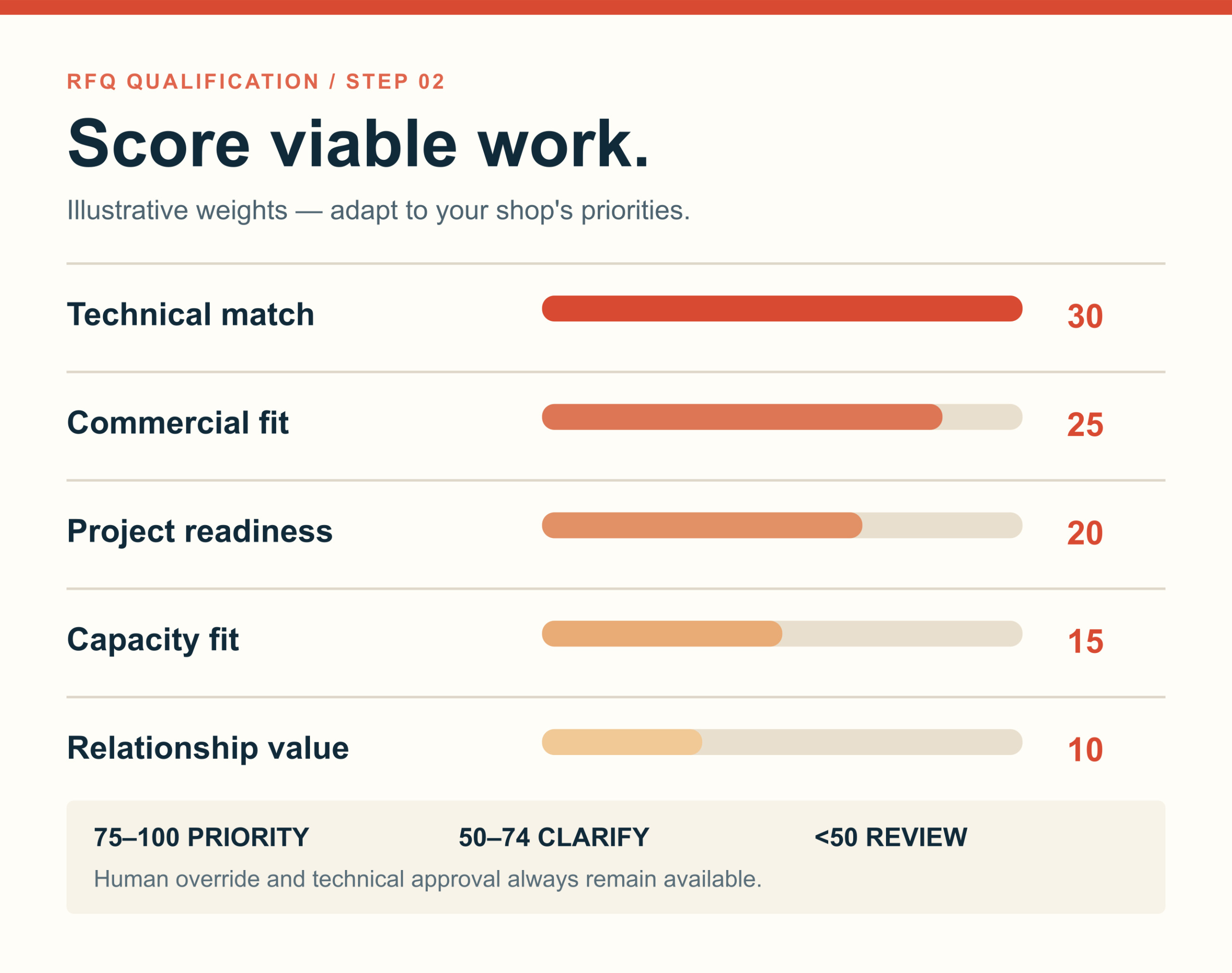
Once an inquiry passes the fit gates, a simple scorecard helps the team make consistent tradeoffs. Do not treat the result as an algorithmic quote decision. It is a triage aid that shows why an opportunity deserves more attention and what information is still missing.
Here is a sample 100-point model to adapt:
| Dimension | Points | What to look for |
|---|---|---|
| Technical match | 30 | Work fits proven processes, materials, tolerances, inspection, and partner network. |
| Commercial fit | 25 | Quantity, repeat potential, likely order value, and payment or purchasing terms fit your business. |
| Project readiness | 20 | Current revision, usable files, decision timeline, and a clear next step are available. |
| Capacity fit | 15 | The shop has a realistic window to quote and produce without disrupting committed work. |
| Relationship value | 10 | The buyer fits a target market, is a current customer, or offers a credible path to repeat work. |
Suggested routing, not an industry benchmark: 75–100 points gets priority review; 50–74 gets a clarification or discovery step; below 50 gets a limited review or a polite decline if a required gate fails. A repeat customer, strategic account, or urgent problem can warrant an override. Record the reason, so the scorecard remains accountable to human judgment.
Avoid scoring a lead down because the buyer does not know machining terminology. An engineer may have a complete print but no purchasing authority; a founder may have a promising prototype and need help defining specifications. Ask which missing information changes your ability to quote. Do not make every unanswered field look like a disqualifier.
Example: two RFQs, different next steps
RFQ A: A purchasing manager submits a revised drawing, material specification, annual usage, first-order quantity, required documentation, and target date. The part fits a process your shop runs weekly. It passes the gates and earns a high score. Assign an estimator, acknowledge receipt, and give a realistic date for the next update.
RFQ B: A product team asks about a small prototype with an attractive long-term market, but sends an early model without critical tolerances or a controlled revision. The technical gate is not yet resolved. Send two or three specific questions and offer a short technical conversation. Quoting from assumptions would create more risk than value; discarding the lead would be premature.
Both inquiries deserve a response. They do not need the same response.
Collect enough information without building a form obstacle course
Your website's RFQ path begins qualification. It should let buyers submit what they have and explain what the shop needs next. A “name, email, message” form pushes basic questions into the inbox. Demanding every technical detail can stop an early-stage buyer before a conversation begins.
Start with the essentials: contact name, company, business email, project description, process if known, estimated quantity, desired date, and an optional secure file upload or approved file-transfer method. Then use conditional fields for material, finish, quality documentation, and repeat volume when they matter to your work. Label optional information honestly. Explain which files you accept and what happens after submission.
For technical files, preserve the original attachment and revision. Ask the buyer to identify which drawing or model controls when multiple versions are sent. NIST's model-based enterprise work illustrates why design data and its authority matter across supplier handoffs; a shop should not silently reconstruct requirements from a partial file. NIST describes the manufacturing data exchange problem in its Model-Based Enterprise Summit proceedings.
Sensitive drawings also need a deliberate handling path. Restrict access to the people reviewing the opportunity, use approved storage, and protect the accounts that hold the files. CISA recommends multifactor authentication for business systems that contain sensitive information. If a customer requires an NDA, export-control review, or other special handling, route that requirement before files circulate through ordinary marketing tools.

Make the first review a repeatable workflow
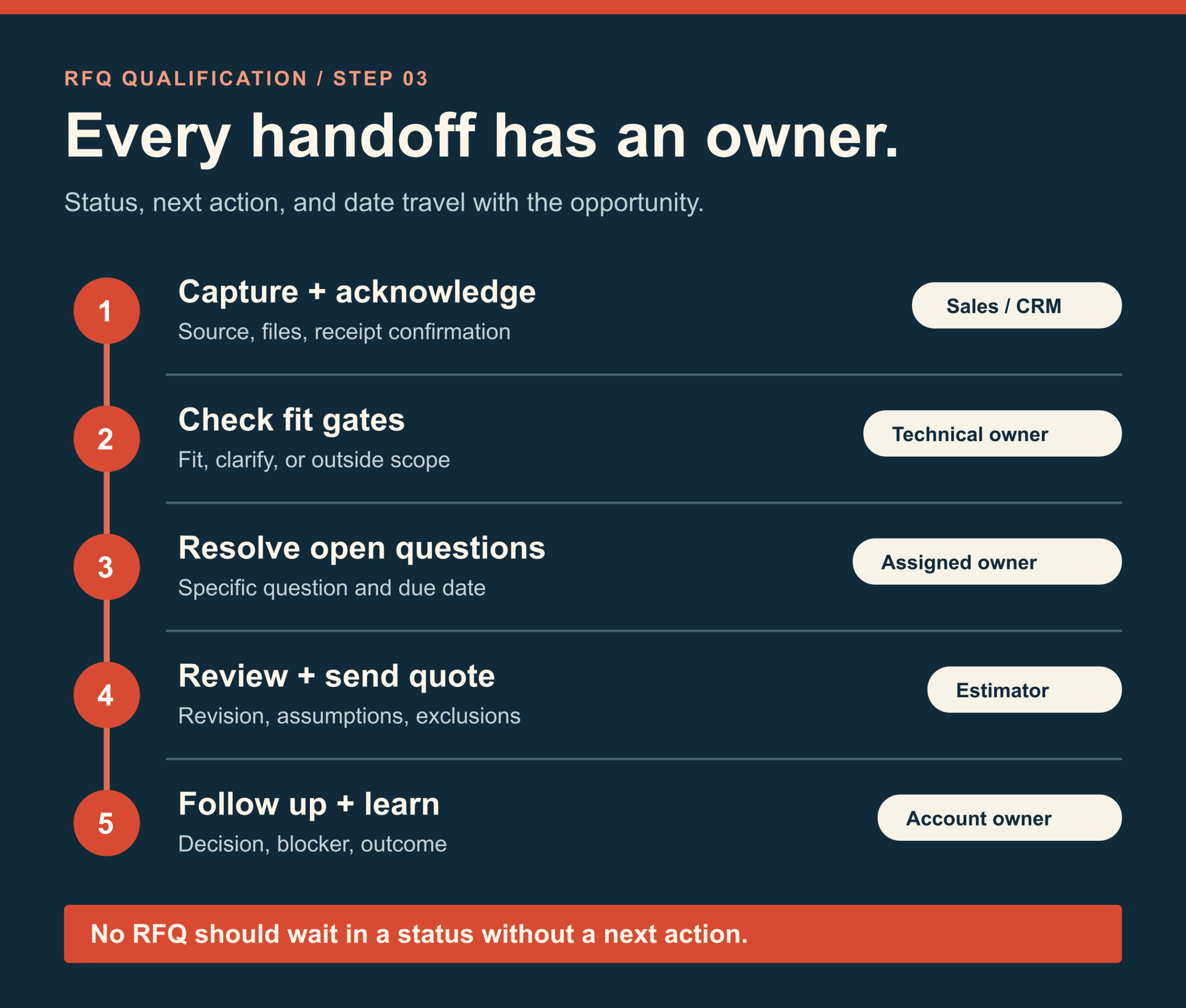
The qualification process should answer three questions quickly: Who owns this? What is missing? When will the buyer hear from us? A shared inbox alone does not answer them. A CRM or lead log does not need to be elaborate, but each RFQ should have a source, owner, status, last contact, next action, and outcome.
Use a short sequence:
- Capture and acknowledge. Record the original source—organic search, paid ad, referral, returning customer, or other channel. Confirm that the RFQ arrived, without promising a quote date before the team reviews it.
- Check the gates. A trained owner checks process, material, envelope, quality, capacity, and handling requirements. Mark uncertain facts as open questions.
- Assign the next action. Route fit leads to estimating. Route unclear leads to a named person for clarification. Route out-of-scope work to a courteous decline or a vetted referral, when appropriate.
- Score viable opportunities. Use the scorecard to set review order when several qualified RFQs compete for limited estimator time. Keep the score and the reasoning together.
- Set a follow-up date. Once a quote is sent, record when the team will check for feedback, the buyer's decision timing, and any blocker identified.
Give each status a clear definition. “New” means unreviewed; “clarification needed” means a specific question is waiting on a specific person; “estimating” means the team has accepted the quote task; “quoted” means the buyer received a reviewed offer. These definitions prevent an inquiry from appearing active while nobody owns the next step.

Keep people in charge of technical and commercial promises
An intake tool can flag missing fields, organize files, and prepare a draft acknowledgement. It should not independently decide manufacturability, capacity, price, tolerance, certification, or delivery. Our separate guide to AI-assisted machine shop RFQ responses covers where automation can help while a person reviews the result.
The same rule applies without AI. A salesperson should be able to say, “We have your request and are reviewing the drawing,” without implying that the shop has accepted the work. A technical reviewer should be able to return a clear question before the buyer receives a price based on unstated assumptions.
Write responses that move the opportunity forward
The first response should make the buyer feel heard and establish the next action. It does not need a lengthy sales pitch. Use templates as a starting point, then tailor them to the actual project.
For a quote-ready RFQ: “Thanks for sending the drawing for [part/project] at revision [X]. We have the requested quantity and target date. [Name] is reviewing the technical requirements and will update you by [date]. If we identify a question that changes the quote basis, we will contact you before proceeding.”
For missing information: “We can review this for fit. Before we quote, could you confirm [specific question 1] and [specific question 2]? We have [files received], and want to make sure we use the correct revision. If a short call is easier, we can review those points together.”
For work outside the shop's scope: “Thank you for considering us. This project requires [process or requirement] that we do not currently offer, so we should not quote it as though we can perform it. If the specification changes or you have a future project in [actual capability], we would be glad to review it.”
In each case, use a real owner and a real next date. Do not publish a blanket “24-hour quotes” promise unless your shop can deliver it for the RFQs that matter. A timely, specific update is more useful than an automatic message that says nothing about the project.
Follow up on quoted work without chasing blindly
Qualification does not end when the price goes out. A quoted project can stall because the buyer is waiting on internal approval, comparing suppliers, changing the design, or shifting the launch schedule. A follow-up should ask about the decision process and help resolve an obstacle, not simply ask whether the quote was received again.
At quote delivery, capture the revision quoted, quantity breaks, assumptions, exclusions, validity period, and buyer's stated decision timing. Schedule a check-in based on that timing. If the buyer is still evaluating, ask whether price, lead time, documentation, or a technical point needs clarification. If the project is paused, record a future contact date rather than treating it as lost. If the order goes elsewhere, ask what you can learn, and distinguish price from capability, timing, and supplier qualification.
This history helps the next RFQ. It also helps marketing. A lead source that brings many form fills but few fit opportunities may be less valuable than a smaller source that consistently reaches your preferred work. KriXis's machine shop lead generation service connects search and paid traffic with RFQ conversion and follow-up; this scorecard gives that system a clearer definition of “qualified.”

Measure the pipeline you actually want
Do not stop at website traffic or form submissions. Track the path from inquiry to work your shop wants to accept. A simple monthly view can include:
- Inquiries by source and the percentage that pass the hard fit gates
- Time from receipt to first useful human response
- Percentage of viable RFQs that reach a quote
- Quote turnaround time by project type, measured from receipt of enough information
- Quotes won, lost, paused, or still open, with the reason when known
- Revenue and repeat work from awarded opportunities, tied back to source
Define the denominator before comparing months. A “quoted RFQ” should not include an auto-reply, and “response time” should distinguish acknowledgement from substantive review. Review sudden changes: a campaign may look worse after a form captures more early-stage buyers, or better after staff close incomplete requests without quoting.
If you lack a CRM, start with a shared spreadsheet and one accountable owner. Move to a more integrated system when the process is stable. KriXis has long emphasized connecting the front end of marketing to the back end of machine shop CRM; the qualification fields are what make that connection useful.
Put the system in place over 30 days
Week 1: Audit recent inquiries. Pull the last 20 to 30 RFQs if available, including won, lost, declined, and unanswered opportunities. Record source, technical fit, missing information, response time, quote status, and outcome. Use the review to identify the questions that genuinely determine fit for your shop.
Week 2: Agree on gates and ownership. Write the five gates in shop-specific language. Decide who can mark a job out of scope, who approves exceptions, and who owns clarifications. Choose a small set of statuses that everyone understands. Establish approved language for receipt, clarification, and decline.
Week 3: Pilot the scorecard. Have two people independently review several new RFQs and compare scores. Disagreement is useful: it shows where a dimension or weight needs a better definition. Do not let the point total overrule an engineer's concern or a contractual requirement.
Week 4: Connect the website and reporting. Adjust the RFQ form only where the audit shows a real information gap. Test file handling and confirmation. Review the first month's source-to-quote path and decide which marketing channels and page topics are bringing qualified work. The machine shop website design service explains how capability proof and a clear RFQ path fit together.
The goal is a usable routine. A team that records the same facts and assigns each next action will learn more than one with a dashboard nobody maintains.
Frequently asked questions
Should we require a drawing before talking to a lead?
Require enough information for the next decision, not necessarily a complete drawing for the first conversation. Some early-stage buyers are validating a concept or supplier fit. If a drawing is essential to price or feasibility, explain that and offer a clear path to submit it securely. Do not quote a technical requirement you have not reviewed.
What if a promising customer scores below our threshold?
Use the score to flag the reason, then allow a documented human override. A strategic buyer may have an incomplete first RFQ but strong long-term fit. Assign a discovery step instead of pretending the project is quote-ready or discarding it.
How often should we change the scorecard?
Review it monthly during the pilot, then when your capacity, capabilities, customer mix, or win patterns change. Compare scored leads with actual quotes and awarded work. If the model rewards activity that does not produce good jobs, change the model.
Turn better inquiries into better work
More leads only help when your shop can recognize the right opportunities and respond well. Begin with hard capability gates, use a flexible score for viable RFQs, assign every next step, and learn from the outcome. That is how a lead generation program becomes a reliable path to the work your shop wants.
If you want to connect your website, search visibility, RFQ intake, and follow-up, talk with KriXis about your machine shop's growth goals.
Sources and further reading
- NIST: Model-Based Enterprise Summit proceedings — manufacturing data authority and supplier handoffs.
- CISA: Require Multifactor Authentication — protecting systems with sensitive business data.
- Google Search Central: SEO Starter Guide — guidance for clear, useful search content.

Trackbacks & Pingbacks
[…] a practical next step, read the machine shop website checklist and RFQ qualification guide. The original interview follows, with its period-specific statements […]
[…] a practical next step, read the machine shop website checklist and RFQ qualification guide. The original interview follows, with its period-specific statements […]
[…] RFQ qualification scorecard can help organize those questions. Keep human review for ambiguous or strategic opportunities. A […]
[…] to a relevant capability page or guide. The RFQ qualification article provides a useful model for explaining fit and missing information without promising an instant […]
[…] website measurement with the RFQ qualification scorecard. Record accepted, clarification-needed, and declined inquiries so the team can distinguish a […]
Leave a Reply
Want to join the discussion?Feel free to contribute!