
How to Write Machine Shop Case Studies Buyers Can Use
KriXis editorial guide · Published October 10, 2026 · About 13 minutes to read
Machine shop case studies should help a prospective buyer understand how a supplier approaches a real manufacturing problem. A useful story explains the requirement, the decisions, the verification and the outcome. A page that only says “another happy customer” gives the reader very little to evaluate.
Start with a completed project, verifiable records and publishable information. A specific account can be useful even when the customer stays unnamed and commercial figures remain private. You do not need an impressive percentage or recognizable logo.
This guide explains how to choose a project, gather the facts, structure the story, qualify results and connect the page to a relevant inquiry. It also includes a fictional example and a free writing kit. Use the framework to prepare a draft; your responsible technical team should approve manufacturing claims before publication.
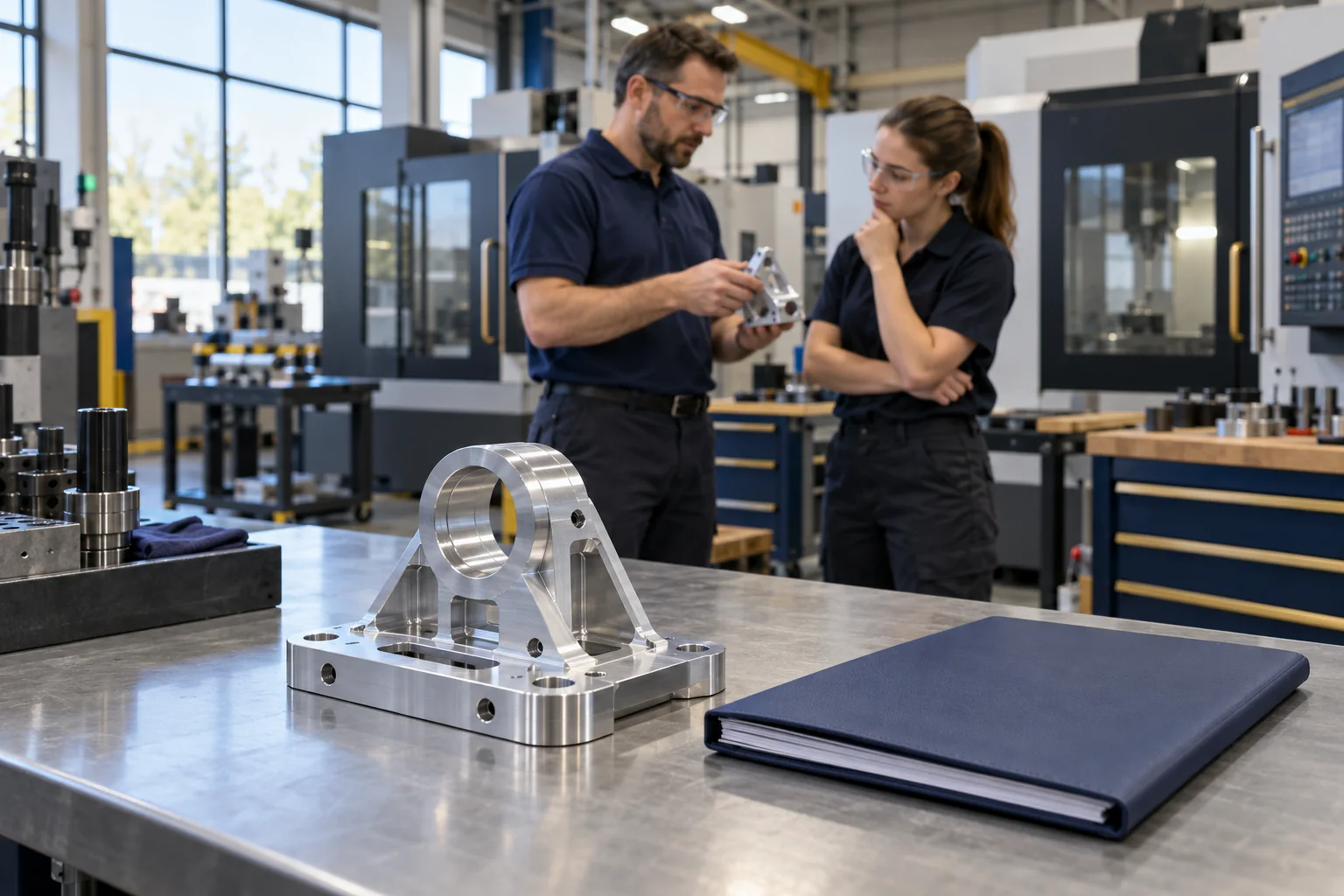
What a manufacturing case study should help buyers decide
A capability page explains what the shop supports. A case study shows how selected capabilities were applied in a particular situation. Together, they can help a reader decide whether to ask for a drawing review, a technical conversation or a quote.
Buyers may want to understand the challenge, how your team communicated, what was checked and which conditions affected the result. NIST's supplier selection guidance discusses evaluating capabilities, quality systems, production and inspection documentation. Our editorial recommendation is to make relevant examples support those questions, while keeping the story within its actual evidence.
The case study does not replace supplier qualification, a quality audit or a project-specific technical review. It introduces a documented example. Avoid letting one successful project imply that every part, material or production situation will achieve the same result.
If your service pages need clearer context first, use our machine shop capability page blueprint. Then choose an example that helps explain a question those pages leave open.
Choose a project with a clear buyer question
Start with the question the story will answer. Perhaps a buyer needs to understand how you handle incomplete specifications, coordinate an outside finishing operation, or prepare an inspection plan for agreed requirements. Select a project with enough verified detail to explain that process.
Use four selection checks: relevance to work you want, availability of records, clarity of the manufacturing decisions, and publication permission. If any check is unresolved, choose another project or narrow the story. Do not invent missing details to make an otherwise incomplete account feel finished.
Write a short purpose statement: “Show how our team clarified requirements and verified an agreed feature before delivery.” That keeps the draft focused. It also distinguishes a process story from a testimonial, a machine description or a general company profile.
Gather facts before asking for polished copy
Interview the people who handled the work: estimating, programming, operations, quality and the account contact as relevant. Ask what the requirement was, what changed, why a decision was made and which records support the account. Keep answers separate from interpretation until the facts are reconciled.

Useful source material can include an approved project summary, revision history, inspection records, documented delivery dates and customer-approved comments. Keep the internal evidence file separate from the public draft. The writer generally needs a verified summary, not unrestricted access to every customer document.
Record who supplied each fact and who can approve it. Reconcile the sequence, including customer revisions, before describing a turnaround result.
Ask what needed clarification, what was verified and what remains unknown. Avoid questions that assume savings or risk reduction without evidence.
Use a six-part machine shop case study framework
A readable case study follows a decision trail. The six sections below give the reader enough context to understand the work without turning the page into an internal production report. Adjust their length to the complexity of the example.
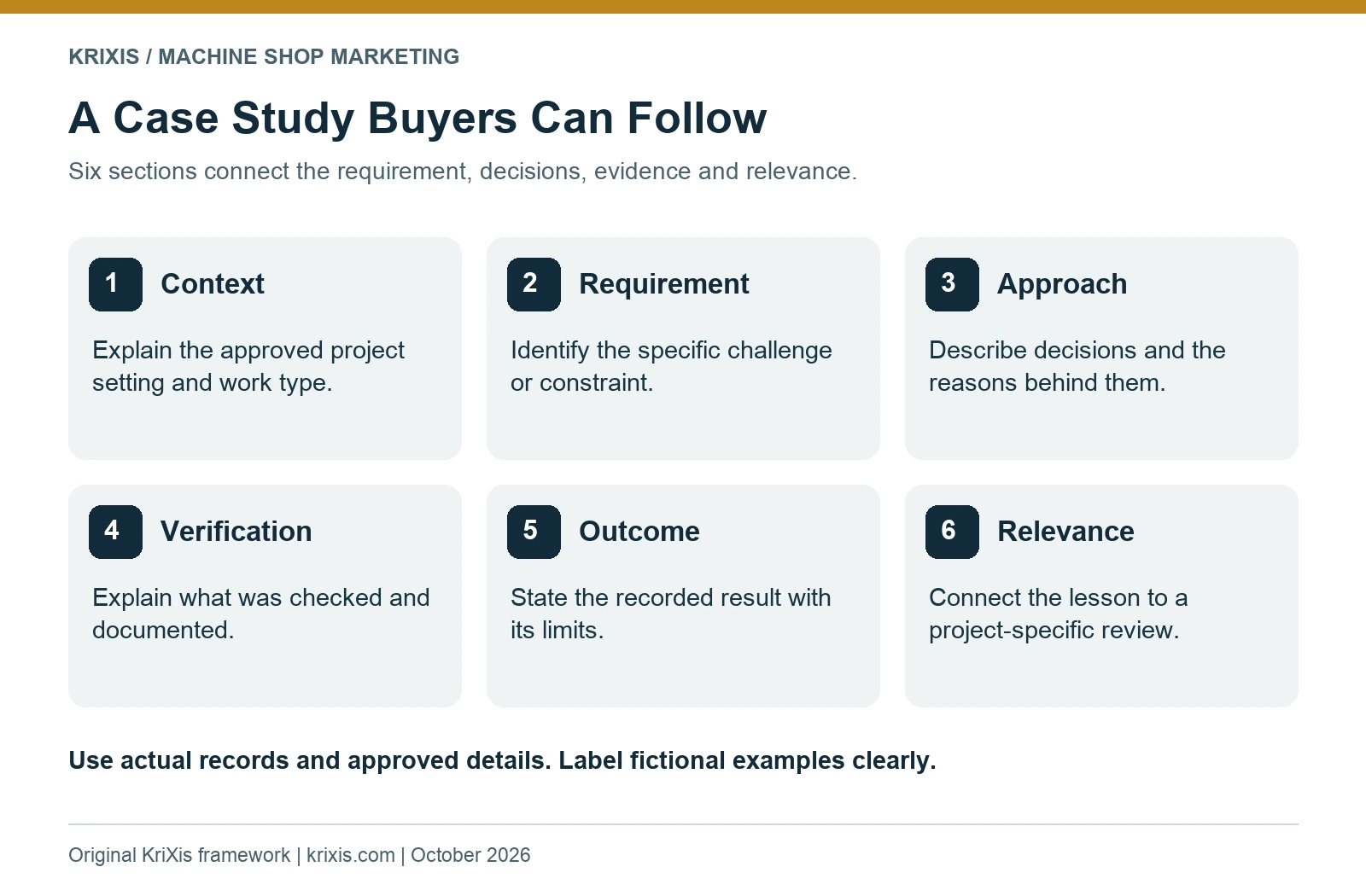
1. Context: what work was being evaluated?
Explain the application at an approved level of detail, the relevant process and the project stage. Include material or quantity information only when verified and publishable. A general description such as a repeat-order machined component can be useful without revealing a customer product or program.
2. Requirement: what made the project distinct?
Describe the specific challenge or constraint. It could involve documentation, a feature requiring review, a revision change or coordination between operations. Avoid describing the customer as disorganized or a previous supplier as incompetent. The goal is to explain the work, not assign blame.
3. Approach: which decisions did the team make?
Show the relevant sequence and the reasoning behind it. Explain clarification, process planning, communication or supporting operations in language a buyer can follow. Leave proprietary methods out when they are unnecessary to the story. Connect the decisions to the requirement rather than listing every machine involved.
4. Verification: how was the work checked?
Explain the agreed verification or documentation step at an appropriate level. Identify what was checked and who reviewed the result. Do not use “certified” or “validated” casually when those terms would imply a status the project does not have. An inspection description should match the actual process.
5. Outcome: what is documented?
State the completed outcome with its scope and period. Delivery, an approved inspection record or a documented customer response may be enough. If you include a numerical comparison, explain the baseline, the measure and the conditions. Keep uncertain benefits out of the headline.
6. Relevance: what should a similar buyer do next?
Explain the lesson and the limits. Identify the type of need the example helps illustrate, link to the relevant capability, and invite a project-specific review. Do not imply that a new buyer's work is already feasible because it resembles a photograph in the story.
Keep result claims narrower than the evidence
A result should be traceable to a record. “Delivered on the agreed date” requires a clear agreed date and delivery record. “Reduced setup time” requires a defined setup measure and comparable observations. “Saved the customer money” needs a defensible cost basis and permission to publish it.
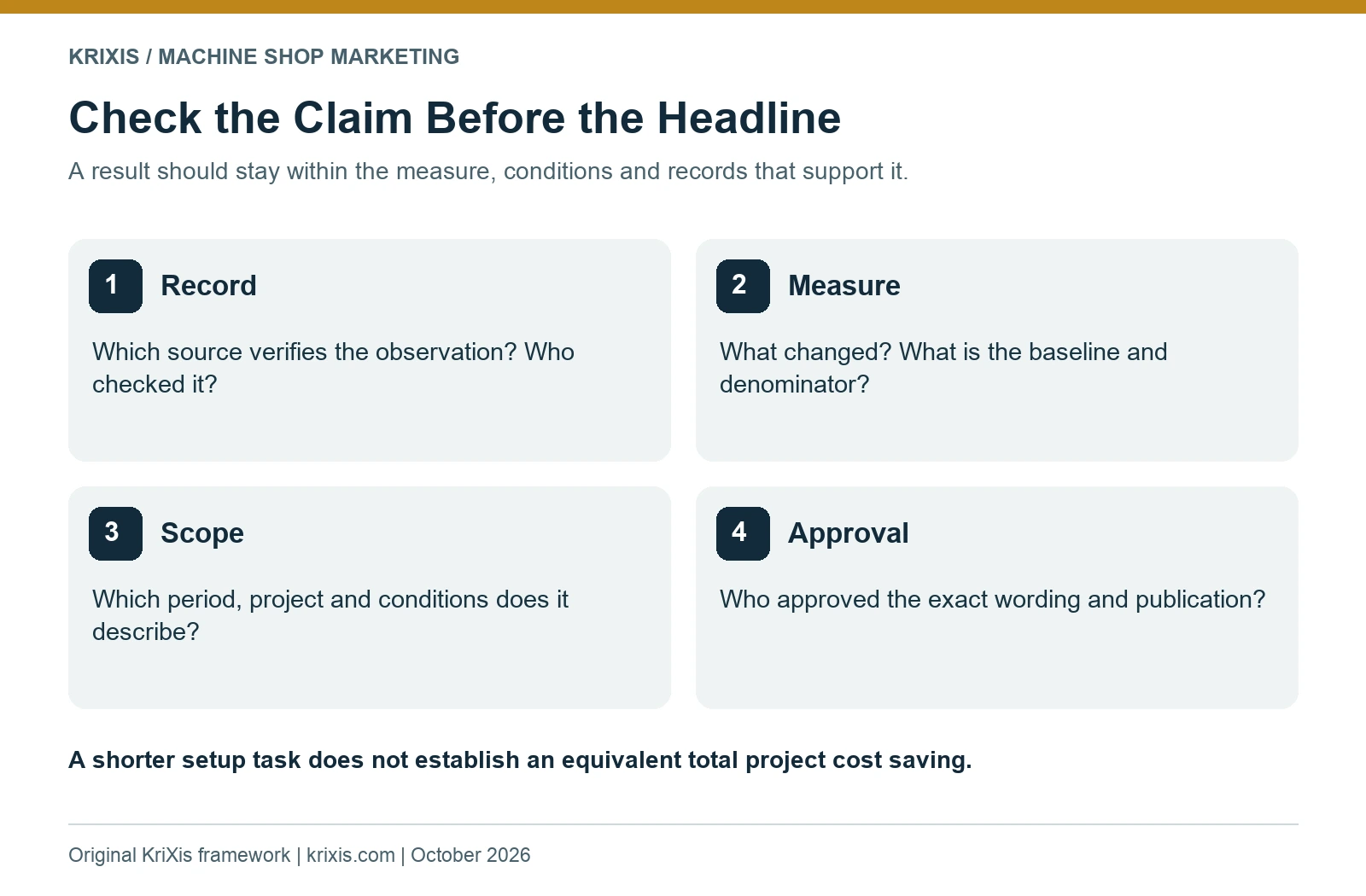
For a numerical illustration, imagine a measured setup task falling from 100 minutes to 80 minutes. The difference is 20 minutes, or 20% of the 100-minute baseline. That arithmetic does not establish a 20% reduction in total project cost, a 20% throughput increase or a repeatable result for other jobs. These numbers are fictional, not a KriXis client result.
If the earlier and later jobs used different materials, quantities or requirements, explain those differences. A comparison may still describe the observations, but you should not present it as proof that one change caused the entire outcome. Use the metric your records actually support.
Some stories have no appropriate quantitative result. Explain the documented deliverable and decision instead. A clear account of resolving a specification question can be more useful than an unsupported savings percentage. Qualitative outcomes should also have an identifiable basis; a writer's assumption is not a customer endorsement.
Page views or downloads do not demonstrate won work. Our marketing ROI guide connects inquiries with later commercial stages while keeping attribution limits visible.
A fictional example of a useful project story
The following example demonstrates the structure. It is an invented teaching scenario, not an account of an actual shop, customer or KriXis engagement. It contains no claimed measured savings, production tolerances or certification status.
Context: A shop was reviewing a repeat order for a machined aluminum housing. The new request included a drawing revision and additional inspection documentation.
Requirement: The team needed to confirm which revision governed the order and which features the customer wanted included in the inspection report. Proceeding with the earlier assumptions would have left that requirement unclear.
Approach: Estimating recorded the questions and obtained clarification through the customer's approved contact. The project record was updated before the team finalized the manufacturing and inspection plan.
Verification: Quality reviewed the agreed documentation requirements. The shop recorded the inspection results for the specified features and checked that the report referenced the approved revision.
Outcome: The completed order was delivered with the agreed documentation. The example makes no broader claim about reduced cost, accelerated delivery or future repeatability.
Relevance: For buyers placing repeat orders with changed requirements, the story illustrates the importance of communicating revisions and documentation needs during review. A CTA could invite the reader to discuss a new revision through the shop's approved inquiry route.
This example is deliberately modest. It explains a useful behavior and a supported outcome. For a real story, replace the fictional details with verified facts, retain relevant conditions and obtain approval for the exact final copy.
Plan names, quotes and photos before publication
Confirm what you may publish before polishing the draft. Follow your organization's agreements and approval process for customer names, logos, quotations, project details and images. If the permission is unclear, ask the responsible owner to resolve it or exclude the information.
Calling a customer anonymous is not enough if the combination of part shape, application, location and timing identifies the project. Review the complete page, including photos, captions, file names and downloadable documents. A distinctive component may reveal more than the text does.

Keep quotations faithful to the approved wording and context. Do not turn an internal comment into a public testimonial without approval. If a customer has not supplied a publishable comment, explain the documented outcome in your own factual prose instead of fabricating a quote.
Use real approved project photographs as evidence for a real case study. Illustrations can help explain a general concept, but label them clearly.
Publish a readable HTML story with relevant SEO
Give the page a distinctive title describing the manufacturing need, not just “Case Study Number 7.” Use a clear introduction, one H1 and descriptive subheadings. Put the useful answer near the beginning so readers can decide whether the example relates to their work.
Write a concise meta description that matches the story. Use a readable, stable URL and descriptive internal links. Connect the page from the relevant capability page and a findable case study or resource hub. Link back to the service that the story illustrates.
Place photos beside the explanation they support. Google's image guidance discusses descriptive filenames, useful alt text and relevant surrounding text. Describe what an informative photo shows; keep specifications and key results in HTML text so readers do not need to interpret an image to understand the outcome.
Optimize image files, provide dimensions and check the phone layout. Make detailed diagrams available at full size. A PDF can help a buyer share the story internally, but maintain a useful HTML version and keep the versions aligned when the facts change.
Check the live canonical, indexability, sitemap and sharing image. Structured data should describe the visible content accurately. Do not add a review score, rating or other claim that the page does not support. Use our SEO audit checklist for a broader review.
There is no required case study word count for SEO. Google says it has no preferred word count. Write enough to explain the situation, evidence and relevance; remove generic company copy that repeats the capability page without advancing the story.
Connect the story to a useful buyer action
A case study usually serves a reader who is evaluating fit. Make the next step relevant to the example. Link to the supported capability and explain how to request a project review. Avoid a button that suggests the same outcome is guaranteed for any similar part.
Tell the reader which inputs help start the conversation and where to send them. Material, quantity, timing, revision and documentation requirements can be useful when appropriate. Use the shop's approved method for drawings or sensitive files, with clear instructions for arranging a suitable transfer.

Preserve the case study's context when the inquiry reaches sales or estimating. A simple note that the prospect referenced a particular example can help the team understand their question. The RFQ qualification guide covers how to evaluate the request after it arrives.
Ask buyers which information helped and which questions remain. Keep page activity separate from qualified inquiries; a few submissions cannot prove that a case study caused an order.
Give the draft a clear review and maintenance owner
Before publication, have the responsible technical reviewer check manufacturing claims, the account owner check customer context, and the content owner check the final page. Assign the necessary approvals according to your process; do not assume that silence means a draft was approved.
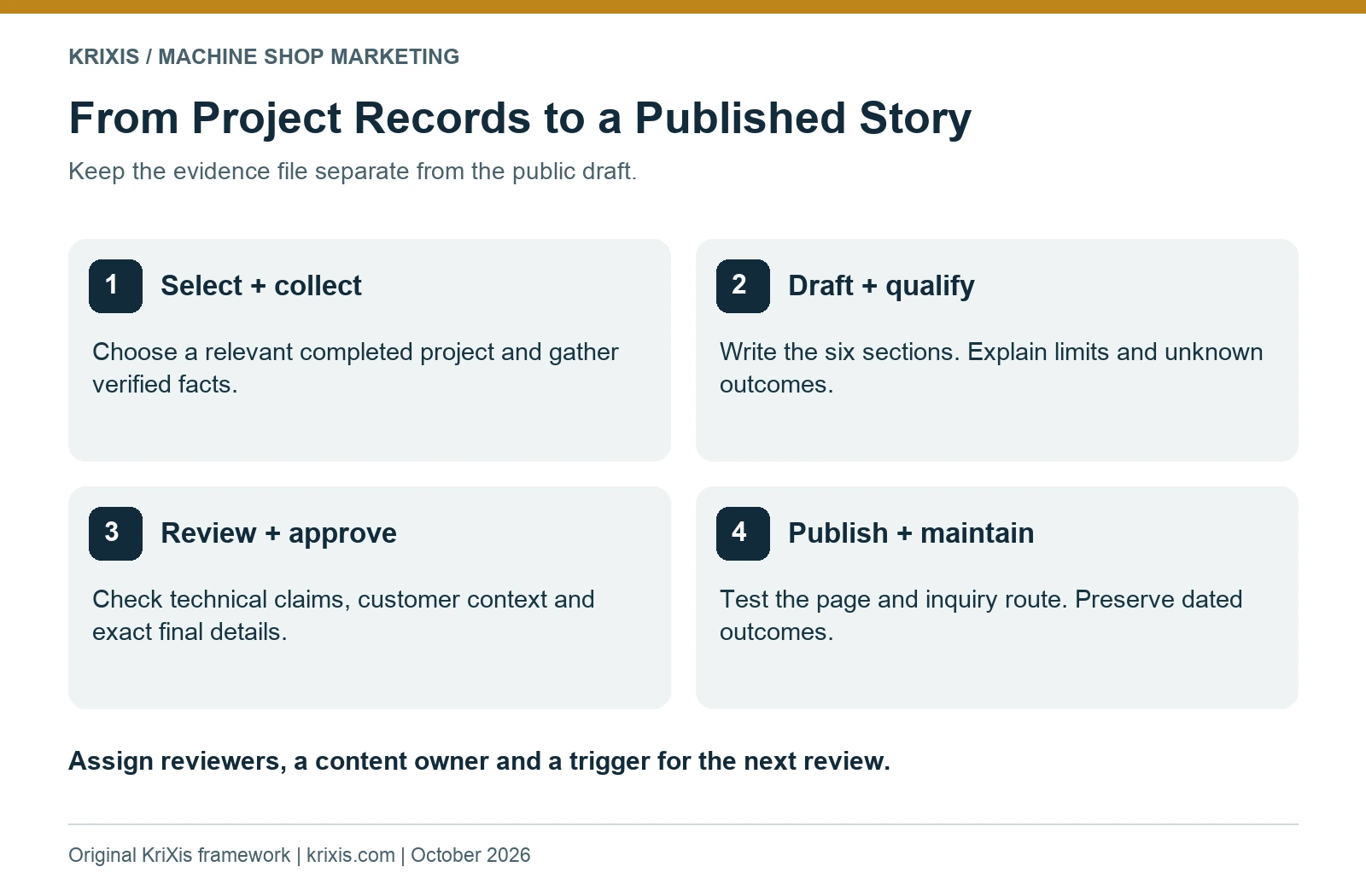
Review the rendered page on desktop and phone. Check captions, links, downloads and the inquiry route. For a contact form, confirm receipt by the intended team.
Keep a record of the approved version and its evidence. Revisit the page when permissions, documents, capability claims or linked services change. Historical outcomes should remain dated historical observations. Do not make an old project appear current by simply replacing its publication date.
Common questions about machine shop case studies
Can we write a case study without naming the customer?
Yes, when the approved information is useful and does not expose the customer through other details. Explain the work at the level you are permitted to share. Review text, images and context together before publication.
What if we cannot publish a numerical result?
Describe the documented requirement, decision, verification and deliverable. Do not invent a percentage to make the story more persuasive. A useful process explanation can stand on its own.
Should we call a hypothetical example a case study?
Label it prominently as fictional or hypothetical and explain its teaching purpose. Do not present invented people, quotes or outcomes as customer evidence. Keep actual project accounts distinct from illustrations.
Where should case studies appear on the website?
Make them reachable from a findable resource hub and link relevant examples from capability pages. Each story should link to the capability it illustrates and a clear inquiry route. Avoid orphaned pages that require a visitor to know the URL.
Start with one verified story
Choose a completed project that answers a buyer's question, gather the records and use the six-part framework to prepare the draft. Approve the final details, explain the limits and connect the story to the next useful conversation.
For implementation, explore KriXis machine shop website design and machine shop SEO services.


Leave a Reply
Want to join the discussion?Feel free to contribute!