
Machine Shop Capability Pages: A Blueprint That Helps Buyers Request a Quote
KriXis editorial guide · Published October 10, 2026 · About 13 minutes to read
A machine shop capability page should help a buyer answer three questions: Can this supplier do the work? What evidence supports that answer? How do I start a useful quote conversation? An equipment list can contribute to those answers, but it rarely answers them alone.
When a page says “precision machining” and shows a row of machines, the buyer still has to infer materials, part characteristics, inspection practices and production fit. That uncertainty can create extra emails or an inquiry your estimator cannot use. A better page connects each capability with context, proof and a clear next step.
This guide gives owners and marketing teams a practical blueprint for building that page. It includes an evidence matrix, a fictional copy example, a publishing checklist and a maintenance process. Use it for a capability your shop actually supports, with technical claims reviewed by the people responsible for the work.
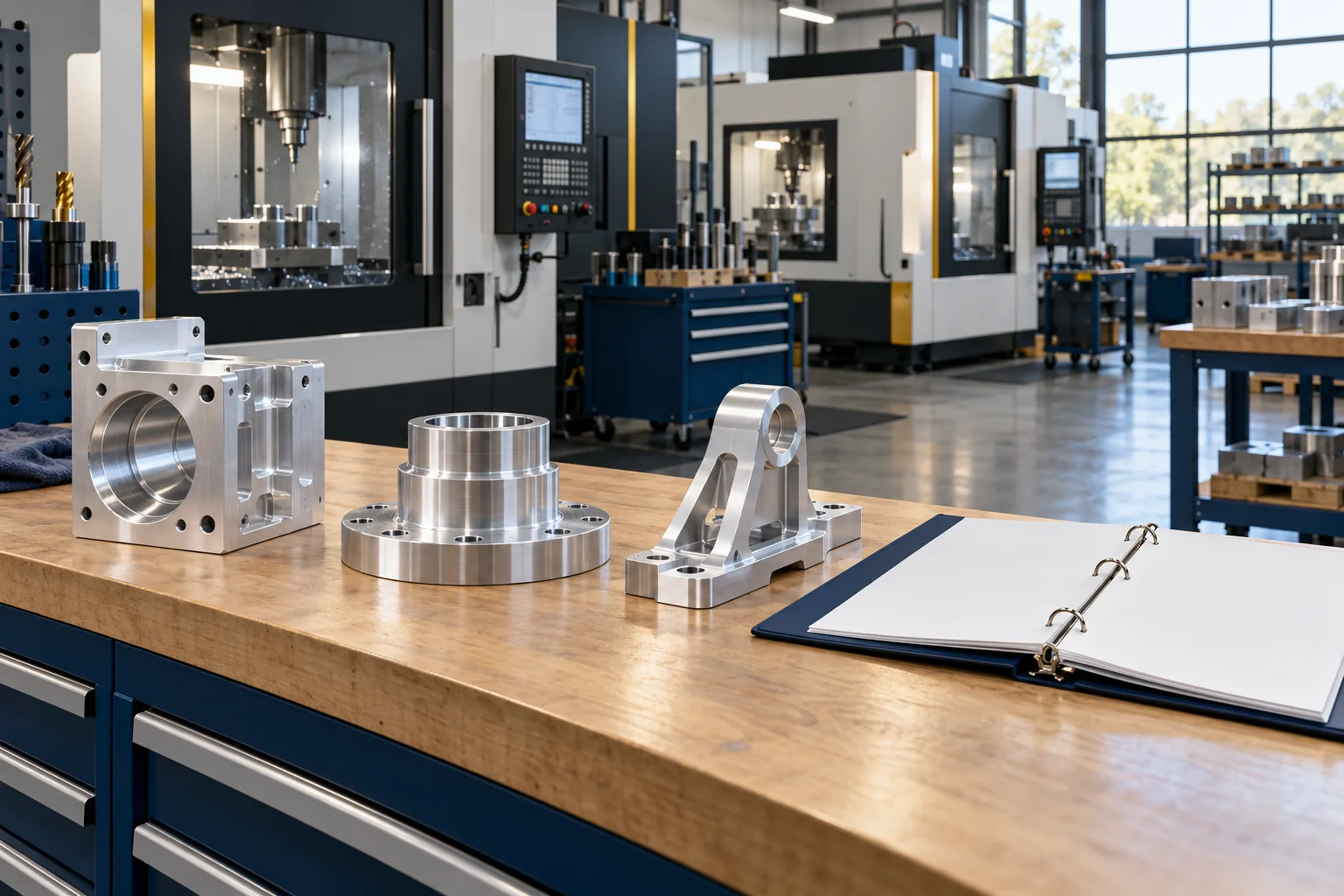
Why capability pages are the next step after an equipment list
An equipment list describes assets. A capability page explains how those assets, people and processes support a particular manufacturing need. Buyers should be able to find both without treating a machine's nominal travel as a promise about every finished part.
There is a useful public example of how specific supplier evaluation can become: the NIST MEP supplier scouting request asks about manufacturing processes, dimensions, tolerances, materials, certifications, business volume and delivery requirements. Your website does not need to reproduce that form. The fields illustrate why a buyer needs more context than a slogan.
Our recommendation is to organize public capability content around the questions your team can answer accurately before a drawing review. Keep project-specific commitments in the quoting process. A page that makes these boundaries clear can help suitable prospects identify themselves and help unsuitable prospects understand the mismatch sooner.
KriXis's broader machine shop SEO guide explains how capability content supports discovery. This blueprint focuses on what one useful page should contain once the visitor arrives.
Choose one buyer need for the first page
Begin with a real process or service that matters to the business: CNC milling, turning, a specific supported material, or another clearly defined capability. Choose a topic with enough distinct information to justify its own page. Do not create separate pages for every material and city if the content would be nearly identical.
Ask sales and estimating which work the shop wants more of, which questions appear repeatedly, and which requests waste time because the website implies a capability you do not offer. Then check those answers with operations. Commercial interest and operational fit should both shape the brief.
Write a one-sentence purpose before drafting: “Help buyers evaluating our CNC milling service understand supported work, relevant evidence and the information needed for a drawing review.” That sentence gives the page a job and helps you remove unrelated company history or generic marketing paragraphs.
Keep a separate list of exclusions and conditional work. Perhaps a process is outsourced, certain materials need additional review, or production quantities depend on capacity. Explain the relevant boundaries in plain language. You can be specific without publishing a blanket lead-time or tolerance commitment.
Build an evidence matrix before writing copy
Collect the facts first. For each proposed statement, record the buyer question, the supporting evidence, the person who can approve it, and the condition that might make it misleading. This is the fastest way to discover that an attractive claim lacks a defensible basis.
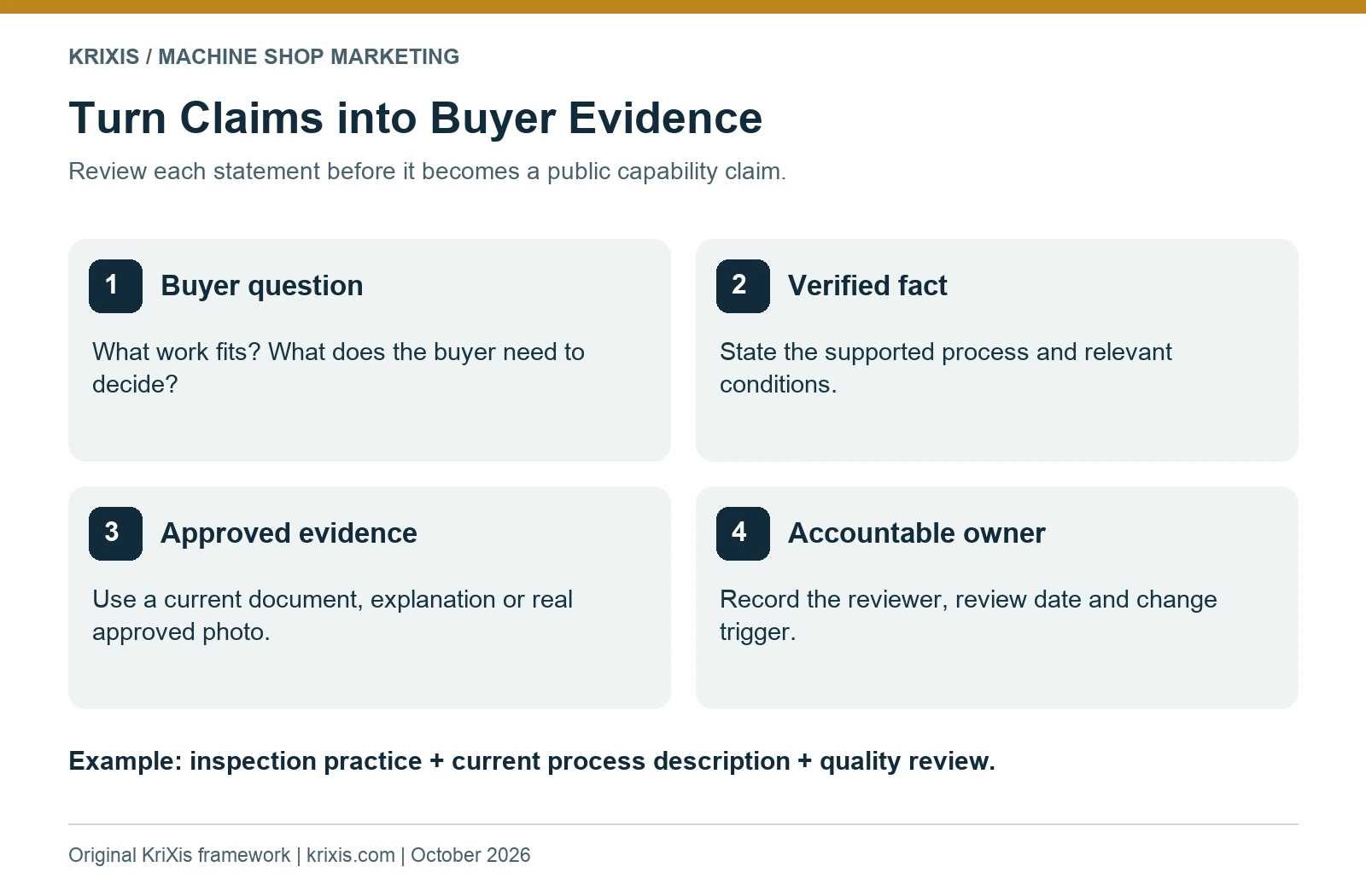
For example, “we support repeat production” might be supported by documented revision control, a repeat-order workflow and an approved example. “We can hold this tolerance” needs much more context: material, geometry, feature, setup and inspection method may affect the answer. Avoid converting one successful job into a general promise.
Useful source material includes current equipment information, approved process photos, inspection descriptions, a maintained certification document where applicable, and questions from estimating. Customer names, drawings, recognizable parts and outcomes need appropriate permission before publication. An anonymized example should still be reviewed for identifying details.
If a fact is uncertain, leave it out until it is checked. If a claim is conditional, publish the condition beside it. If the evidence is stale, assign someone to update it. The matrix should make those decisions visible instead of hiding them in a draft that everyone assumes someone else reviewed.

Use an eight-part capability page blueprint
Give readers a quick route through the page while preserving the detail needed for supplier evaluation. The following sequence is a starting structure, not a requirement to write eight long sections for every service.
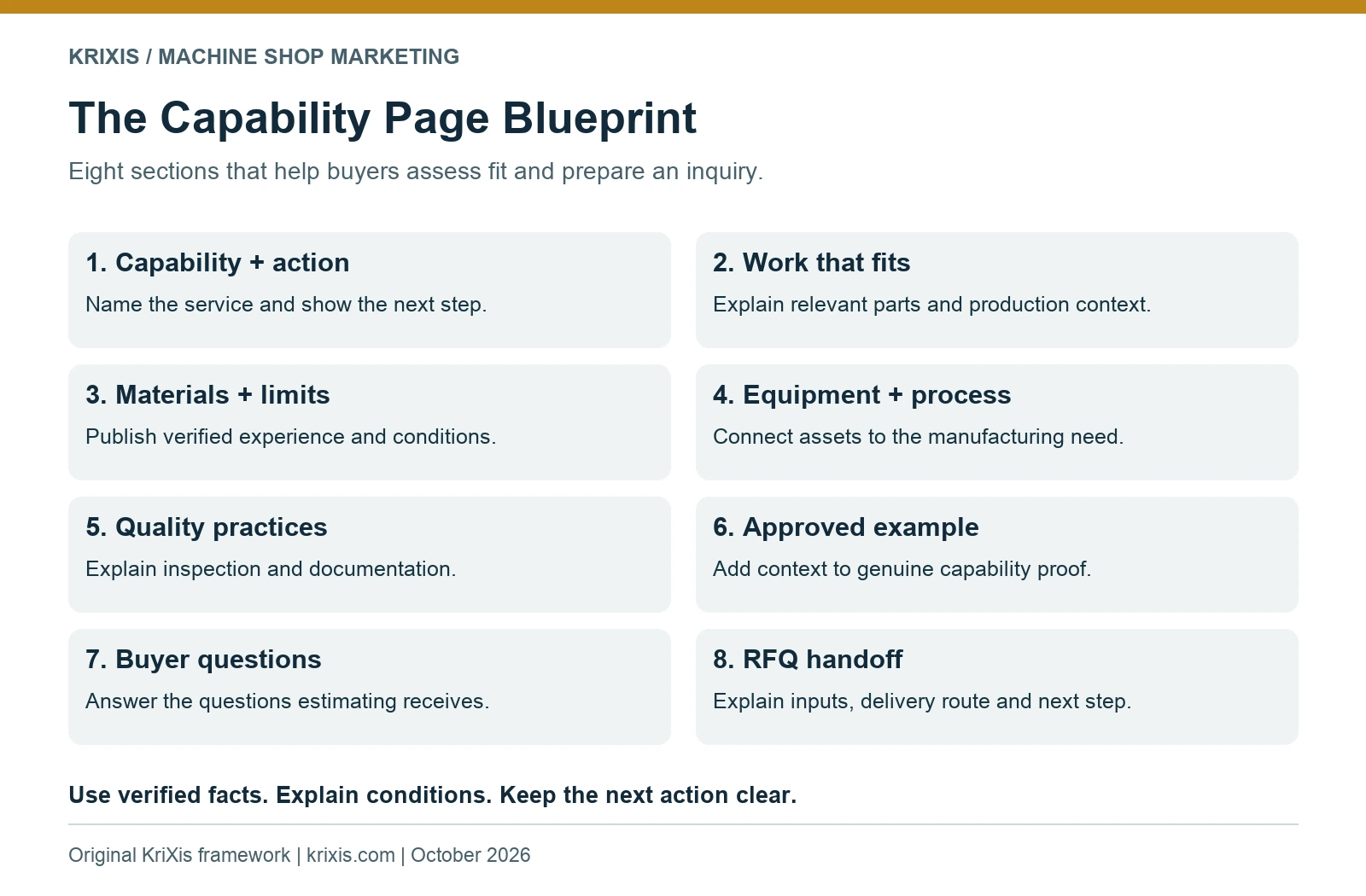
1. State the capability and the next step
Use a descriptive main heading such as “CNC Milling Services.” Follow it with a short explanation of the work you support and an obvious inquiry link. Avoid an opening paragraph made entirely of “quality,” “innovation” and “excellence.” Those words leave the buyer with almost no usable information.
2. Describe the work that fits
Explain supported part characteristics, prototype or production context, and relevant applications when verified. Describe who the service helps through the manufacturing need rather than a long list of industries. Do not imply sector-specific approval or compliance merely because you have machined a part used in that sector.
3. Explain materials and practical boundaries
List materials with actual experience behind them. Where size information is useful, qualify what it means and when review is needed. Machine travel, workholding clearance and feasible part size are different ideas. Use a table only when it simplifies a comparison; short lists are often easier to read on a phone.
4. Connect equipment to the process
Include relevant machines, supporting operations and programming or setup context. Explain which stages occur in-house and which rely on outside services. Link to a fuller equipment list if buyers need it, while keeping this page centered on the manufacturing problem the equipment helps solve.
5. Make quality practices concrete
Describe the inspection, documentation and traceability practices the shop actually provides. State when requirements must be agreed during quotation. If you reference a certification, verify its current status and scope, and link to an approved current document when appropriate. Avoid using a badge to imply broader coverage.
6. Show an approved example
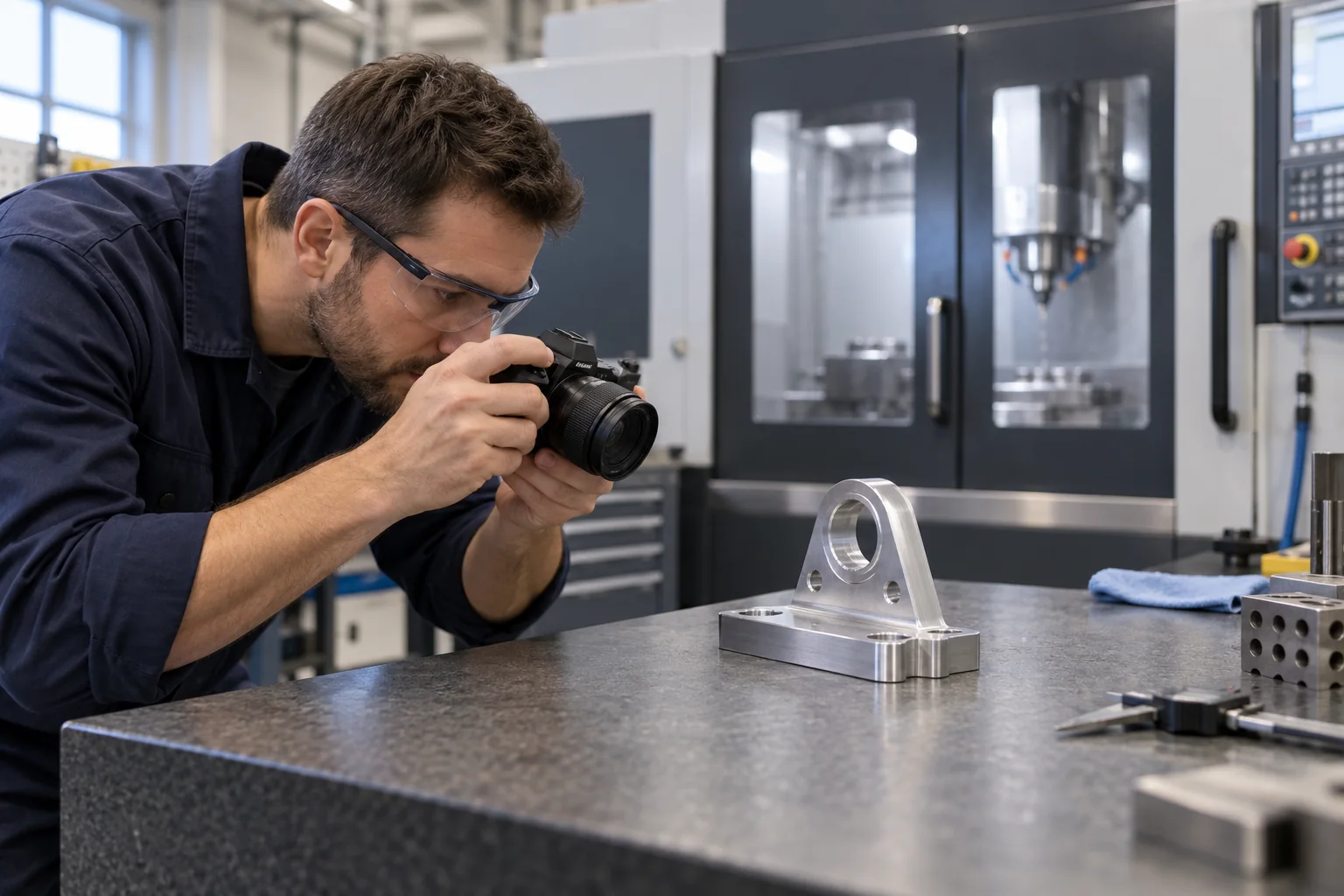
Pair a relevant photograph with a brief explanation: the manufacturing need, the capability used, and the evidence the image illustrates. A part photo alone may look impressive while explaining very little. Use real shop photography for your own capability proof.
For a fuller project account, use our case study writing guide and free template to document the requirement, decisions and verified outcome.
7. Answer the questions that delay inquiries
Use questions your team actually receives. Do you review customer-supplied drawings? What information helps assess a request? Are finishing operations performed in-house? Which questions require technical review? Answer directly and avoid copying the same generic FAQ onto every capability page.
8. Explain the RFQ handoff
Tell the buyer what to send, how to send it and what happens next. Link to your approved inquiry route and provide an alternative contact option. Publish a response-time expectation only if the responsible team can meet it. A prominent button cannot compensate for a request that never reaches estimating.
Replace vague claims with useful, qualified copy
Here is a fictional example for a shop planning a CNC milling page. It is sample wording, not a claim about KriXis or a real manufacturer. Replace every operational detail with facts your own team approves.
Vague version: “We are a leading precision machine shop with state-of-the-art equipment, unmatched quality and fast delivery for every industry.”
More useful version: “We provide CNC milling for prototype and repeat-order components. Our team reviews drawings, material specifications, quantities and inspection requirements before confirming fit. Ask us about supported aluminum and stainless steel work, and tell us whether finishing or additional documentation is required.”
The second version helps the buyer understand a process and prepare the conversation. It still needs supporting detail elsewhere on the page: which materials are supported, what repeat-order controls exist, and who reviews the inquiry. Clear copy is a starting point, not a substitute for evidence.
You can apply the same approach to a heading. Replace “Our Unrivaled Technology” with “Equipment and Supporting Processes.” Replace “Guaranteed Precision” with “Inspection and Documentation.” These headings tell the reader what they will find and reduce the risk of making promises the page cannot substantiate.
Use visuals as evidence, with enough context
Plan photos around buyer questions. A machine overview can establish process context; a setup image can explain a relevant operation; an inspection image can support an account of verification. A finished-part photograph is more useful when its caption explains the approved example and its limits.

For your own site, prioritize genuine approved images over generic stock or AI imagery presented as facility proof. Obtain permission, check for customer information in the background, and remove misleading captions. Do not describe an illustration as your equipment, an actual customer job or a certified process.
Use descriptive filenames and alternative text for informative images. Write alt text about the visible content and its purpose, rather than repeating a keyword string. Put important specifications in page text as well as any infographic so readers can access them without interpreting a picture.
Optimize image files for the display size, include width and height, and load later images lazily where supported. Check that phone readers can open detailed diagrams at full size. A page can fit the screen while its embedded specification table or infographic remains unreadable.
Make the RFQ action match the buyer's readiness
Offer a clear primary action for someone ready to discuss work: “Request a quote” or “Send your project for review,” according to your actual process. Nearby instructions should explain the minimum useful information, such as material, quantity, timing and applicable requirements.
A buyer who is still checking fit may prefer a capability document or a technical conversation. Give that reader a sensible secondary route without surrounding every paragraph with competing buttons. The page should help them choose a next step they understand.
Use only your approved method for handling drawings and sensitive files. If the public form is not suitable, explain how to arrange a secure transfer. Do not tell prospects to upload confidential data to an arbitrary tool or assume that an attachment field makes the whole workflow appropriate.
Test the handoff with non-confidential information. Check required fields, error messages, confirmation text, receipt in the intended inbox or CRM, ownership and follow-up. KriXis's RFQ qualification guide covers the next decision after an inquiry arrives.
Complete on-page SEO without making pages repetitive
Give each capability page a distinct title, a useful description, a readable URL and one clear H1. Organize supporting content under descriptive headings. Write the opening for the reader evaluating this service; avoid repeating the same geography and process phrase in every sentence.
Connect the page from your services or capabilities hub and link to related processes, useful buyer resources and the RFQ route. Google's link guidance recommends crawlable links and descriptive anchor text. A useful link tells people what they will find when they follow it.
Verify the live page's canonical URL, indexability and sitemap inclusion. Check sharing titles, descriptions and images. Structured data should accurately describe visible content; adding markup does not create a certification, make an unsupported claim true, or guarantee a special search appearance.
Keep a useful HTML page even if you offer a downloadable capability sheet. A PDF can help a buyer circulate information internally, but the page still needs enough content to explain the service and support navigation. Assign an owner to keep both versions aligned.
There is no universal ideal length for a capability page. Google explicitly says it has no preferred word count. Include the verified information required to answer the buyer's questions, remove repetition, and use the machine shop SEO audit checklist for a broader review.
Publish one page, then measure and maintain it
Start with one priority capability rather than rebuilding the entire site at once. Assign the technical reviewer, the content owner and the person responsible for inquiry delivery. Use a documented checklist so the final review includes both accuracy and usability.
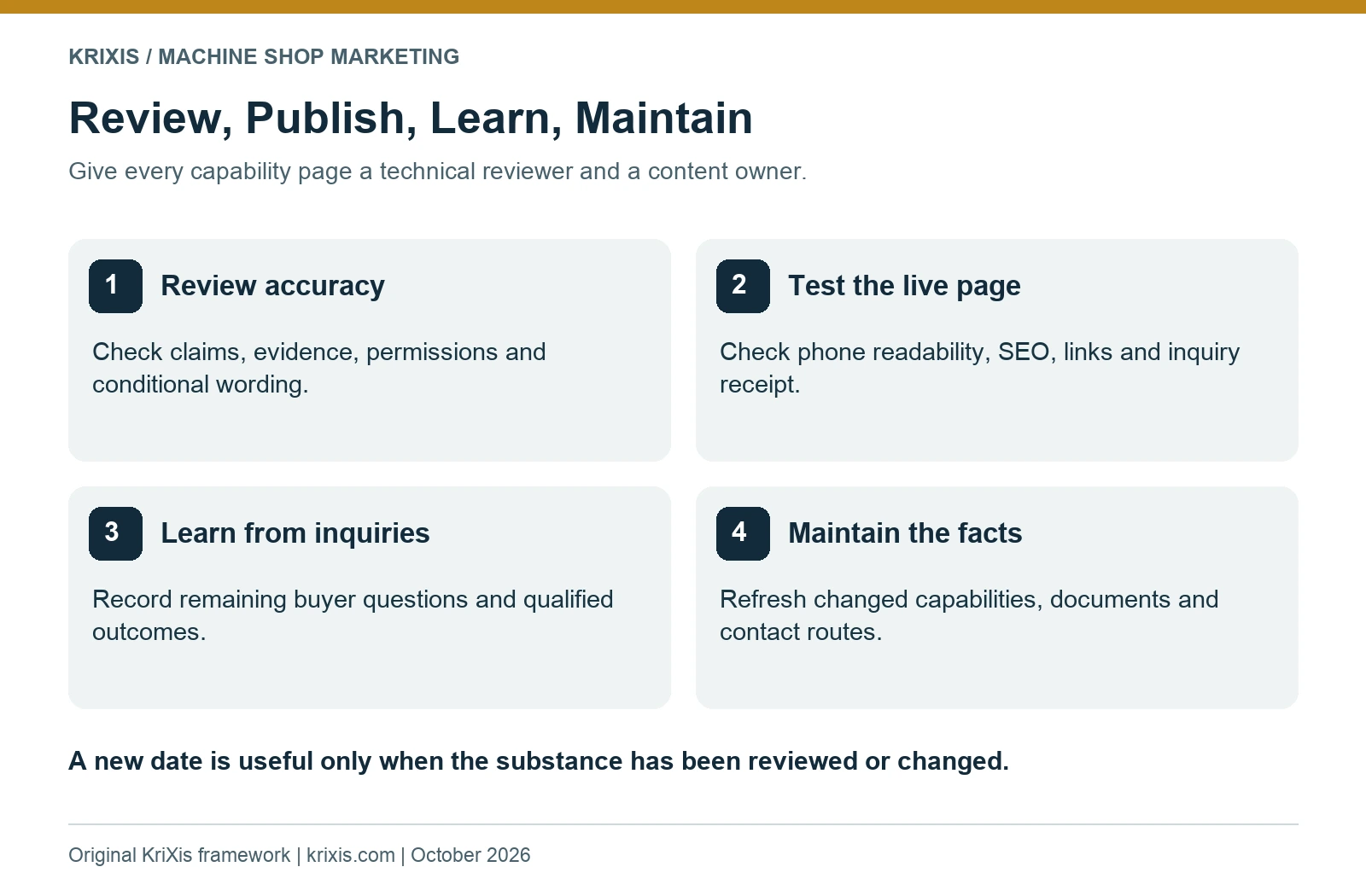
After publication, collect the questions buyers still ask and review inquiry quality. Track which relevant inquiries involved the page where your systems can support that connection. A download or button click is an interest signal; it is not automatically a qualified RFQ.
Use KriXis's marketing ROI guide to connect page activity with downstream stages. On low-volume sites, a few inquiries cannot establish that a wording change caused a commercial result. Record the change and interpret outcomes with source, timing and project mix in mind.
Schedule reviews around meaningful operational changes as well as a regular check. Update equipment, supported processes, documents, contact instructions and examples when they change. Remove expired or misleading evidence promptly. Refreshing a visible date without changing the substance does not make a page more useful.
Questions machine shop owners ask
Should each machine have its own page?
Usually start with the service buyers need. A dedicated machine page can be useful if it answers distinct questions with substantial information. An equipment list can support the service page without turning every asset into a thin landing page.
Should we publish exact tolerances and lead times?
Publish only values your team can substantiate with clear conditions. If the answer depends on a drawing, material, inspection requirement or current capacity, say that. Avoid letting a headline imply an unconditional commitment.
Is a capability PDF enough?
A PDF can support internal sharing, but a maintained HTML page gives readers a direct route to relevant detail and an inquiry. Keep the PDF consistent with the page and make its issue date or version clear.
How do we decide whether a new page is worthwhile?
Ask whether it serves a distinct buyer need with different, verified information. If it mainly swaps a material or location name into existing copy, improve the existing page instead. Use actual inquiry questions to guide the decision.
Build the page buyers can use
A strong capability page brings accurate facts, relevant evidence and a dependable inquiry route together. Begin with one service, review the claims with your shop team and publish a page that makes the next conversation easier to prepare.
For broader implementation, explore KriXis machine shop website design and machine shop SEO services.


Trackbacks & Pingbacks
[…] the machine shop capability page blueprint to define a useful page structure. Buyers need enough information to judge fit. Avoid publishing […]
[…] your service pages need clearer context first, use our machine shop capability page blueprint. Then choose an example that helps explain a question those pages leave […]
Leave a Reply
Want to join the discussion?Feel free to contribute!