Krixis Consulting
  • Services
    • Manufacturing Marketing Agency
      • Machine Shop SEO
      • Machine Shop Website Design
      • Machine Shop Lead Generation
  • Blog
  • Contact
  • Menu Menu
  • Link to X
  • Link to Facebook
  • Link to LinkedIn
  • Link to Pinterest
  • Link to Instagram
Machine Shop Marketing

Machine Shop Website Redesign: An SEO Migration Checklist

KriXis editorial guide · Published October 11, 2026 · About 12 minutes to read

A machine shop website redesign should make the business easier to evaluate and contact. Yet a polished launch can create new problems: an established capability URL disappears, a buyer's bookmarked RFQ page stops working, or the replacement contact form never reaches the person responsible for quotes.

The remedy starts before design approval. Treat the rebuild as a controlled transfer of useful pages, buyer paths and operational responsibilities. Give every important existing URL a destination, every inquiry route a test, and every launch decision an owner.

This guide explains how to plan a machine shop website redesign, protect useful search connections and check the finished site. It includes a free planning kit with a URL mapping worksheet and launch checklist. No process can guarantee unchanged rankings, but a documented migration makes avoidable failures easier to find and correct.

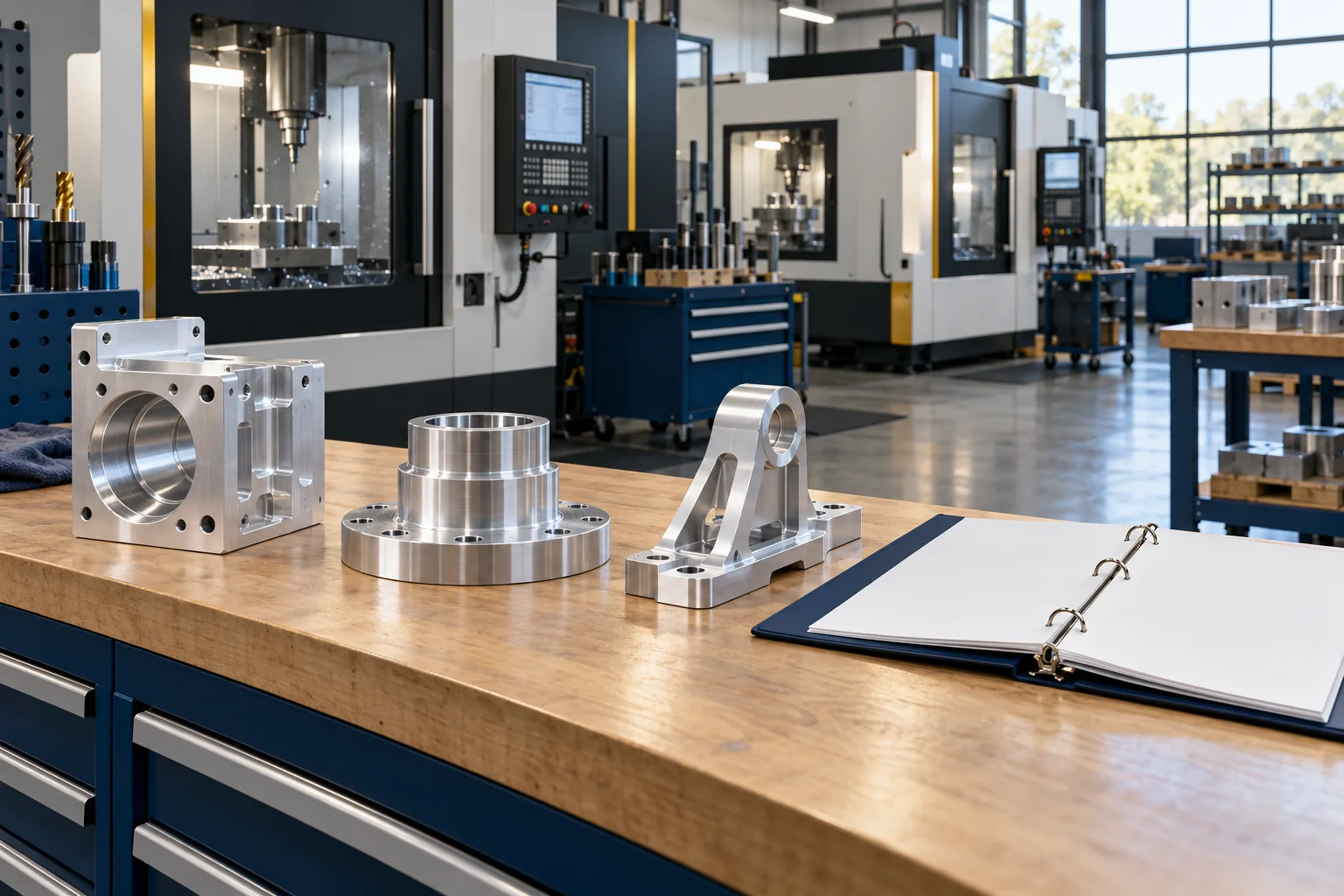
Manufacturing professionals planning a website beside a machined aluminum housing
In this guide

  • Define the redesign before choosing a layout
  • Record what the existing website already does
  • Map old URLs to deliberate destinations
  • Preserve the information manufacturing buyers need
  • Check page templates and search signals together
  • Test the buyer journey on desktop and mobile
  • Set a launch gate and a recovery plan
  • Monitor the launch through actual evidence
  • Common questions about machine shop website redesigns
  • Make the redesign easier to operate

Define the redesign before choosing a layout

Write a short project brief that answers three questions: what is failing today, what should a buyer accomplish on the new site, and which evidence will show that the change works?

“Modernize the website” is too broad to guide a launch. A more useful goal might be: help procurement teams find the right machining capability, understand the shop's approved scope, and send an inquiry with enough context for routing. That goal influences navigation, page content, mobile presentation and contact instructions.

Separate visual changes from structural changes in the brief. Replacing fonts and layouts while keeping URLs differs from changing page paths, merging content or moving domains. Google publishes separate guidance for site moves with URL changes and infrastructure changes without URL changes. Ask the developer to identify which situation applies.

Assign a business owner, a technical launch owner and an inquiry owner. In a small shop, one person may hold multiple roles, but the responsibilities still need names. Agree who can approve content, who can restore the previous site, and who confirms that a test request reached its intended destination.

Start with a written redesign brief

Use the project brief, URL mapping records and launch checklist to assign the next decisions.

Get the free redesign planning kit

Record what the existing website already does

An inventory helps prevent useful content from vanishing during a rebuild. Start with the sitemap, navigation and a crawl of the current public site. Add landing pages linked from advertisements, directories, email signatures, customer documents and sales presentations. A page can matter even when it receives little organic traffic.

For each URL, record its purpose, current title, relevant capability, buyer action and proposed treatment. Include PDFs, downloadable resources, images referenced by other pages, and the thank-you or confirmation screens used after an inquiry. Save a copy of the current content and screenshots of important templates.

If Search Console and analytics are available, use actual records to prioritize pages. Look for relevant queries, impressions, clicks, entry pages and recorded inquiry activity. Write the date range and metric definition beside the numbers. A website redesign is not a reason to invent a baseline when access or tracking is missing.

Ask sales which links they share most often. Ask the RFQ owner where visitors become confused. An older page with modest traffic may explain a specialty process that matters to a particular buyer. Review its usefulness before deleting it.

Use KriXis's machine shop SEO audit guide to organize broader discovery, then keep this migration inventory focused on what the rebuild changes. A short prioritized list with clear owners is more actionable than an export nobody has reviewed.

Website page inventory on a laptop beside a notebook and machined parts

Map old URLs to deliberate destinations

Keeping a clear, established URL is often the simplest choice when the page's purpose remains the same. A redesign does not require every page to receive a new path. Make changes when they improve a real structural problem, and document the reason.

Use four decisions in your worksheet: keep, move, merge or retire. “Keep” means the content stays at the existing URL. “Move” means the equivalent content receives a new URL. “Merge” means several genuinely related pages become one stronger resource. “Retire” means the content has no suitable replacement and should be handled intentionally rather than concealed.

For a permanent move, Google recommends server-side permanent redirects such as 301 or 308. Point old URLs directly to their relevant final destinations and avoid chains. Sending many unrelated pages to the homepage can be treated as a soft 404. See Google's redirect guidance for implementation details.

A fictional mapping example

Suppose a shop has separate pages for aluminum CNC milling and a general equipment list. The milling page answers a distinct buyer question and has an established path. It could keep that URL while receiving clearer content. The equipment list could move into a broader capabilities resource if that new page actually preserves its useful information.

Do not redirect the milling page to the new homepage merely because the homepage mentions CNC machining. The replacement should satisfy the original reader's purpose. If the shop has stopped offering a process, have the responsible team decide whether an explanatory page remains useful or whether removal is appropriate.

Record the old URL, destination, decision, reason, owner and test result. Review mappings with both the developer and someone who understands the services. Automated rules still need spot checks; a technically successful redirect can send a buyer to the wrong information.
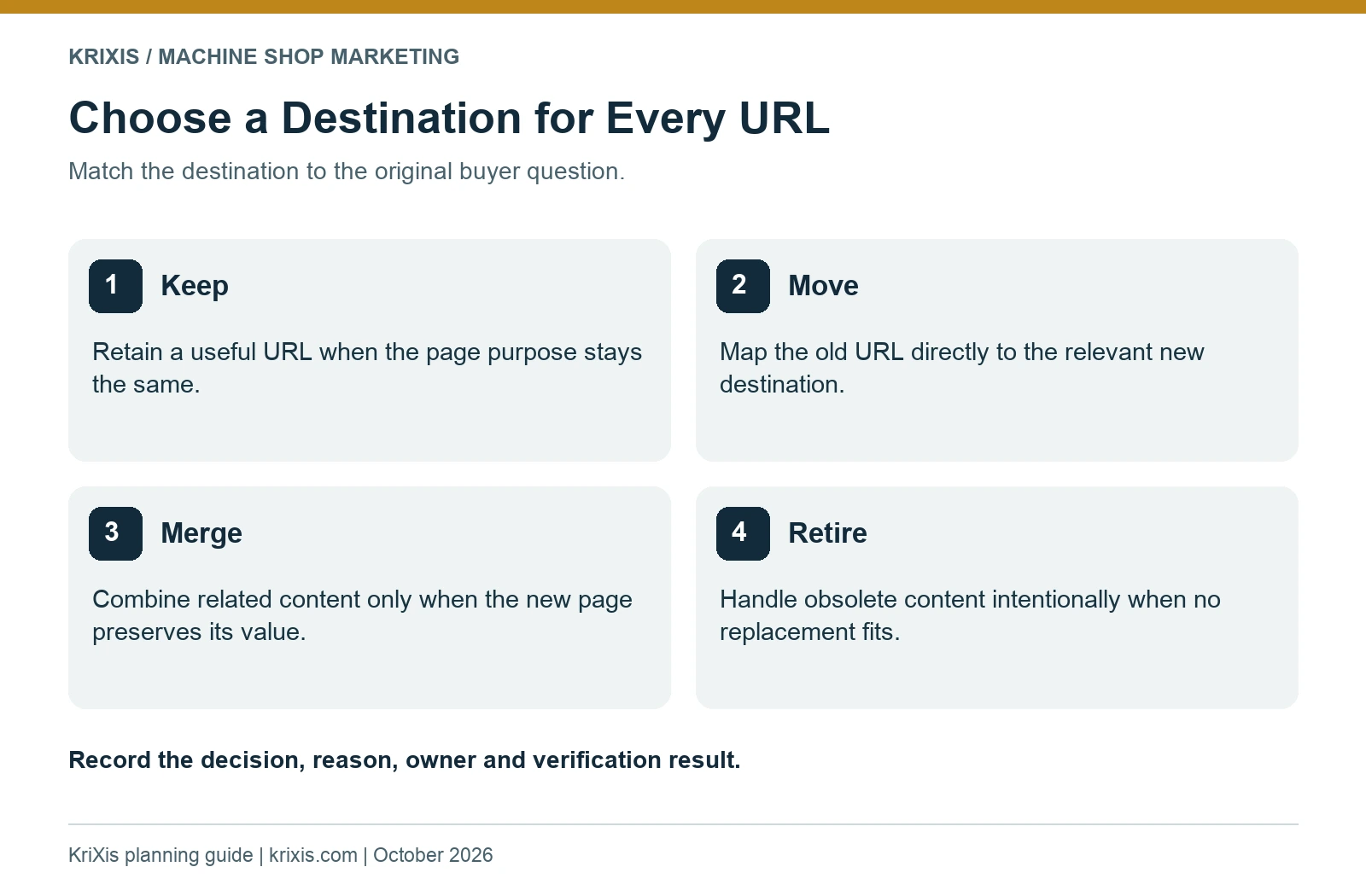
Four URL decisions: keep, move, merge or retire, each with a relevant treatment
Choose each URL destination according to the page purpose and buyer question. View full-size infographic

Have a proposed page map ready?

Share your public website URL, the problem to solve and proposed timing for a focused conversation.

Request a website redesign review

Preserve the information manufacturing buyers need

A migration plan cannot compensate for thin replacement pages. Before launch, compare important old pages with their new versions. Confirm that approved capability details, relevant materials, process limits, inspection context and inquiry instructions survived the rewrite.

Use the machine shop capability page blueprint to define a useful page structure. Buyers need enough information to judge fit. Avoid publishing tolerances, certifications, equipment availability or industry approvals that the responsible team has not verified.

Content consolidation deserves particular attention. Combining several pages can simplify navigation, but a long generic page may erase meaningful distinctions between milling, turning, finishing coordination or production support. Keep distinct pages when they answer different supplier evaluation questions with substantive information.

Review approved case studies, technical downloads and photographs separately. Check publication permissions and whether the information remains current. Replace outdated claims with verified wording instead of carrying them forward because they appeared on the old site. Existing case study guidance can help organize that review.

Make the RFQ next step visible on capability pages. Explain what a visitor should send, how to contact the shop and what happens next. Keep initial requests appropriate for your information-handling process; do not encourage buyers to email sensitive drawings through an unsuitable channel.

Check page templates and search signals together

Test at least one example of every important template: homepage, capability page, article, resource page and contact route. A shared template defect can affect many URLs, so fix the pattern before polishing isolated pages.

Each page needs a descriptive title, a useful meta description, one clear main heading and headings that organize its actual content. Write meaningful image alt text when an image conveys information. Decorative images should not add repetitive spoken descriptions. Review social previews so shared capability or resource links show the intended title and image.

For moved pages, Google's migration checklist includes updating internal links, canonical references and sitemap URLs, and removing development-only crawl or indexing restrictions before launch. The technical owner should verify those details against the final live URLs. A staging environment's settings should never be assumed correct for production.

Keep the relationship between page signals understandable. A public page intended for search should not simultaneously declare itself unindexable or identify a different obsolete URL as canonical. Check rendered output rather than relying only on a plugin's editing screen.

Structured data should describe what is actually on the page. Retain supported organization, article or breadcrumb information where appropriate. Do not add fabricated ratings, product claims or service outcomes to make a schema test look more impressive.
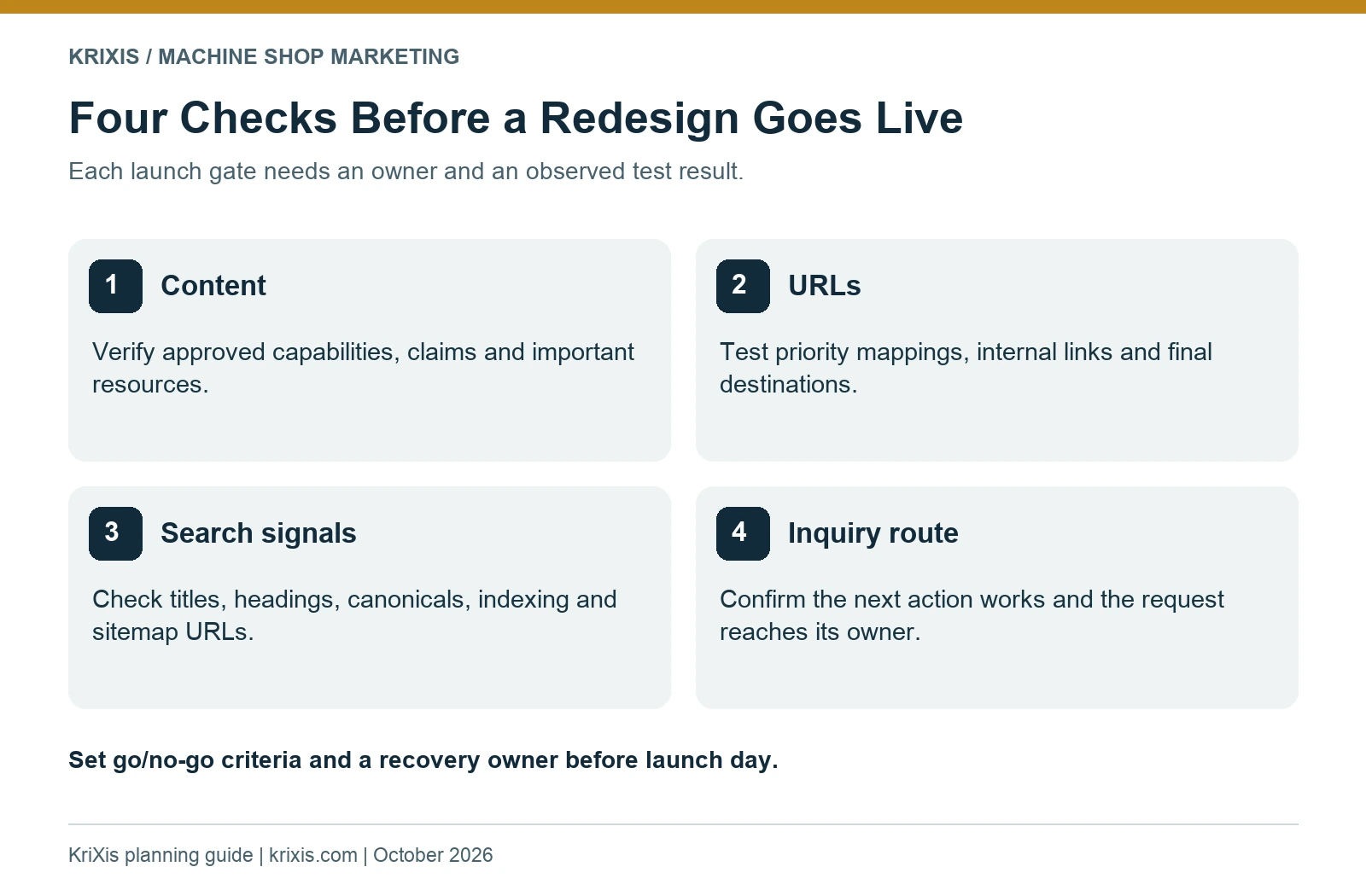
Four launch gates: approved content, tested URLs, checked search signals and a verified inquiry route
Assign an owner and an observed result to each launch gate. View full-size infographic

Turn the checks into assigned tasks

Use the project brief, URL mapping records and launch checklist to assign the next decisions.

Download the launch checklist

Test the buyer journey on desktop and mobile

Start from the pages visitors actually use. Search for a capability in the site's navigation, open its page, read the relevant details and follow the inquiry route. Repeat on a phone-sized screen. Confirm that menus, tables, diagrams, downloads and buttons remain usable without awkward horizontal scrolling.

Check ordinary interactions that screenshots cannot prove. Does a phone link use the intended number? Does a mail link open with the right recipient? Does a download contain the promised resource? Can a visitor find contact information after landing directly on an article rather than the homepage?

If the site uses an RFQ form, send a clearly identified test request through the live form using an authorized address. Verify receipt with the inquiry owner, including any attachments permitted by the approved process. A success message only proves that the browser displayed a message; it does not establish delivery to the quoting team.

Test validation and error recovery too. Required fields should be understandable, errors should explain what to fix, and the visitor should not lose a detailed message unnecessarily. Maintain spam protections while resolving problems. A working visible email fallback can help when a form needs further investigation.

Compare loading behavior across key templates. Oversized images, unnecessary scripts and unstable layouts can make a beautiful redesign cumbersome. Use appropriately sized media, reserve image space and evaluate real pages on representative devices. Avoid declaring the whole site fast from a single homepage test.

Designer comparing a manufacturing website on desktop and phone screens

Set a launch gate and a recovery plan

Choose a launch window when the responsible people can respond. Save the previous site, content, configuration and redirect rules through the team's approved backup process. Know what can be restored and who controls hosting, DNS, WordPress and any external inquiry service.

Use a short go/no-go checklist. Important mappings should be approved and tested. Priority content should be verified. Public indexing settings should be checked. Contact routes should be usable. The inquiry owner should know when to monitor requests and report problems.

Classify unresolved items by impact. A missing approved capability detail, broken RFQ destination or widespread redirect failure can justify delaying launch. A minor spacing adjustment may be logged for follow-up. Define the threshold before launch day so urgency does not replace judgment.

If the project changes both platform and content structure, consider whether the team can stage those changes into manageable steps. Record dependencies and the specific checks for each step. The aim is a launch that the available team can diagnose and support.

For a same-domain redesign, do not treat Google's Change of Address tool as a general launch button. Google's URL migration guidance limits its use to qualifying domain or subdomain moves. Have the technical owner follow the instructions for the actual type of change.

Review the plan before the launch window

Share your public website URL, the problem to solve and proposed timing for a focused conversation.

Talk with KriXis about your redesign

Monitor the launch through actual evidence

Create a simple issue log with the affected URL, observed problem, severity, owner, next action and verification date. Start with priority pages and contact paths rather than waiting for a visitor to report a failure.

Review crawl errors, sitemap processing and available Search Console reports after launch. Google notes that URL moves can involve temporary search fluctuations while pages are recrawled and reindexed. Do not promise a fixed recovery date. Its guidance also recommends keeping redirects for at least a year, with longer retention useful for visitors following old links.

Keep redirects under change control. A later cleanup should not accidentally remove them because the new site has been live for a few weeks. Include useful old links from brochures, directories and customer records in the retention decision.

Compare inquiry activity using a consistent definition and comparable periods. Separate form delivery failures, tracking changes, seasonal differences and page visibility issues before attributing a change to design. If tracking began only at launch, record that limitation and build an honest baseline going forward.

Schedule a practical review with the website owner and inquiry owner. Which pages are generating relevant questions? Which requests need clarification? Which broken links remain? Use those observations to improve the next task, without turning every early fluctuation into a redesign emergency.
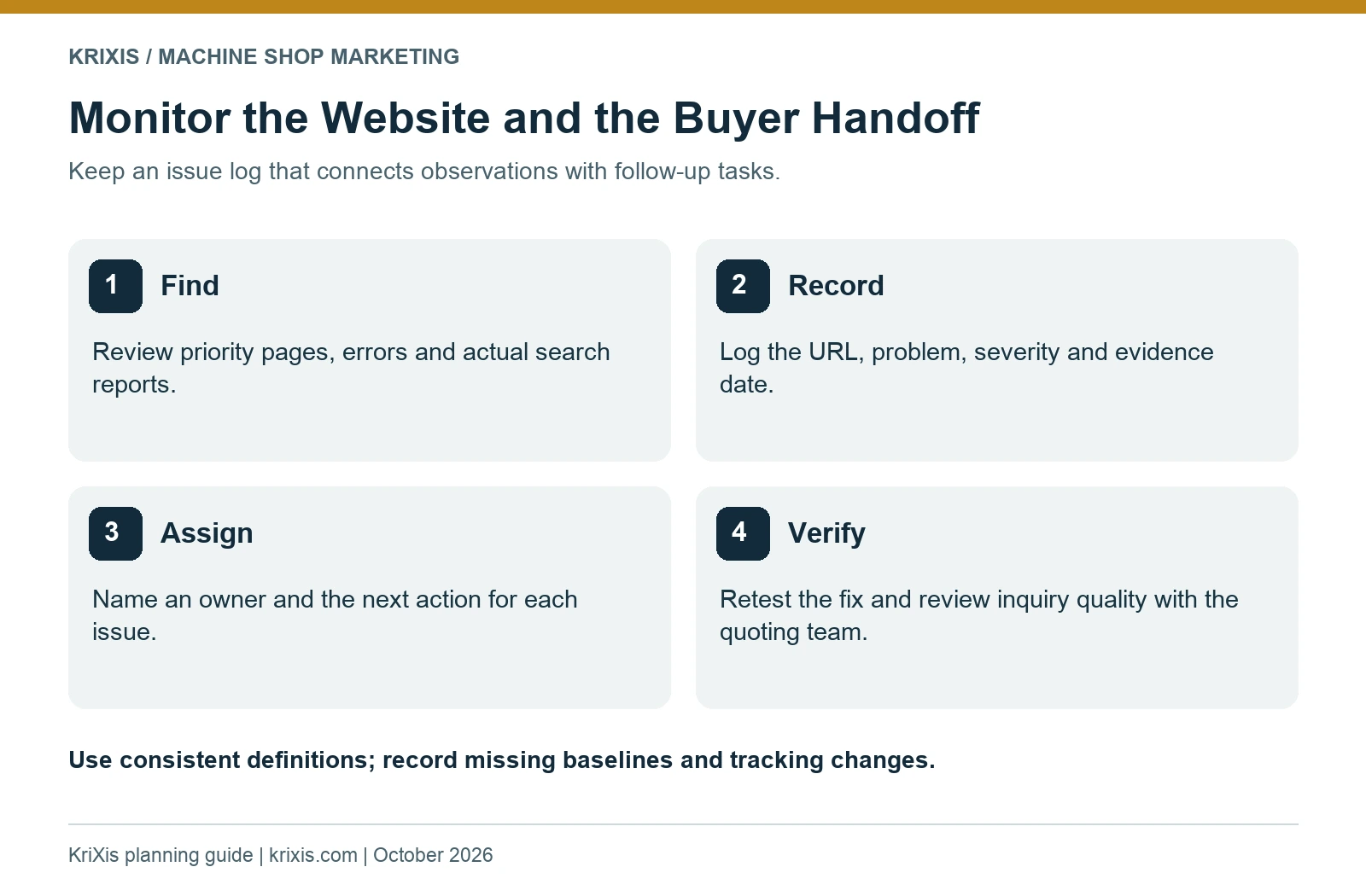

Four monitoring steps: find issues, record evidence, assign an owner and verify the fix
Keep a dated issue log and review the buyer handoff with the inquiry owner. View full-size infographic
Manufacturing team reviewing an inquiry brief beside an aluminum component

Common questions about machine shop website redesigns

Will a redesign automatically improve SEO?

No. It can improve clarity, usability and technical presentation, but those benefits depend on implementation and useful content. Rankings and inquiry outcomes are not guaranteed. Preserve valuable pages and use actual evidence to assess changes.

Do we need to change every URL?

No. Keep suitable URLs when the purpose remains the same. Map and test necessary changes, including downloads and important campaign destinations. A visual refresh and a URL migration are different project decisions.

How long should the redesign take?

The scope, content readiness, integrations and approval process determine the schedule. Build the estimate from an inventory and assigned responsibilities. A launch date chosen before those details are known can hide unresolved work.

Can we launch while the RFQ form is still being tested?

Treat inquiry delivery as a launch requirement when it is a primary buyer action. If a form cannot be verified, resolve it or provide a clearly explained working contact route. Never present an untested delivery path as confirmed.

Make the redesign easier to operate

The most useful redesign plan connects page decisions with business responsibilities. Preserve approved information, map necessary URL changes, verify the buyer's next step and give the team a manageable launch checklist.

KriXis supports machine shop website design and machine shop SEO. Bring an existing site URL, the problem you want to solve and your proposed timing to a conversation about the next step.

Build your first URL map today

Use the project brief, URL mapping records and launch checklist to assign the next decisions.

Get the free redesign planning kit

October 11, 2026/1 Comment/by Matthew Borza
https://www.krixis.com/wp-content/uploads/2026/10/machine-shop-website-redesign-hero.webp 1024 1536 Matthew Borza https://krixis.com/wp-content/uploads/2015/12/KriXis-Full-Logo-Trans-300x79.png Matthew Borza2026-10-11 19:15:422026-10-11 19:25:05Machine Shop Website Redesign: An SEO Migration Checklist
Machine Shop Marketing

How to Write Machine Shop Case Studies Buyers Can Use

KriXis editorial guide · Published October 10, 2026 · About 13 minutes to read

Machine shop case studies should help a prospective buyer understand how a supplier approaches a real manufacturing problem. A useful story explains the requirement, the decisions, the verification and the outcome. A page that only says “another happy customer” gives the reader very little to evaluate.

Start with a completed project, verifiable records and publishable information. A specific account can be useful even when the customer stays unnamed and commercial figures remain private. You do not need an impressive percentage or recognizable logo.

This guide explains how to choose a project, gather the facts, structure the story, qualify results and connect the page to a relevant inquiry. It also includes a fictional example and a free writing kit. Use the framework to prepare a draft; your responsible technical team should approve manufacturing claims before publication.

Generic machined bracket and project folder with manufacturing professionals in a CNC shop
In this guide

  • What a manufacturing case study should help buyers decide
  • Choose a project with a clear buyer question
  • Gather facts before asking for polished copy
  • Use a six-part machine shop case study framework
  • Keep result claims narrower than the evidence
  • A fictional example of a useful project story
  • Plan names, quotes and photos before publication
  • Publish a readable HTML story with relevant SEO
  • Connect the story to a useful buyer action
  • Give the draft a clear review and maintenance owner
  • Common questions about machine shop case studies
  • Start with one verified story

What a manufacturing case study should help buyers decide

A capability page explains what the shop supports. A case study shows how selected capabilities were applied in a particular situation. Together, they can help a reader decide whether to ask for a drawing review, a technical conversation or a quote.

Buyers may want to understand the challenge, how your team communicated, what was checked and which conditions affected the result. NIST's supplier selection guidance discusses evaluating capabilities, quality systems, production and inspection documentation. Our editorial recommendation is to make relevant examples support those questions, while keeping the story within its actual evidence.

The case study does not replace supplier qualification, a quality audit or a project-specific technical review. It introduces a documented example. Avoid letting one successful project imply that every part, material or production situation will achieve the same result.

If your service pages need clearer context first, use our machine shop capability page blueprint. Then choose an example that helps explain a question those pages leave open.

Turn one completed project into a useful story

Use interview prompts, claim records and a six-part outline to prepare a verified project story.

Get the free machine shop case study writing kit

Choose a project with a clear buyer question

Start with the question the story will answer. Perhaps a buyer needs to understand how you handle incomplete specifications, coordinate an outside finishing operation, or prepare an inspection plan for agreed requirements. Select a project with enough verified detail to explain that process.

Use four selection checks: relevance to work you want, availability of records, clarity of the manufacturing decisions, and publication permission. If any check is unresolved, choose another project or narrow the story. Do not invent missing details to make an otherwise incomplete account feel finished.

Write a short purpose statement: “Show how our team clarified requirements and verified an agreed feature before delivery.” That keeps the draft focused. It also distinguishes a process story from a testimonial, a machine description or a general company profile.

Gather facts before asking for polished copy

Interview the people who handled the work: estimating, programming, operations, quality and the account contact as relevant. Ask what the requirement was, what changed, why a decision was made and which records support the account. Keep answers separate from interpretation until the facts are reconciled.

Marketing professional interviewing a manufacturing engineer beside a generic component

Useful source material can include an approved project summary, revision history, inspection records, documented delivery dates and customer-approved comments. Keep the internal evidence file separate from the public draft. The writer generally needs a verified summary, not unrestricted access to every customer document.

Record who supplied each fact and who can approve it. Reconcile the sequence, including customer revisions, before describing a turnaround result.

Ask what needed clarification, what was verified and what remains unknown. Avoid questions that assume savings or risk reduction without evidence.

Use a six-part machine shop case study framework

A readable case study follows a decision trail. The six sections below give the reader enough context to understand the work without turning the page into an internal production report. Adjust their length to the complexity of the example.

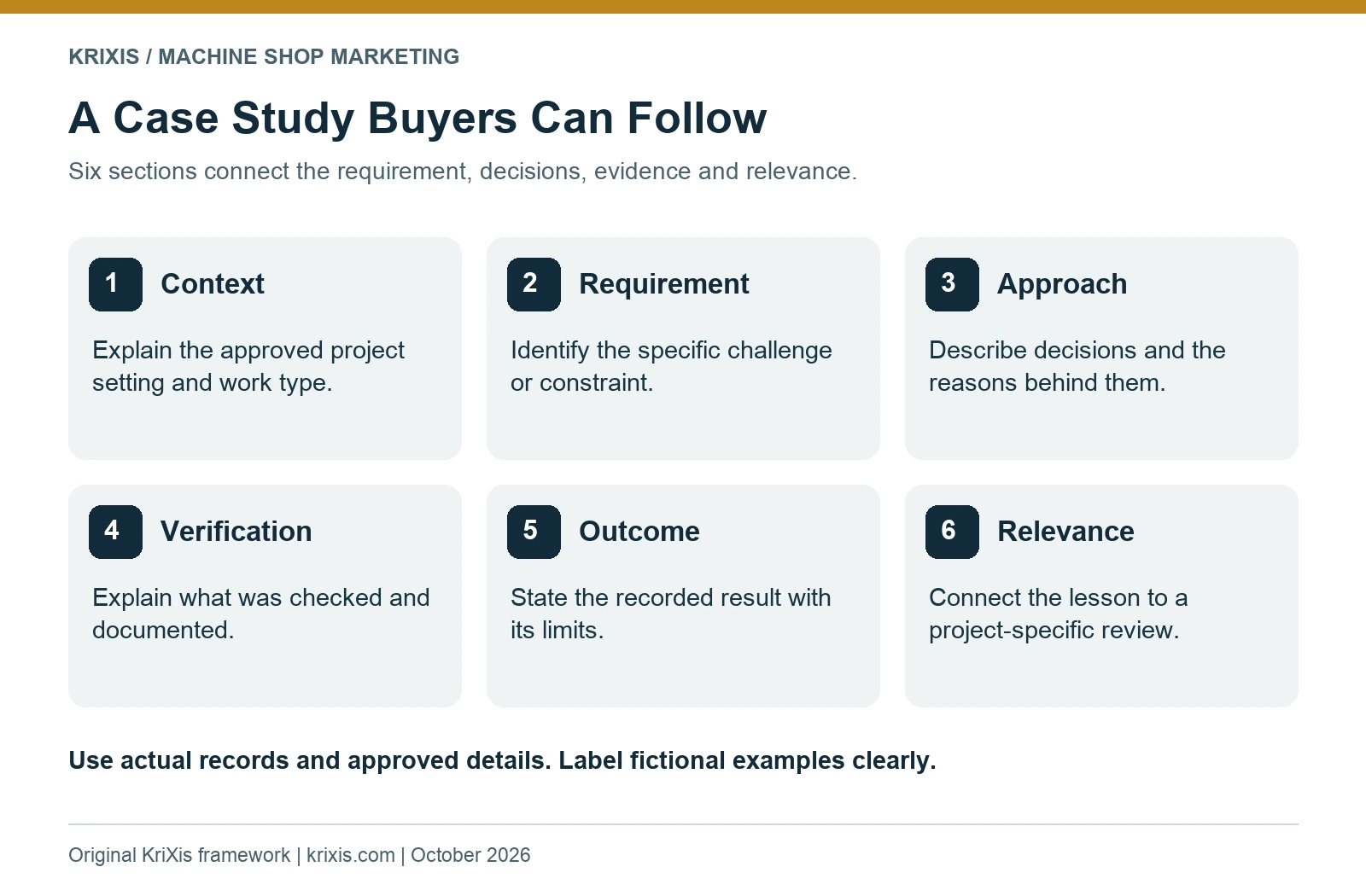
Six story sections: context, requirement, approach, verification, outcome and relevance
Follow the project decision trail through six sections. View full-size infographic

1. Context: what work was being evaluated?

Explain the application at an approved level of detail, the relevant process and the project stage. Include material or quantity information only when verified and publishable. A general description such as a repeat-order machined component can be useful without revealing a customer product or program.

2. Requirement: what made the project distinct?

Describe the specific challenge or constraint. It could involve documentation, a feature requiring review, a revision change or coordination between operations. Avoid describing the customer as disorganized or a previous supplier as incompetent. The goal is to explain the work, not assign blame.

3. Approach: which decisions did the team make?

Show the relevant sequence and the reasoning behind it. Explain clarification, process planning, communication or supporting operations in language a buyer can follow. Leave proprietary methods out when they are unnecessary to the story. Connect the decisions to the requirement rather than listing every machine involved.

4. Verification: how was the work checked?

Explain the agreed verification or documentation step at an appropriate level. Identify what was checked and who reviewed the result. Do not use “certified” or “validated” casually when those terms would imply a status the project does not have. An inspection description should match the actual process.

5. Outcome: what is documented?

State the completed outcome with its scope and period. Delivery, an approved inspection record or a documented customer response may be enough. If you include a numerical comparison, explain the baseline, the measure and the conditions. Keep uncertain benefits out of the headline.

6. Relevance: what should a similar buyer do next?

Explain the lesson and the limits. Identify the type of need the example helps illustrate, link to the relevant capability, and invite a project-specific review. Do not imply that a new buyer's work is already feasible because it resembles a photograph in the story.

Have a story, but the evidence is scattered?

Share your public story URL or a non-confidential summary and the buyer question it should answer.

Request a machine shop case study review

Keep result claims narrower than the evidence

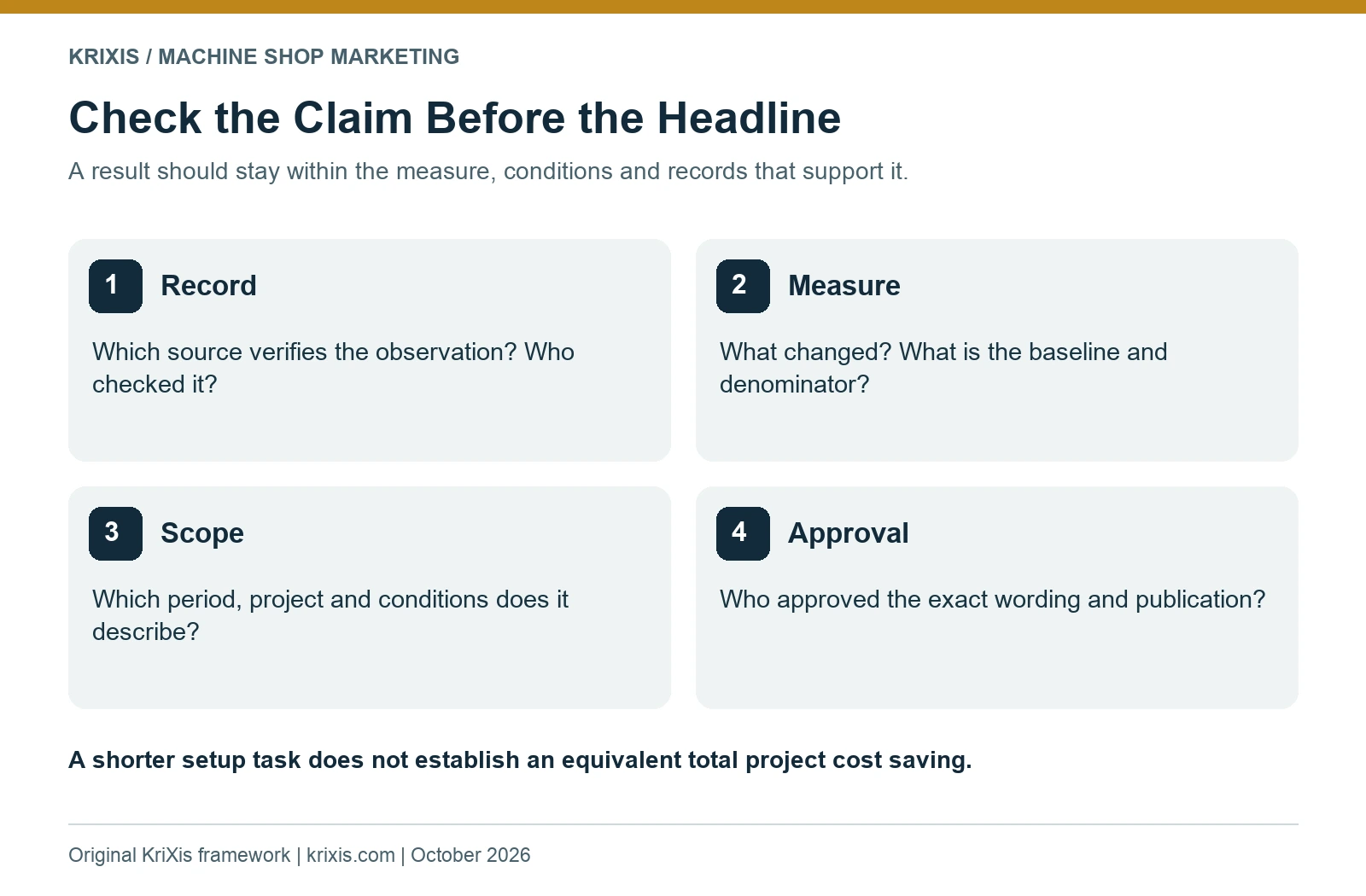
A result should be traceable to a record. “Delivered on the agreed date” requires a clear agreed date and delivery record. “Reduced setup time” requires a defined setup measure and comparable observations. “Saved the customer money” needs a defensible cost basis and permission to publish it.

Four claim checks: source record, measure and baseline, scope and conditions, and publication approval
Check the record, measure, scope and approval before publishing a result. View full-size infographic

For a numerical illustration, imagine a measured setup task falling from 100 minutes to 80 minutes. The difference is 20 minutes, or 20% of the 100-minute baseline. That arithmetic does not establish a 20% reduction in total project cost, a 20% throughput increase or a repeatable result for other jobs. These numbers are fictional, not a KriXis client result.

If the earlier and later jobs used different materials, quantities or requirements, explain those differences. A comparison may still describe the observations, but you should not present it as proof that one change caused the entire outcome. Use the metric your records actually support.

Some stories have no appropriate quantitative result. Explain the documented deliverable and decision instead. A clear account of resolving a specification question can be more useful than an unsupported savings percentage. Qualitative outcomes should also have an identifiable basis; a writer's assumption is not a customer endorsement.

Page views or downloads do not demonstrate won work. Our marketing ROI guide connects inquiries with later commercial stages while keeping attribution limits visible.

A fictional example of a useful project story

The following example demonstrates the structure. It is an invented teaching scenario, not an account of an actual shop, customer or KriXis engagement. It contains no claimed measured savings, production tolerances or certification status.

Context: A shop was reviewing a repeat order for a machined aluminum housing. The new request included a drawing revision and additional inspection documentation.

Requirement: The team needed to confirm which revision governed the order and which features the customer wanted included in the inspection report. Proceeding with the earlier assumptions would have left that requirement unclear.

Approach: Estimating recorded the questions and obtained clarification through the customer's approved contact. The project record was updated before the team finalized the manufacturing and inspection plan.

Verification: Quality reviewed the agreed documentation requirements. The shop recorded the inspection results for the specified features and checked that the report referenced the approved revision.

Outcome: The completed order was delivered with the agreed documentation. The example makes no broader claim about reduced cost, accelerated delivery or future repeatability.

Relevance: For buyers placing repeat orders with changed requirements, the story illustrates the importance of communicating revisions and documentation needs during review. A CTA could invite the reader to discuss a new revision through the shop's approved inquiry route.

This example is deliberately modest. It explains a useful behavior and a supported outcome. For a real story, replace the fictional details with verified facts, retain relevant conditions and obtain approval for the exact final copy.

Draft the story around facts your team can approve

Use interview prompts, claim records and a six-part outline to prepare a verified project story.

Download the free case study writing kit

Plan names, quotes and photos before publication

Confirm what you may publish before polishing the draft. Follow your organization's agreements and approval process for customer names, logos, quotations, project details and images. If the permission is unclear, ask the responsible owner to resolve it or exclude the information.

Calling a customer anonymous is not enough if the combination of part shape, application, location and timing identifies the project. Review the complete page, including photos, captions, file names and downloadable documents. A distinctive component may reveal more than the text does.

Quality professional reviewing a folder beside a machined component and caliper

Keep quotations faithful to the approved wording and context. Do not turn an internal comment into a public testimonial without approval. If a customer has not supplied a publishable comment, explain the documented outcome in your own factual prose instead of fabricating a quote.

Use real approved project photographs as evidence for a real case study. Illustrations can help explain a general concept, but label them clearly.

Publish a readable HTML story with relevant SEO

Give the page a distinctive title describing the manufacturing need, not just “Case Study Number 7.” Use a clear introduction, one H1 and descriptive subheadings. Put the useful answer near the beginning so readers can decide whether the example relates to their work.

Write a concise meta description that matches the story. Use a readable, stable URL and descriptive internal links. Connect the page from the relevant capability page and a findable case study or resource hub. Link back to the service that the story illustrates.

Place photos beside the explanation they support. Google's image guidance discusses descriptive filenames, useful alt text and relevant surrounding text. Describe what an informative photo shows; keep specifications and key results in HTML text so readers do not need to interpret an image to understand the outcome.

Optimize image files, provide dimensions and check the phone layout. Make detailed diagrams available at full size. A PDF can help a buyer share the story internally, but maintain a useful HTML version and keep the versions aligned when the facts change.

Check the live canonical, indexability, sitemap and sharing image. Structured data should describe the visible content accurately. Do not add a review score, rating or other claim that the page does not support. Use our SEO audit checklist for a broader review.

There is no required case study word count for SEO. Google says it has no preferred word count. Write enough to explain the situation, evidence and relevance; remove generic company copy that repeats the capability page without advancing the story.

Keep the evidence and publishing checks in one brief

Use interview prompts, claim records and a six-part outline to prepare a verified project story.

Get the case study writing kit

Connect the story to a useful buyer action

A case study usually serves a reader who is evaluating fit. Make the next step relevant to the example. Link to the supported capability and explain how to request a project review. Avoid a button that suggests the same outcome is guaranteed for any similar part.

Tell the reader which inputs help start the conversation and where to send them. Material, quantity, timing, revision and documentation requirements can be useful when appropriate. Use the shop's approved method for drawings or sensitive files, with clear instructions for arranging a suitable transfer.

Manufacturing professional preparing a generic machined component for protective packaging

Preserve the case study's context when the inquiry reaches sales or estimating. A simple note that the prospect referenced a particular example can help the team understand their question. The RFQ qualification guide covers how to evaluate the request after it arrives.

Ask buyers which information helped and which questions remain. Keep page activity separate from qualified inquiries; a few submissions cannot prove that a case study caused an order.

Give the draft a clear review and maintenance owner

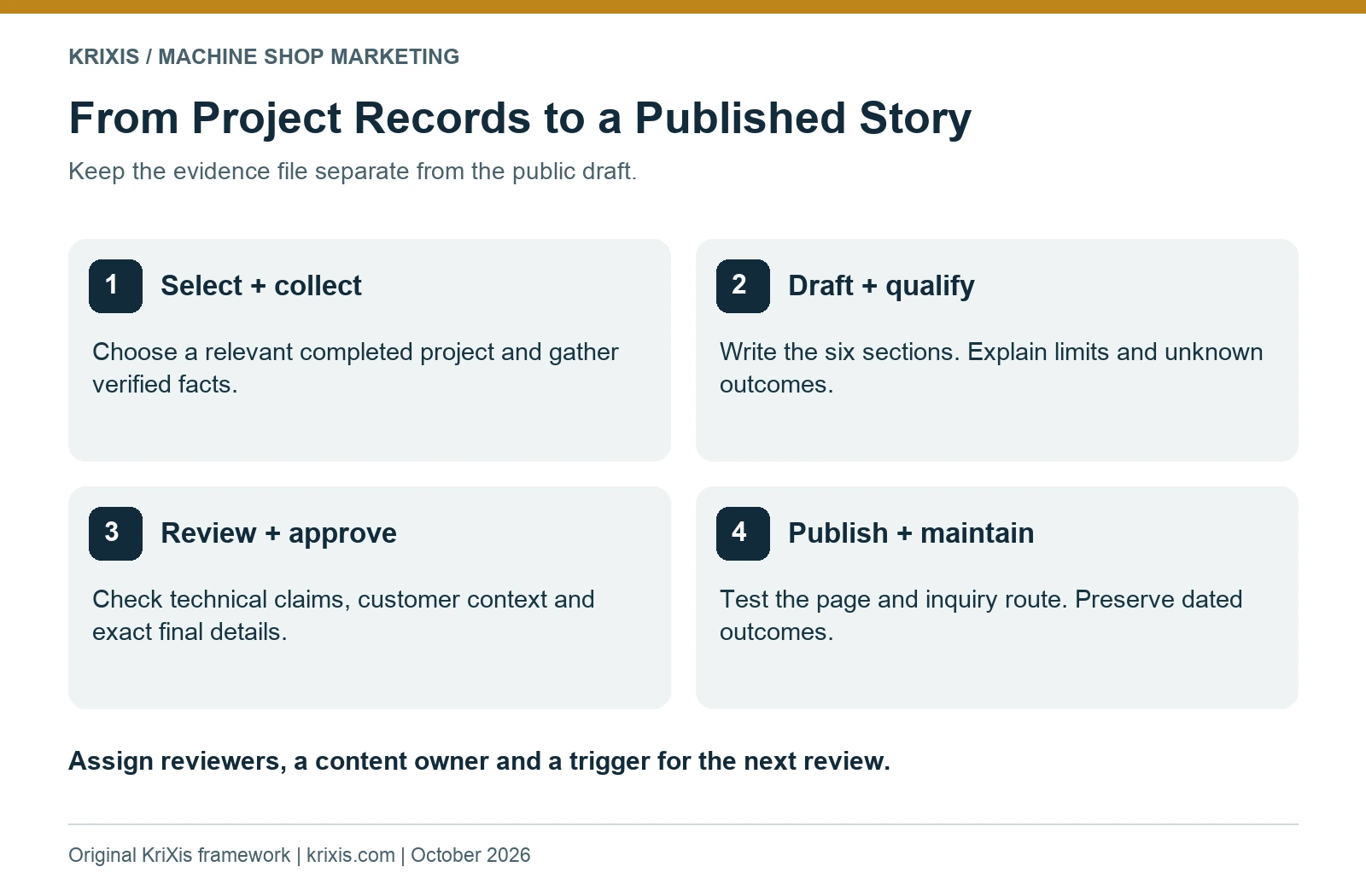
Before publication, have the responsible technical reviewer check manufacturing claims, the account owner check customer context, and the content owner check the final page. Assign the necessary approvals according to your process; do not assume that silence means a draft was approved.

Four publishing steps: select and collect, draft and qualify, review and approve, publish and maintain
Keep internal evidence separate from the public draft and assign reviewers. View full-size infographic

Review the rendered page on desktop and phone. Check captions, links, downloads and the inquiry route. For a contact form, confirm receipt by the intended team.

Keep a record of the approved version and its evidence. Revisit the page when permissions, documents, capability claims or linked services change. Historical outcomes should remain dated historical observations. Do not make an old project appear current by simply replacing its publication date.

Common questions about machine shop case studies

Can we write a case study without naming the customer?

Yes, when the approved information is useful and does not expose the customer through other details. Explain the work at the level you are permitted to share. Review text, images and context together before publication.

What if we cannot publish a numerical result?

Describe the documented requirement, decision, verification and deliverable. Do not invent a percentage to make the story more persuasive. A useful process explanation can stand on its own.

Should we call a hypothetical example a case study?

Label it prominently as fictional or hypothetical and explain its teaching purpose. Do not present invented people, quotes or outcomes as customer evidence. Keep actual project accounts distinct from illustrations.

Where should case studies appear on the website?

Make them reachable from a findable resource hub and link relevant examples from capability pages. Each story should link to the capability it illustrates and a clear inquiry route. Avoid orphaned pages that require a visitor to know the URL.

Start with one verified story

Choose a completed project that answers a buyer's question, gather the records and use the six-part framework to prepare the draft. Approve the final details, explain the limits and connect the story to the next useful conversation.

Want help turning your draft into a useful buyer resource?

Share your public story URL or a non-confidential summary and the buyer question it should answer.

Request a machine shop case study review

For implementation, explore KriXis machine shop website design and machine shop SEO services.

October 10, 2026/0 Comments/by Matthew Borza
https://www.krixis.com/wp-content/uploads/2026/10/machine-shop-case-study-hero.webp 1024 1536 Matthew Borza https://krixis.com/wp-content/uploads/2015/12/KriXis-Full-Logo-Trans-300x79.png Matthew Borza2026-10-10 07:58:322026-10-11 02:01:18How to Write Machine Shop Case Studies Buyers Can Use
Machine Shop Marketing

Machine Shop Capability Pages: A Blueprint That Helps Buyers Request a Quote

KriXis editorial guide · Published October 10, 2026 · About 13 minutes to read

A machine shop capability page should help a buyer answer three questions: Can this supplier do the work? What evidence supports that answer? How do I start a useful quote conversation? An equipment list can contribute to those answers, but it rarely answers them alone.

When a page says “precision machining” and shows a row of machines, the buyer still has to infer materials, part characteristics, inspection practices and production fit. That uncertainty can create extra emails or an inquiry your estimator cannot use. A better page connects each capability with context, proof and a clear next step.

This guide gives owners and marketing teams a practical blueprint for building that page. It includes an evidence matrix, a fictional copy example, a publishing checklist and a maintenance process. Use it for a capability your shop actually supports, with technical claims reviewed by the people responsible for the work.

Generic machined aluminum parts and a blank capability binder in a CNC shop
In this guide

  • Why capability pages are the next step after an equipment list
  • Choose one buyer need for the first page
  • Build an evidence matrix before writing copy
  • Use an eight-part capability page blueprint
  • Replace vague claims with useful, qualified copy
  • Use visuals as evidence, with enough context
  • Make the RFQ action match the buyer's readiness
  • Complete on-page SEO without making pages repetitive
  • Publish one page, then measure and maintain it
  • Questions machine shop owners ask
  • Build the page buyers can use

Why capability pages are the next step after an equipment list

An equipment list describes assets. A capability page explains how those assets, people and processes support a particular manufacturing need. Buyers should be able to find both without treating a machine's nominal travel as a promise about every finished part.

There is a useful public example of how specific supplier evaluation can become: the NIST MEP supplier scouting request asks about manufacturing processes, dimensions, tolerances, materials, certifications, business volume and delivery requirements. Your website does not need to reproduce that form. The fields illustrate why a buyer needs more context than a slogan.

Our recommendation is to organize public capability content around the questions your team can answer accurately before a drawing review. Keep project-specific commitments in the quoting process. A page that makes these boundaries clear can help suitable prospects identify themselves and help unsuitable prospects understand the mismatch sooner.

KriXis's broader machine shop SEO guide explains how capability content supports discovery. This blueprint focuses on what one useful page should contain once the visitor arrives.

Start with one capability, not a blank screen

Use the brief, evidence records, eight-section outline and launch checklist to plan one useful page.

Get the free capability page planning kit

Choose one buyer need for the first page

Begin with a real process or service that matters to the business: CNC milling, turning, a specific supported material, or another clearly defined capability. Choose a topic with enough distinct information to justify its own page. Do not create separate pages for every material and city if the content would be nearly identical.

Ask sales and estimating which work the shop wants more of, which questions appear repeatedly, and which requests waste time because the website implies a capability you do not offer. Then check those answers with operations. Commercial interest and operational fit should both shape the brief.

Write a one-sentence purpose before drafting: “Help buyers evaluating our CNC milling service understand supported work, relevant evidence and the information needed for a drawing review.” That sentence gives the page a job and helps you remove unrelated company history or generic marketing paragraphs.

Keep a separate list of exclusions and conditional work. Perhaps a process is outsourced, certain materials need additional review, or production quantities depend on capacity. Explain the relevant boundaries in plain language. You can be specific without publishing a blanket lead-time or tolerance commitment.

Build an evidence matrix before writing copy

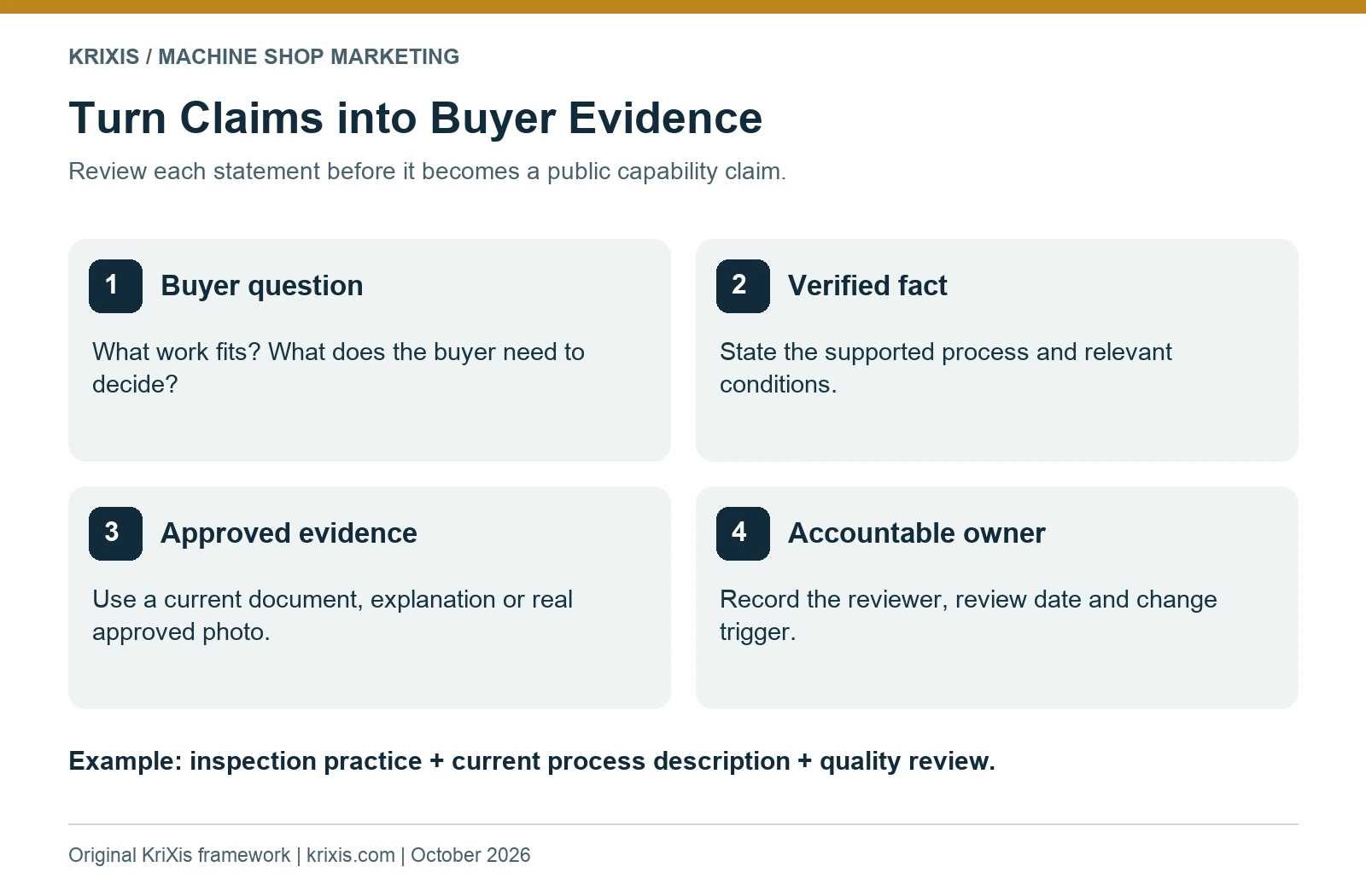
Collect the facts first. For each proposed statement, record the buyer question, the supporting evidence, the person who can approve it, and the condition that might make it misleading. This is the fastest way to discover that an attractive claim lacks a defensible basis.

Four evidence records: buyer question, verified fact, approved evidence and accountable owner
Connect the buyer question to a verified fact, approved evidence and an accountable reviewer. View full-size infographic

For example, “we support repeat production” might be supported by documented revision control, a repeat-order workflow and an approved example. “We can hold this tolerance” needs much more context: material, geometry, feature, setup and inspection method may affect the answer. Avoid converting one successful job into a general promise.

Useful source material includes current equipment information, approved process photos, inspection descriptions, a maintained certification document where applicable, and questions from estimating. Customer names, drawings, recognizable parts and outcomes need appropriate permission before publication. An anonymized example should still be reviewed for identifying details.

If a fact is uncertain, leave it out until it is checked. If a claim is conditional, publish the condition beside it. If the evidence is stale, assign someone to update it. The matrix should make those decisions visible instead of hiding them in a draft that everyone assumes someone else reviewed.

Two manufacturing professionals reviewing a planning document beside a machined component

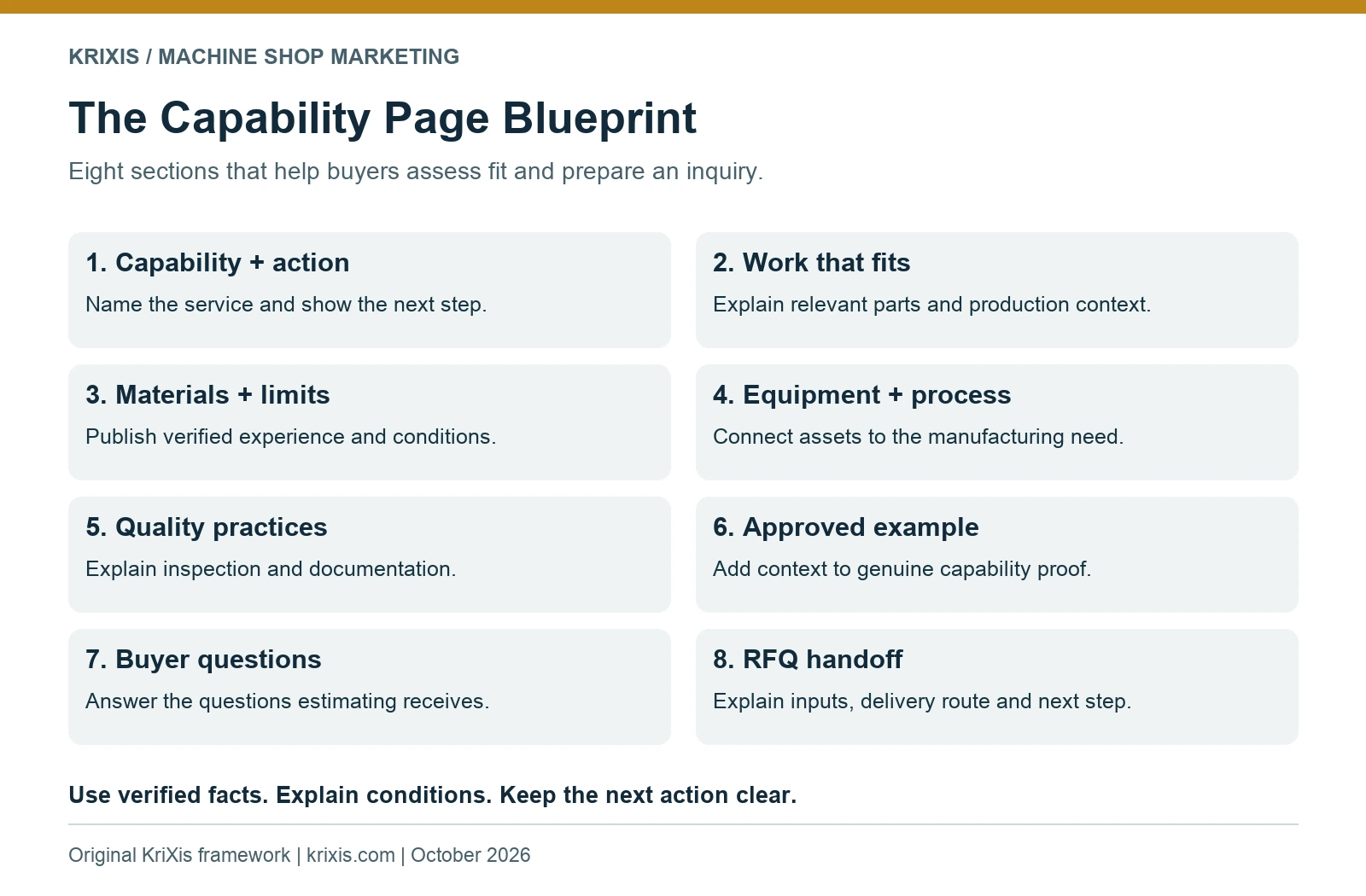
Use an eight-part capability page blueprint

Give readers a quick route through the page while preserving the detail needed for supplier evaluation. The following sequence is a starting structure, not a requirement to write eight long sections for every service.

Eight capability page sections from service introduction to RFQ handoff
Capability and action, work fit, materials and limits, equipment and process, quality practices, approved example, buyer questions and RFQ handoff. View full-size infographic

1. State the capability and the next step

Use a descriptive main heading such as “CNC Milling Services.” Follow it with a short explanation of the work you support and an obvious inquiry link. Avoid an opening paragraph made entirely of “quality,” “innovation” and “excellence.” Those words leave the buyer with almost no usable information.

2. Describe the work that fits

Explain supported part characteristics, prototype or production context, and relevant applications when verified. Describe who the service helps through the manufacturing need rather than a long list of industries. Do not imply sector-specific approval or compliance merely because you have machined a part used in that sector.

3. Explain materials and practical boundaries

List materials with actual experience behind them. Where size information is useful, qualify what it means and when review is needed. Machine travel, workholding clearance and feasible part size are different ideas. Use a table only when it simplifies a comparison; short lists are often easier to read on a phone.

4. Connect equipment to the process

Include relevant machines, supporting operations and programming or setup context. Explain which stages occur in-house and which rely on outside services. Link to a fuller equipment list if buyers need it, while keeping this page centered on the manufacturing problem the equipment helps solve.

5. Make quality practices concrete

Describe the inspection, documentation and traceability practices the shop actually provides. State when requirements must be agreed during quotation. If you reference a certification, verify its current status and scope, and link to an approved current document when appropriate. Avoid using a badge to imply broader coverage.

6. Show an approved example

Pair a relevant photograph with a brief explanation: the manufacturing need, the capability used, and the evidence the image illustrates. A part photo alone may look impressive while explaining very little. Use real shop photography for your own capability proof.

For a fuller project account, use our case study writing guide and free template to document the requirement, decisions and verified outcome.

7. Answer the questions that delay inquiries

Use questions your team actually receives. Do you review customer-supplied drawings? What information helps assess a request? Are finishing operations performed in-house? Which questions require technical review? Answer directly and avoid copying the same generic FAQ onto every capability page.

8. Explain the RFQ handoff

Tell the buyer what to send, how to send it and what happens next. Link to your approved inquiry route and provide an alternative contact option. Publish a response-time expectation only if the responsible team can meet it. A prominent button cannot compensate for a request that never reaches estimating.

Have a capability page that leaves buyers guessing?

Share your public page URL and the buyer question you want it to answer.

Request a capability page review

Replace vague claims with useful, qualified copy

Here is a fictional example for a shop planning a CNC milling page. It is sample wording, not a claim about KriXis or a real manufacturer. Replace every operational detail with facts your own team approves.

Vague version: “We are a leading precision machine shop with state-of-the-art equipment, unmatched quality and fast delivery for every industry.”

More useful version: “We provide CNC milling for prototype and repeat-order components. Our team reviews drawings, material specifications, quantities and inspection requirements before confirming fit. Ask us about supported aluminum and stainless steel work, and tell us whether finishing or additional documentation is required.”

The second version helps the buyer understand a process and prepare the conversation. It still needs supporting detail elsewhere on the page: which materials are supported, what repeat-order controls exist, and who reviews the inquiry. Clear copy is a starting point, not a substitute for evidence.

You can apply the same approach to a heading. Replace “Our Unrivaled Technology” with “Equipment and Supporting Processes.” Replace “Guaranteed Precision” with “Inspection and Documentation.” These headings tell the reader what they will find and reduce the risk of making promises the page cannot substantiate.

Use visuals as evidence, with enough context

Plan photos around buyer questions. A machine overview can establish process context; a setup image can explain a relevant operation; an inspection image can support an account of verification. A finished-part photograph is more useful when its caption explains the approved example and its limits.

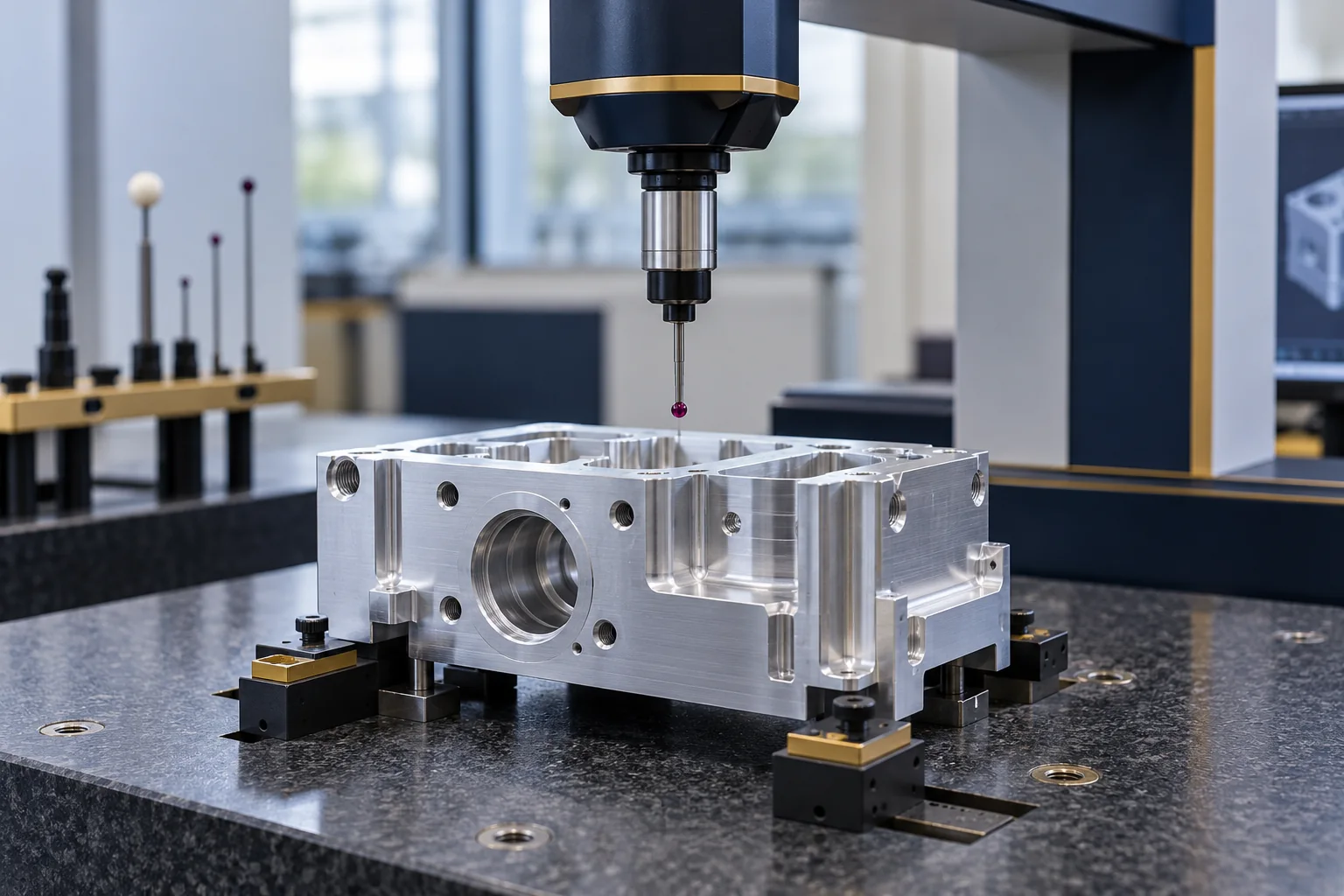
Coordinate measuring machine probe above a generic aluminum component

For your own site, prioritize genuine approved images over generic stock or AI imagery presented as facility proof. Obtain permission, check for customer information in the background, and remove misleading captions. Do not describe an illustration as your equipment, an actual customer job or a certified process.

Use descriptive filenames and alternative text for informative images. Write alt text about the visible content and its purpose, rather than repeating a keyword string. Put important specifications in page text as well as any infographic so readers can access them without interpreting a picture.

Optimize image files for the display size, include width and height, and load later images lazily where supported. Check that phone readers can open detailed diagrams at full size. A page can fit the screen while its embedded specification table or infographic remains unreadable.

Manufacturing professional photographing a generic metal bracket at a workbench

Keep claims, evidence and approvals together

Use the brief, evidence records, eight-section outline and launch checklist to plan one useful page.

Get your free page planning kit

Make the RFQ action match the buyer's readiness

Offer a clear primary action for someone ready to discuss work: “Request a quote” or “Send your project for review,” according to your actual process. Nearby instructions should explain the minimum useful information, such as material, quantity, timing and applicable requirements.

A buyer who is still checking fit may prefer a capability document or a technical conversation. Give that reader a sensible secondary route without surrounding every paragraph with competing buttons. The page should help them choose a next step they understand.

Use only your approved method for handling drawings and sensitive files. If the public form is not suitable, explain how to arrange a secure transfer. Do not tell prospects to upload confidential data to an arbitrary tool or assume that an attachment field makes the whole workflow appropriate.

Test the handoff with non-confidential information. Check required fields, error messages, confirmation text, receipt in the intended inbox or CRM, ownership and follow-up. KriXis's RFQ qualification guide covers the next decision after an inquiry arrives.

Turn the blueprint into a publishable brief

Use the brief, evidence records, eight-section outline and launch checklist to plan one useful page.

Download the free planning kit

Complete on-page SEO without making pages repetitive

Give each capability page a distinct title, a useful description, a readable URL and one clear H1. Organize supporting content under descriptive headings. Write the opening for the reader evaluating this service; avoid repeating the same geography and process phrase in every sentence.

Connect the page from your services or capabilities hub and link to related processes, useful buyer resources and the RFQ route. Google's link guidance recommends crawlable links and descriptive anchor text. A useful link tells people what they will find when they follow it.

Verify the live page's canonical URL, indexability and sitemap inclusion. Check sharing titles, descriptions and images. Structured data should accurately describe visible content; adding markup does not create a certification, make an unsupported claim true, or guarantee a special search appearance.

Keep a useful HTML page even if you offer a downloadable capability sheet. A PDF can help a buyer circulate information internally, but the page still needs enough content to explain the service and support navigation. Assign an owner to keep both versions aligned.

There is no universal ideal length for a capability page. Google explicitly says it has no preferred word count. Include the verified information required to answer the buyer's questions, remove repetition, and use the machine shop SEO audit checklist for a broader review.

Publish one page, then measure and maintain it

Start with one priority capability rather than rebuilding the entire site at once. Assign the technical reviewer, the content owner and the person responsible for inquiry delivery. Use a documented checklist so the final review includes both accuracy and usability.

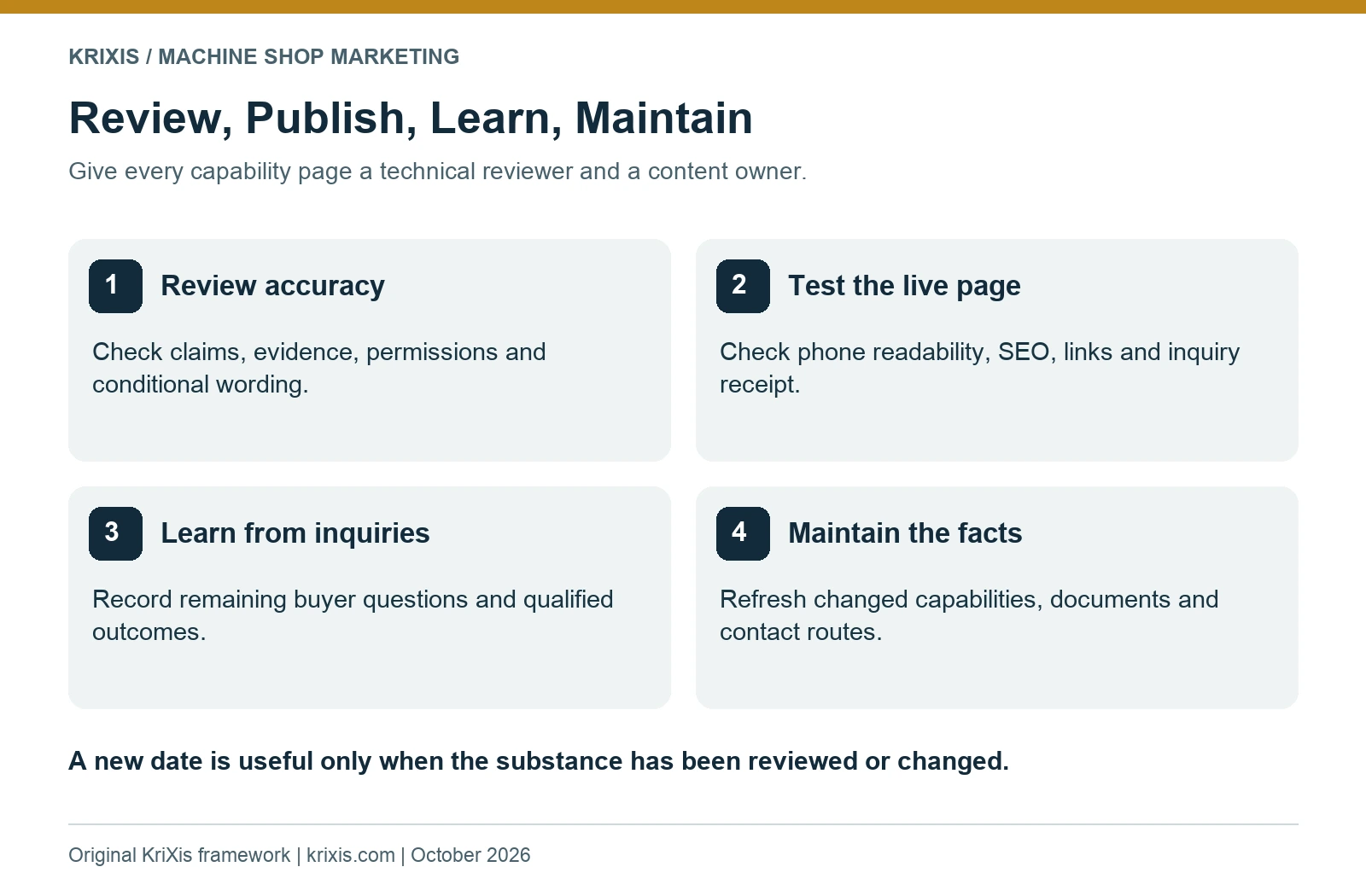
Four steps: review accuracy, test the live page, learn from inquiries and maintain facts
Review, publish, learn and maintain with named owners. View full-size infographic

After publication, collect the questions buyers still ask and review inquiry quality. Track which relevant inquiries involved the page where your systems can support that connection. A download or button click is an interest signal; it is not automatically a qualified RFQ.

Use KriXis's marketing ROI guide to connect page activity with downstream stages. On low-volume sites, a few inquiries cannot establish that a wording change caused a commercial result. Record the change and interpret outcomes with source, timing and project mix in mind.

Schedule reviews around meaningful operational changes as well as a regular check. Update equipment, supported processes, documents, contact instructions and examples when they change. Remove expired or misleading evidence promptly. Refreshing a visible date without changing the substance does not make a page more useful.

Questions machine shop owners ask

Should each machine have its own page?

Usually start with the service buyers need. A dedicated machine page can be useful if it answers distinct questions with substantial information. An equipment list can support the service page without turning every asset into a thin landing page.

Should we publish exact tolerances and lead times?

Publish only values your team can substantiate with clear conditions. If the answer depends on a drawing, material, inspection requirement or current capacity, say that. Avoid letting a headline imply an unconditional commitment.

Is a capability PDF enough?

A PDF can support internal sharing, but a maintained HTML page gives readers a direct route to relevant detail and an inquiry. Keep the PDF consistent with the page and make its issue date or version clear.

How do we decide whether a new page is worthwhile?

Ask whether it serves a distinct buyer need with different, verified information. If it mainly swaps a material or location name into existing copy, improve the existing page instead. Use actual inquiry questions to guide the decision.

Build the page buyers can use

A strong capability page brings accurate facts, relevant evidence and a dependable inquiry route together. Begin with one service, review the claims with your shop team and publish a page that makes the next conversation easier to prepare.

Want help choosing and improving that first page?

Share your public page URL and the buyer question you want it to answer.

Request your capability page review

For broader implementation, explore KriXis machine shop website design and machine shop SEO services.

October 10, 2026/2 Comments/by Matthew Borza
https://www.krixis.com/wp-content/uploads/2026/10/machine-shop-capability-hero.webp 1024 1536 Matthew Borza https://krixis.com/wp-content/uploads/2015/12/KriXis-Full-Logo-Trans-300x79.png Matthew Borza2026-10-10 07:39:282026-10-11 02:01:53Machine Shop Capability Pages: A Blueprint That Helps Buyers Request a Quote
Machine Shop Marketing

How to Measure Machine Shop Marketing ROI: From RFQ to Won Work

By Matthew Borza, KriXis · Published October 9, 2026 · About 13 minutes to read

More website traffic can look encouraging while the estimating team sees little useful change. Perhaps inquiries increased, but most need a process you do not offer. Perhaps good RFQs arrived, but nobody recorded where they came from. Perhaps quotes are still open when the monthly report declares the campaign unsuccessful.

Measuring machine shop marketing ROI starts by connecting discovery, qualification, quoting, and commercial outcomes. The aim is a defensible answer to two questions: which activities bring work worth pursuing, and where does that work stop progressing?

This guide gives owners and sales teams a practical measurement system, a worked example, and a monthly review process. The examples are fictional planning illustrations. They are not KriXis client results or machining industry benchmarks.

Machine shop owner and estimator reviewing opportunity records and a machined part
In this guide

  • Start with the work your shop wants to win
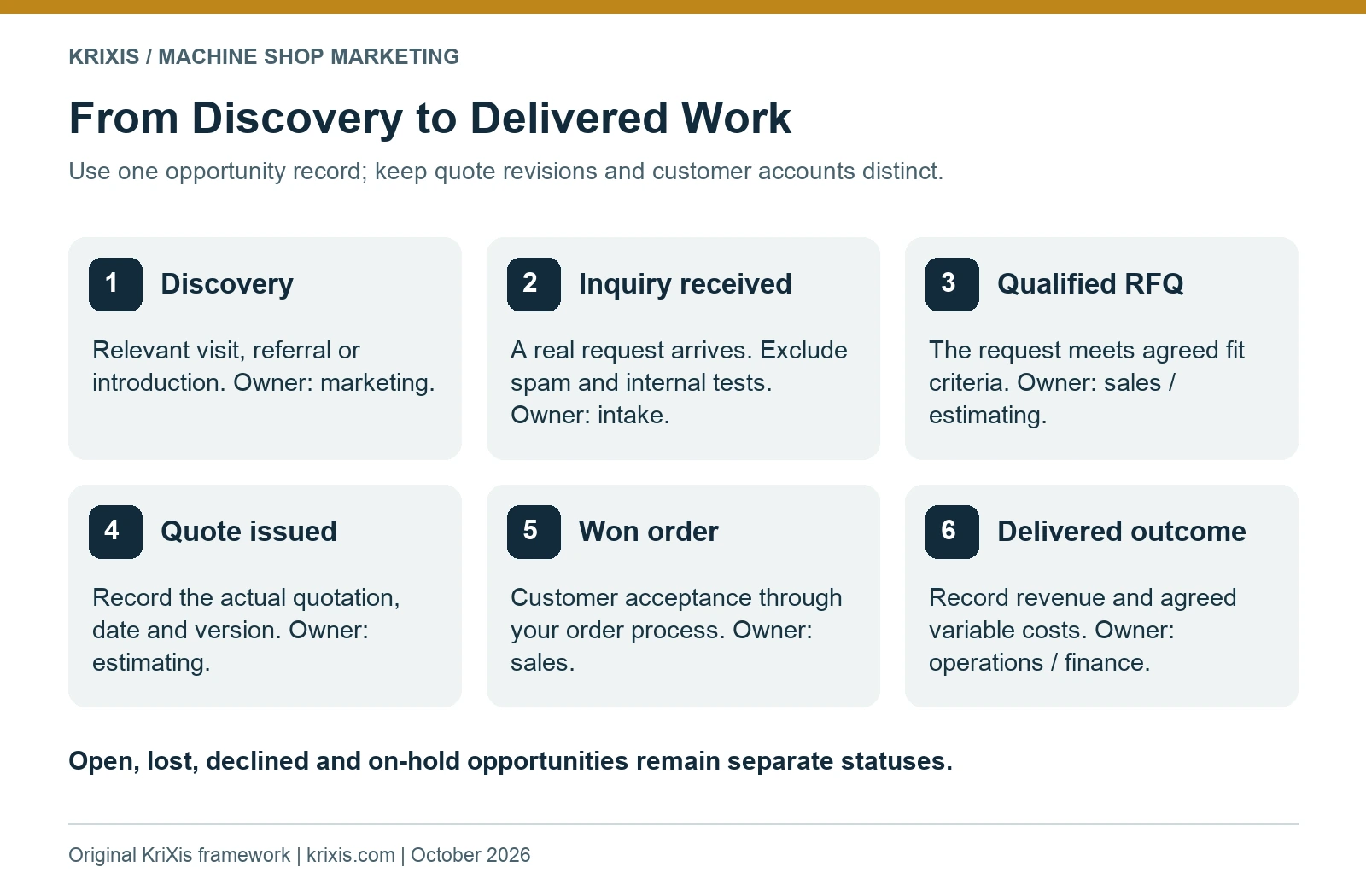
  • Track six stages from discovery to delivered work
  • Capture source information without slowing intake
  • Use website analytics for successful actions
  • Calculate a compact set of useful metrics
  • Work through a fictional machine shop example
  • Match reporting periods to the sales cycle
  • Use attribution to inform decisions, with its limits visible
  • Run a monthly review with sales and estimating
  • Diagnose the bottleneck before increasing spend
  • Build a reliable baseline in the next 30 days
  • Common questions about machine shop marketing ROI

Build your baseline before changing the budget

Use a browser-based worksheet to calculate your baseline and record one next action.

Get the free RFQ scorecard and ROI worksheet

Start with the work your shop wants to win

Define the business goal before selecting dashboard metrics. A shop with open capacity may need new production accounts. A fully booked operation may prefer repeatable work, a healthier customer mix, or fewer unsuitable requests. Those goals lead to different definitions of success.

Write a short description of a suitable opportunity: processes, materials, part sizes, quantities, quality requirements, commercial conditions, and timing. Ask estimating and operations to review it. The description must reflect current capability and capacity rather than an idealized service list.

Our machine shop lead qualification guide provides a scorecard for this decision. Use the same acceptance criteria when reviewing sources. Otherwise, one channel can appear stronger simply because its inquiries received a more generous assessment.

Also decide what counts as a new opportunity. One buyer may send three revisions of the same RFQ. Count that as one opportunity with a revision history, not three new leads. Keep customer accounts, projects, quote revisions, and purchase orders distinguishable.

Track six stages from discovery to delivered work

Use a small set of stages that everyone can explain. Website activity provides context; the opportunity record supplies the operational history.

  1. Discovery: a relevant visit, referral, event interaction, or other introduction.
  2. Inquiry received: a real request reached the team, excluding spam and internal tests.
  3. Qualified RFQ: the request meets the agreed criteria for estimating review.
  4. Quote issued: an actual quotation was sent, with its version and date recorded.
  5. Won order: the customer accepted the offer through your normal order process.
  6. Delivered outcome: revenue and the agreed cost or contribution measure are available.

Missing information is a status that needs an owner and a next action. It is not automatically a rejection. Keep declined, lost, canceled, and on-hold work distinct, and record “unknown” when the reason is unknown.

Six measurement stages from discovery to delivered work, with responsible teams
Discovery, inquiry, qualified RFQ, quote, won order and delivered outcome. View full-size infographic

A quoted amount is potential work, while a won order is a commercial commitment. Neither is identical to recognized revenue or cash collected. Choose the financial measure with the person responsible for your accounts and label it consistently in the report.

If you need a shared place to maintain these records, our machine shop CRM workflow explains ownership and stage rules. A maintained spreadsheet can also be a practical starting point for a small team.

Capture source information without slowing intake

Create one opportunity record when the inquiry arrives. At minimum, record its ID, receipt date, source, requested capability, qualification status, owner, quote date, outcome, and next action. Add financial values only when the business can support them.

Keep the first known source and later influences separate. A buyer might discover a capability article, return directly, speak to a colleague, and then submit an RFQ. The last visit alone would miss useful context. Conversely, an existing customer reading a new article does not make all subsequent account revenue newly acquired by marketing.

Ask a simple optional question such as “How did you first hear about us?” Use consistent categories and allow an unknown answer. Record the response as self-reported context, not independently proven attribution.

Estimator organizing RFQ folders beside a laptop and stainless steel component

Use tagged links for campaigns you control, such as a newsletter or a paid advertisement. Google’s campaign URL guidance explains how source, medium, and campaign parameters support reporting. Use a naming convention the team can maintain. Never put an email address, customer name, drawing identifier, or other sensitive detail into the URL.

When a source is missing, preserve the gap. Guessing “organic search” because a buyer found the website creates misleading precision. Review unknown records monthly and correct the collection process where possible.

Use website analytics for successful actions

A button click, a form start, and a successfully received inquiry are different events. Measure each only if it answers a useful question. Validate the submission path by checking the confirmation and the intended inbox or CRM record with clearly marked test data.

Google Analytics recommends lead lifecycle events including generate_lead, qualify_lead, and close_convert_lead. Its recommended events documentation provides the current definitions. Later stages require an appropriate connection to your sales process; they do not appear simply because tracking code is installed.

Choose website key events carefully. A resource download can indicate interest, but it should remain separate from a qualified RFQ. A reporting setup that combines downloads, telephone clicks, and received RFQs into one “lead” number can obscure performance.

Keep ordinary analytics events free of names, email addresses, phone numbers, form-message text, and technical drawings. Google’s guidance on avoiding personally identifiable information applies to the information you send. Store project details in approved business systems and review the actual implementation before enabling integrations.

Find the gaps between your website and sales records

Get help defining your measurement gaps and the next practical improvement.

Request a machine shop marketing measurement review

Calculate a compact set of useful metrics

Begin with six measures. Define the date range, denominator, and source rules beside them so future reports are comparable.

Qualification rate = qualified RFQs ÷ valid inquiries × 100. This indicates how well incoming demand matches the agreed criteria. Review it alongside the number of accepted opportunities. A perfect percentage based on one inquiry tells a limited story.

Quote rate = quoted opportunities ÷ qualified RFQs × 100. Use a sufficiently mature group of opportunities. Low quote rate may reflect missing information, estimating capacity, technical review, or a deliberate decision to decline.

Quote win rate = won opportunities ÷ decided quoted opportunities × 100. In this definition, decided means won or lost. Report open and canceled quotes separately. An alternative definition can use all quotes, but the report must explain it and avoid comparing the two approaches as though they were identical.

Cost per qualified RFQ = allocated marketing cost ÷ qualified RFQs. Include the costs covered by the decision: agency fees, advertising, relevant tools, and agreed internal marketing effort. Document how shared costs are allocated. This measure does not capture all estimating effort or prove the opportunity is profitable.

Cost per acquired customer = allocated acquisition cost ÷ new customers acquired. Count customer accounts rather than orders. Define the period and allocation policy, especially when a campaign creates opportunities that convert months later.

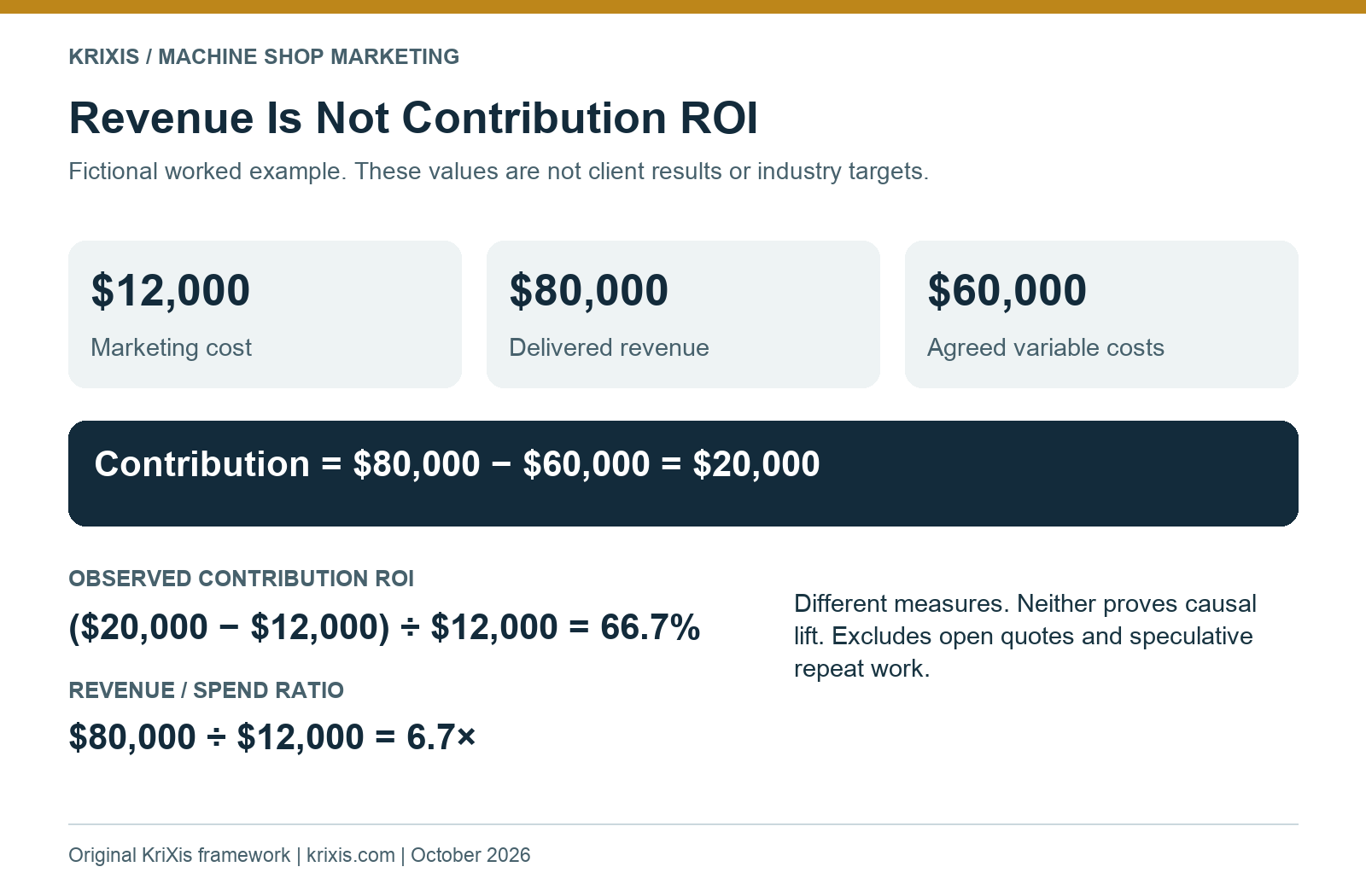
Observed contribution ROI = (attributed contribution − marketing cost) ÷ marketing cost × 100. Define contribution as revenue less the agreed variable costs for the work. If incremental contribution cannot be established, describe this as an attribution-based estimate, not proof of causal lift or accounting profit.

Fictional example comparing 66.7 percent contribution ROI with a 6.7 times revenue to spend ratio
Fictional example: $80,000 revenue less $60,000 variable costs gives $20,000 contribution; after $12,000 marketing cost, observed contribution ROI is 66.7%. View full-size infographic

A revenue-to-spend ratio can supplement these measures: attributed revenue divided by marketing cost. Label it as a ratio. It is not the same calculation as contribution ROI because it does not subtract production costs.

Work through a fictional machine shop example

Suppose a shop spends $12,000 on a defined acquisition program and tracks the resulting opportunity group. It receives 30 valid inquiries, accepts 18 for estimating, and issues 12 quotes. Eight quotes have decisions: four wins and four losses. Four quotes remain open.

The qualification rate is 18 ÷ 30, or 60%. The quote rate is 12 ÷ 18, approximately 66.7%. The decided-quote win rate is four ÷ eight, or 50%. Cost per qualified RFQ is $12,000 ÷ 18, approximately $667. None of those figures is a recommended target.

Assume the four won opportunities represent four new customer accounts. Acquisition cost per customer is $3,000 under the stated allocation. If two orders instead belonged to the same new account, the denominator would change. Record the actual account structure rather than using the order count automatically.

Now assume delivered work associated with those wins produces $80,000 in recognized revenue and $60,000 in the agreed variable costs. Contribution is $20,000. Observed contribution ROI is ($20,000 − $12,000) ÷ $12,000, approximately 66.7%. Revenue divided by spend is approximately 6.7 times. Presenting the latter as “670% ROI” would blur two different measures.

This example leaves open quotes unresolved and excludes speculative repeat orders. It also depends on the attribution and cost assumptions. A different production mix, delayed delivery, or inaccurate source data could change the result substantially.

Use the same definitions in your own review

Use a browser-based worksheet to calculate your baseline and record one next action.

Open the free scorecard and worked ROI example

Match reporting periods to the sales cycle

Use two complementary views. A calendar view shows work occurring this month: spending, received inquiries, quotes issued, orders won, and delivered contribution. A cohort view follows opportunities first received in a specified period as they mature.

Without the cohort view, January spending can be compared with January orders from last year’s relationships. That can make a good acquisition program appear weak or give it credit for work it did not originate.

Choose a review interval from your actual opportunity history. Track days from inquiry to qualification, qualification to quote, and quote to decision. Separate materially different work types when they have different buying cycles. There is no universal manufacturing waiting period that makes a campaign ready for a final verdict.

Show open pipeline separately from completed outcomes. A probability-weighted pipeline can support planning when its assumptions are grounded in your records, but it remains an estimate. Do not add pipeline value to realized revenue to create a larger return figure.

Use attribution to inform decisions, with its limits visible

Start with a simple written attribution policy. For example, assign new opportunities to their first known discovery source, record supporting influences, and mark uncertainty. Apply the same policy across channels before comparing them.

Buyers may cross devices, decline tracking, use private browsing, or contact you by phone. These gaps make perfect attribution unlikely. Keep self-reported answers, campaign evidence, and CRM history available without claiming that each proves causation.

A higher observed return does not establish that marketing caused every order. Existing relationships, customer demand, pricing, available capacity, and production performance also matter. If the business needs stronger evidence of incremental effect, design a comparison appropriate to the available data rather than inventing a counterfactual after the results arrive.

For ordinary monthly decisions, imperfect but consistently defined evidence can still help. Document which source categories need better collection and which conclusions are preliminary.

Keep your definitions beside the results

Use a browser-based worksheet to calculate your baseline and record one next action.

Download the free measurement worksheet

Run a monthly review with sales and estimating

Set a short meeting with the owner, marketing lead, sales contact, and estimating representative. Send the scorecard beforehand. Bring a small set of opportunity records that illustrate the main issue, using approved access controls.

Machine shop team reviewing an opportunity scorecard together

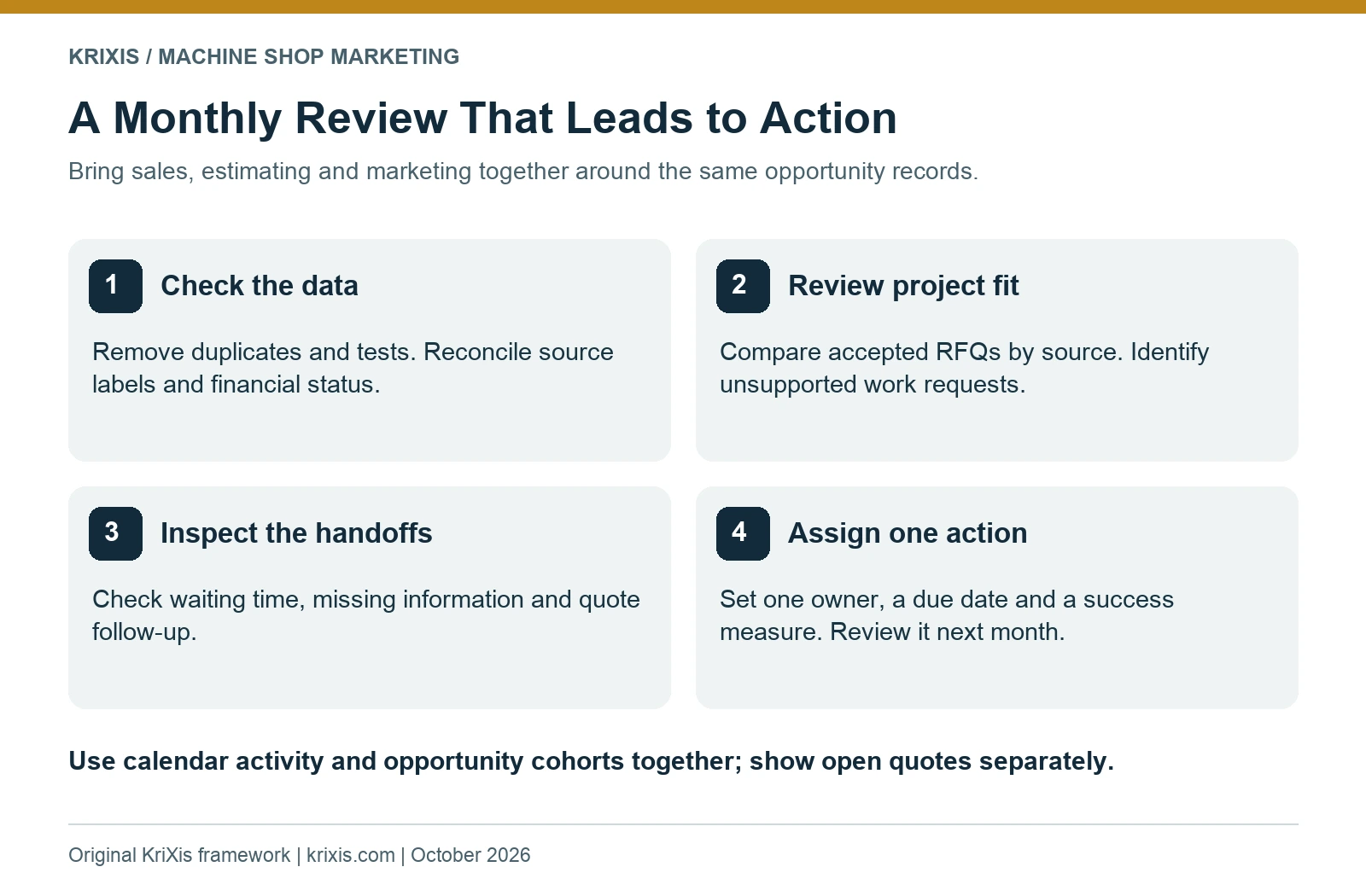
First, check the data. Confirm that tests and spam are excluded, revisions are not duplicated, source labels are consistent, and won work has the right financial status. If the data is incomplete, assign a correction before making a strong performance claim.

Second, examine fit. Which channels create suitable projects? Which create repeated requests for unsupported materials, sizes, quantities, or documentation? Ask whether capability pages or campaign targeting accurately describe the operation.

Third, inspect the handoffs. How long do accepted RFQs wait? Are missing-information requests assigned? Are quotes followed up according to the buyer’s decision timing? A marketing report should make these delays visible so the responsible team can resolve them.

Finally, choose one action, an owner, a due date, and a measure of success. Examples include clarifying a capability limit, repairing form delivery, recording loss reasons, or standardizing the handoff to estimating. Review the action at the next meeting.

Four monthly review steps: check data, review fit, inspect handoffs and assign an action
Review data quality, project fit and handoffs, then assign one owner, due date and success measure. View full-size infographic

Diagnose the bottleneck before increasing spend

If relevant visits rise but valid inquiries do not, review capability clarity and the inquiry path. Our machine shop website design service focuses on helping buyers evaluate fit and take the next step.
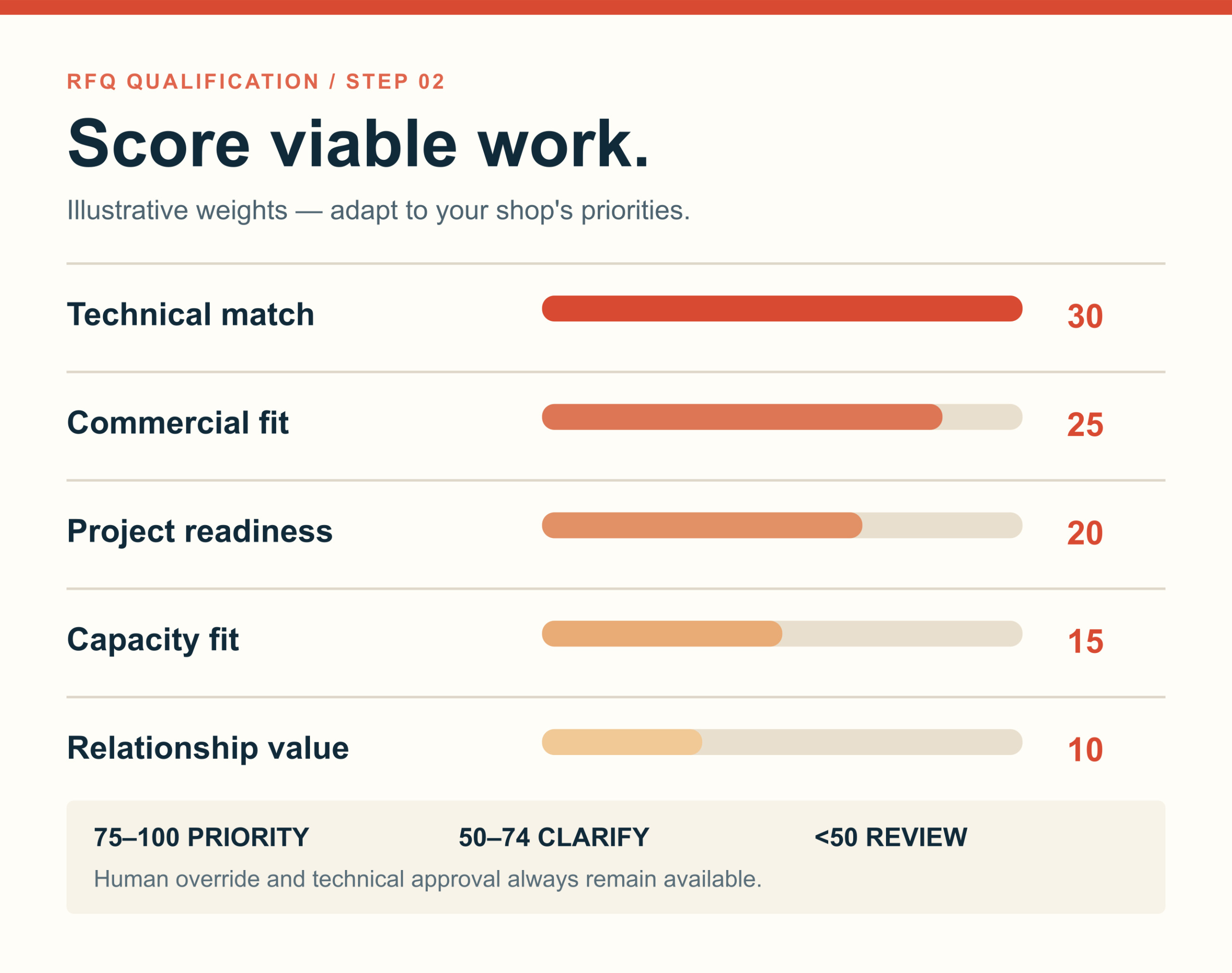
If inquiries increase but qualification falls, review targeting and the work your content implies you accept. If qualified RFQs wait without quotes, investigate capacity and missing information. If suitable quotes repeatedly lose, review the buyer’s feedback, timing, commercial terms, and technical requirements.

Quality professional inspecting an aluminum housing before delivery

If won orders do not produce healthy contribution, inspect the job economics with operations and finance. More demand cannot resolve an unfavorable production mix by itself. The response may involve refining preferred work or reviewing assumptions before scaling acquisition.

KriXis’s machine shop lead generation services connect discovery, website conversion, and follow-up. The measurement review helps identify which part of that process needs attention first.

Build a reliable baseline in the next 30 days

In week one, agree on opportunity definitions, fit criteria, source categories, and the financial basis. In week two, test the inquiry path and start recording new opportunities consistently. In week three, reconcile a recent sample with sales and estimating. In week four, produce the first scorecard and assign one improvement.

Treat that first month as a baseline-building exercise. It can reveal broken delivery, incomplete records, or poor fit quickly. It may not provide enough decided or delivered work to support a meaningful ROI conclusion.

Continue following the original cohort as it matures. Preserve unknown values and document revisions to the calculation. A useful measurement system becomes more informative as the team maintains it.

Turn the scorecard into a practical improvement plan

Get help defining your measurement gaps and the next practical improvement.

Request your marketing measurement review

Common questions about machine shop marketing ROI

Should we measure RFQs or revenue?

Measure both at their appropriate stages. Qualified RFQs help evaluate current demand and fit, while delivered revenue and contribution help assess completed outcomes. Show the relationship and timing rather than combining them into one score.

What is a good cost per qualified RFQ?

There is no universal target. It depends on project economics, quote success, customer value, estimating effort, and your capacity. Use your own history and clearly stated assumptions to decide what is acceptable.

Can we start without a CRM?

Yes. A consistently maintained record with defined stages and an assigned owner can establish a baseline. Move to a CRM when collaboration, volume, reminders, or reporting needs justify it.

Does downloading the worksheet count as a qualified lead?

No. A download indicates resource interest. A qualified RFQ requires the agreed project and fit criteria to be reviewed. Keep those actions separate in reporting.

October 9, 2026/1 Comment/by Matthew Borza
https://www.krixis.com/wp-content/uploads/2026/10/machine-shop-marketing-roi-hero.webp 1024 1536 Matthew Borza https://krixis.com/wp-content/uploads/2015/12/KriXis-Full-Logo-Trans-300x79.png Matthew Borza2026-10-09 21:09:442026-10-11 02:02:22How to Measure Machine Shop Marketing ROI: From RFQ to Won Work
Machine Shop Marketing

How to Qualify Machine Shop Leads: An RFQ Scorecard and Follow-Up Playbook

An inbox full of quote requests can look like a healthy pipeline. It can also keep an estimator busy with work the shop cannot produce, undefined projects, and repeat requests that never become orders. RFQ volume alone does not tell you whether inquiries match your equipment, quality system, capacity, or business goals.

To qualify machine shop leads, decide what happens next: quote, clarify, route, hold for capacity, or decline with an explanation. The process should support consistent responses without making buyers complete a long application.

This guide gives shop owners and sales teams a practical way to separate hard fit requirements from judgment calls, score viable opportunities, and follow up after a quote. The scorecard is a starting template. Adapt its weights and thresholds to your own equipment, margins, capacity, and customer mix.

Estimator reviewing an engineering drawing and machined component at a machine shop

What makes a machine shop lead qualified?

A qualified lead is an opportunity your shop has reason to pursue, not merely an inquiry with complete contact fields. At minimum, there should be a real project, a reachable person, and enough information to decide whether a useful next conversation is possible. For a quote-ready RFQ, you also need a workable technical definition and commercial context.

Qualification is shop-specific. A prototype that fits a five-axis job shop may be poor work for a high-volume turning operation. A 10,000-part request may be attractive to one shop and impossible for another. Fit depends on the operation receiving it.

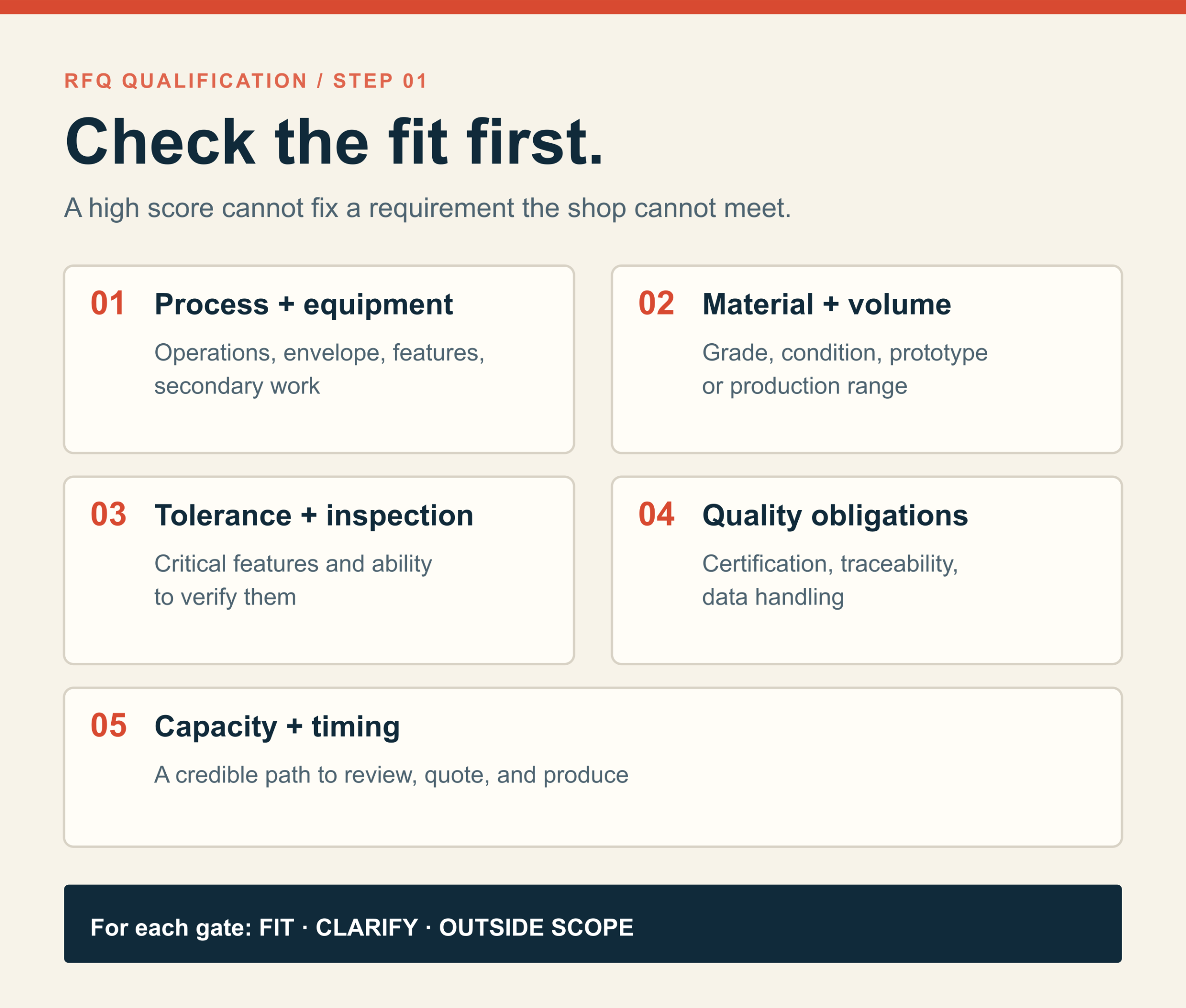
Use two decisions in order. First, test for nonnegotiable fit: process, part envelope, material, quality obligations, and any confidentiality or compliance requirement you must be able to meet. Second, prioritize the opportunities that pass using a flexible score. This prevents a high dollar estimate from masking a job you cannot safely deliver.

CNC machine and inspected aluminum component illustrating technical fit
Verify actual process, material, envelope, and inspection capabilities before accepting work.

Start with five fit gates

  1. Process and equipment. Can your current machines and partners perform the required operations? Record axis needs, part envelope, features, and required secondary processes. A broad label such as “CNC machining” is not enough to answer this.
  2. Material and production range. Can you source and machine the specified material, in the stated condition, at the intended prototype or production volume? Ask whether alternate materials or lot sizes are permitted rather than assuming they are.
  3. Tolerance and inspection. Can you verify the critical characteristics with your equipment, methods, and staff? If a requirement is unclear, route it for engineering review before promising a result.
  4. Quality and contractual obligations. Does the project require a certification, traceability package, controlled data handling, first article inspection, or customer approval process your shop can actually provide? Never imply a certification you do not hold.
  5. Capacity and timing. Can you review, quote, and—if awarded—produce within a credible schedule? A date is a constraint to discuss, not a number to accept automatically.

A gate can have three outcomes: fit, needs clarification, or outside current scope. “Needs clarification” deserves an owner and a question, not an automatic rejection. For example, a tight tolerance may apply to only one feature. A short call can resolve whether your inspection plan is adequate.

Five machine shop RFQ fit gates: process, material, tolerances, quality obligations, and capacity

Use a scorecard only after the gates

Once an inquiry passes the fit gates, a simple scorecard helps the team make consistent tradeoffs. Do not treat the result as an algorithmic quote decision. It is a triage aid that shows why an opportunity deserves more attention and what information is still missing.

Here is a sample 100-point model to adapt:

DimensionPointsWhat to look for
Technical match30Work fits proven processes, materials, tolerances, inspection, and partner network.
Commercial fit25Quantity, repeat potential, likely order value, and payment or purchasing terms fit your business.
Project readiness20Current revision, usable files, decision timeline, and a clear next step are available.
Capacity fit15The shop has a realistic window to quote and produce without disrupting committed work.
Relationship value10The buyer fits a target market, is a current customer, or offers a credible path to repeat work.

Suggested routing, not an industry benchmark: 75–100 points gets priority review; 50–74 gets a clarification or discovery step; below 50 gets a limited review or a polite decline if a required gate fails. A repeat customer, strategic account, or urgent problem can warrant an override. Record the reason, so the scorecard remains accountable to human judgment.

Avoid scoring a lead down because the buyer does not know machining terminology. An engineer may have a complete print but no purchasing authority; a founder may have a promising prototype and need help defining specifications. Ask which missing information changes your ability to quote. Do not make every unanswered field look like a disqualifier.

Sample 100-point RFQ scorecard: technical match 30, commercial fit 25, readiness 20, capacity 15, relationship 10

Example: two RFQs, different next steps

RFQ A: A purchasing manager submits a revised drawing, material specification, annual usage, first-order quantity, required documentation, and target date. The part fits a process your shop runs weekly. It passes the gates and earns a high score. Assign an estimator, acknowledge receipt, and give a realistic date for the next update.

RFQ B: A product team asks about a small prototype with an attractive long-term market, but sends an early model without critical tolerances or a controlled revision. The technical gate is not yet resolved. Send two or three specific questions and offer a short technical conversation. Quoting from assumptions would create more risk than value; discarding the lead would be premature.

Both inquiries deserve a response. They do not need the same response.

Collect enough information without building a form obstacle course

Your website’s RFQ path begins qualification. It should let buyers submit what they have and explain what the shop needs next. A “name, email, message” form pushes basic questions into the inbox. Demanding every technical detail can stop an early-stage buyer before a conversation begins.

Start with the essentials: contact name, company, business email, project description, process if known, estimated quantity, desired date, and an optional secure file upload or approved file-transfer method. Then use conditional fields for material, finish, quality documentation, and repeat volume when they matter to your work. Label optional information honestly. Explain which files you accept and what happens after submission.

For technical files, preserve the original attachment and revision. Ask the buyer to identify which drawing or model controls when multiple versions are sent. NIST’s model-based enterprise work illustrates why design data and its authority matter across supplier handoffs; a shop should not silently reconstruct requirements from a partial file. NIST describes the manufacturing data exchange problem in its Model-Based Enterprise Summit proceedings.

Sensitive drawings also need a deliberate handling path. Restrict access to the people reviewing the opportunity, use approved storage, and protect the accounts that hold the files. CISA recommends multifactor authentication for business systems that contain sensitive information. If a customer requires an NDA, export-control review, or other special handling, route that requirement before files circulate through ordinary marketing tools.

Estimator desk with a laptop, drawing, and sample part illustrating RFQ intake
The best first form captures a useful starting point and leaves room for a technical conversation.

Make the first review a repeatable workflow

The qualification process should answer three questions quickly: Who owns this? What is missing? When will the buyer hear from us? A shared inbox alone does not answer them. A CRM or lead log does not need to be elaborate, but each RFQ should have a source, owner, status, last contact, next action, and outcome.

Use a short sequence:

  1. Capture and acknowledge. Record the original source—organic search, paid ad, referral, returning customer, or other channel. Confirm that the RFQ arrived, without promising a quote date before the team reviews it.
  2. Check the gates. A trained owner checks process, material, envelope, quality, capacity, and handling requirements. Mark uncertain facts as open questions.
  3. Assign the next action. Route fit leads to estimating. Route unclear leads to a named person for clarification. Route out-of-scope work to a courteous decline or a vetted referral, when appropriate.
  4. Score viable opportunities. Use the scorecard to set review order when several qualified RFQs compete for limited estimator time. Keep the score and the reasoning together.
  5. Set a follow-up date. Once a quote is sent, record when the team will check for feedback, the buyer’s decision timing, and any blocker identified.

Give each status a clear definition. “New” means unreviewed; “clarification needed” means a specific question is waiting on a specific person; “estimating” means the team has accepted the quote task; “quoted” means the buyer received a reviewed offer. These definitions prevent an inquiry from appearing active while nobody owns the next step.

Two manufacturing professionals reviewing a component and drawing during RFQ triage
Qualification should surface technical questions for a qualified person to resolve.
RFQ handoff workflow from inquiry and fit review to estimating, quote, buyer follow-up, and outcome tracking

Keep people in charge of technical and commercial promises

An intake tool can flag missing fields, organize files, and prepare a draft acknowledgement. It should not independently decide manufacturability, capacity, price, tolerance, certification, or delivery. Our separate guide to AI-assisted machine shop RFQ responses covers where automation can help while a person reviews the result.

The same rule applies without AI. A salesperson should be able to say, “We have your request and are reviewing the drawing,” without implying that the shop has accepted the work. A technical reviewer should be able to return a clear question before the buyer receives a price based on unstated assumptions.

Write responses that move the opportunity forward

The first response should make the buyer feel heard and establish the next action. It does not need a lengthy sales pitch. Use templates as a starting point, then tailor them to the actual project.

For a quote-ready RFQ: “Thanks for sending the drawing for [part/project] at revision [X]. We have the requested quantity and target date. [Name] is reviewing the technical requirements and will update you by [date]. If we identify a question that changes the quote basis, we will contact you before proceeding.”

For missing information: “We can review this for fit. Before we quote, could you confirm [specific question 1] and [specific question 2]? We have [files received], and want to make sure we use the correct revision. If a short call is easier, we can review those points together.”

For work outside the shop’s scope: “Thank you for considering us. This project requires [process or requirement] that we do not currently offer, so we should not quote it as though we can perform it. If the specification changes or you have a future project in [actual capability], we would be glad to review it.”

In each case, use a real owner and a real next date. Do not publish a blanket “24-hour quotes” promise unless your shop can deliver it for the RFQs that matter. A timely, specific update is more useful than an automatic message that says nothing about the project.

Follow up on quoted work without chasing blindly

Qualification does not end when the price goes out. A quoted project can stall because the buyer is waiting on internal approval, comparing suppliers, changing the design, or shifting the launch schedule. A follow-up should ask about the decision process and help resolve an obstacle, not simply ask whether the quote was received again.

At quote delivery, capture the revision quoted, quantity breaks, assumptions, exclusions, validity period, and buyer’s stated decision timing. Schedule a check-in based on that timing. If the buyer is still evaluating, ask whether price, lead time, documentation, or a technical point needs clarification. If the project is paused, record a future contact date rather than treating it as lost. If the order goes elsewhere, ask what you can learn, and distinguish price from capability, timing, and supplier qualification.

This history helps the next RFQ. It also helps marketing. A lead source that brings many form fills but few fit opportunities may be less valuable than a smaller source that consistently reaches your preferred work. KriXis’s machine shop lead generation service connects search and paid traffic with RFQ conversion and follow-up; this scorecard gives that system a clearer definition of “qualified.”

Estimator reviewing a part and workflow on a tablet during quote follow-up
A quote should have an owner, decision context, and next follow-up date.

Measure the pipeline you actually want

Do not stop at website traffic or form submissions. Track the path from inquiry to work your shop wants to accept. A simple monthly view can include:

  • Inquiries by source and the percentage that pass the hard fit gates
  • Time from receipt to first useful human response
  • Percentage of viable RFQs that reach a quote
  • Quote turnaround time by project type, measured from receipt of enough information
  • Quotes won, lost, paused, or still open, with the reason when known
  • Revenue and repeat work from awarded opportunities, tied back to source

Define the denominator before comparing months. A “quoted RFQ” should not include an auto-reply, and “response time” should distinguish acknowledgement from substantive review. Review sudden changes: a campaign may look worse after a form captures more early-stage buyers, or better after staff close incomplete requests without quoting.

If you lack a CRM, start with a shared spreadsheet and one accountable owner. Move to a more integrated system when the process is stable. KriXis has long emphasized connecting the front end of marketing to the back end of machine shop CRM; the qualification fields are what make that connection useful.

Put the system in place over 30 days

Week 1: Audit recent inquiries. Pull the last 20 to 30 RFQs if available, including won, lost, declined, and unanswered opportunities. Record source, technical fit, missing information, response time, quote status, and outcome. Use the review to identify the questions that genuinely determine fit for your shop.

Week 2: Agree on gates and ownership. Write the five gates in shop-specific language. Decide who can mark a job out of scope, who approves exceptions, and who owns clarifications. Choose a small set of statuses that everyone understands. Establish approved language for receipt, clarification, and decline.

Week 3: Pilot the scorecard. Have two people independently review several new RFQs and compare scores. Disagreement is useful: it shows where a dimension or weight needs a better definition. Do not let the point total overrule an engineer’s concern or a contractual requirement.

Week 4: Connect the website and reporting. Adjust the RFQ form only where the audit shows a real information gap. Test file handling and confirmation. Review the first month’s source-to-quote path and decide which marketing channels and page topics are bringing qualified work. The machine shop website design service explains how capability proof and a clear RFQ path fit together.

The goal is a usable routine. A team that records the same facts and assigns each next action will learn more than one with a dashboard nobody maintains.

Frequently asked questions

Should we require a drawing before talking to a lead?

Require enough information for the next decision, not necessarily a complete drawing for the first conversation. Some early-stage buyers are validating a concept or supplier fit. If a drawing is essential to price or feasibility, explain that and offer a clear path to submit it securely. Do not quote a technical requirement you have not reviewed.

What if a promising customer scores below our threshold?

Use the score to flag the reason, then allow a documented human override. A strategic buyer may have an incomplete first RFQ but strong long-term fit. Assign a discovery step instead of pretending the project is quote-ready or discarding it.

How often should we change the scorecard?

Review it monthly during the pilot, then when your capacity, capabilities, customer mix, or win patterns change. Compare scored leads with actual quotes and awarded work. If the model rewards activity that does not produce good jobs, change the model.

Turn better inquiries into better work

More leads only help when your shop can recognize the right opportunities and respond well. Begin with hard capability gates, use a flexible score for viable RFQs, assign every next step, and learn from the outcome. That is how a lead generation program becomes a reliable path to the work your shop wants.

If you want to connect your website, search visibility, RFQ intake, and follow-up, talk with KriXis about your machine shop’s growth goals.

Next, connect qualification to commercial outcomes with our machine shop marketing ROI guide. Use the free RFQ scorecard and ROI worksheet to build a consistent reporting baseline.

Sources and further reading

  • NIST: Model-Based Enterprise Summit proceedings — manufacturing data authority and supplier handoffs.
  • CISA: Require Multifactor Authentication — protecting systems with sensitive business data.
  • Google Search Central: SEO Starter Guide — guidance for clear, useful search content.
October 7, 2026/8 Comments/by Matthew Borza
https://www.krixis.com/wp-content/uploads/2026/10/machine-shop-rfq-lead-qualification-hero.webp 941 1672 Matthew Borza https://krixis.com/wp-content/uploads/2015/12/KriXis-Full-Logo-Trans-300x79.png Matthew Borza2026-10-07 07:08:462026-10-11 02:03:09How to Qualify Machine Shop Leads: An RFQ Scorecard and Follow-Up Playbook
Machine Shop Marketing

How Machine Shops Can Use AI to Respond to RFQs Faster—Without Risking Customer Data

An RFQ is not just a form submission. It may include drawings, material requirements, quantities, timing, quality requirements, and the first signal that a buyer is looking for a long-term supplier. When it sits unanswered, gets routed to the wrong person, or loses its context between inboxes, a real opportunity can quietly disappear. An AI RFQ response for machine shops starts by making that first handoff clear.

AI RFQ response for machine shops can improve that handoff—but it should not replace engineering judgment, promise a price, or make technical decisions without review. The practical opportunity is simpler: use AI to organize incoming requests, prepare a complete internal summary, draft a human-reviewed response, and ensure the follow-up happens.

For a shop trying to turn more website visits into qualified conversations, that is a meaningful improvement. It connects the front end of marketing with the back end of the sales process, which is the same principle behind a well-configured machine shop CRM.

AI RFQ response for machine shops: where RFQ response breaks down

Most quoting delays are not caused by a lack of effort. They come from incomplete information and scattered processes. A buyer may submit a drawing through a website form, add a short note, and expect the shop to know what matters next. The request then lands in a general inbox, is forwarded manually, and waits while someone determines whether the job fits the shop’s capabilities.

The common points of failure are predictable:

  • An inquiry arrives outside normal hours and receives no acknowledgement.
  • The form misses a drawing, quantity, material, or target date.
  • A capable lead is mixed in with low-fit or incomplete requests.
  • A salesperson or estimator has to reread an email thread to recover context.
  • A quote is sent, but no one has a dependable reminder to follow up.

None of these require an autonomous sales robot. They require a clearer workflow.

The best AI role: prepare the work, not approve it

For most shops, AI is most useful as a controlled assistant. It can perform repeatable, low-risk tasks around the RFQ while a qualified person retains responsibility for feasibility, pricing, lead time, quality requirements, and the final customer communication.

A disciplined AI-supported workflow can look like this. An AI RFQ response for machine shops should make the next human decision easier, not obscure it:

  1. Capture the RFQ in one place. Route website forms, designated email inboxes, and relevant messages into the shop’s CRM or lead system. Preserve the original source and attachments.
  2. Create a structured internal summary. AI can extract stated details—such as process, material, quantity, target delivery date, industry, and attached files—into a reviewable summary. It should clearly mark information it could not find rather than inventing an answer.
  3. Check for missing information. A draft response can ask for the specific items needed to begin a review: drawing revision, material, quantity, tolerance, certification, finish, delivery requirement, or other shop-defined fields.
  4. Route by rules the shop controls. For example, send repeat customers, a particular process, or a defined size range to the right estimator. Route out-of-scope work to a review queue rather than automatically rejecting it.
  5. Draft the acknowledgement and follow-up. AI can prepare a concise, professional response using approved language. A team member reviews it before it is sent.
  6. Keep the opportunity visible. Create follow-up tasks after the quote is delivered, document buyer responses, and report on the source and outcome of each lead.

That process reduces administrative friction without turning a sensitive technical decision into a black box.

A practical RFQ intake checklist

Before implementing any automation, decide what a qualified request means for your shop. The website form and internal workflow should make it easier for buyers to provide useful information, not create an obstacle course.

For many machining RFQs, a practical intake checklist includes:

  • Contact name, company, email, and phone number
  • Part drawing, model, or clear description of the work
  • Process or capability needed, if known
  • Material and any required finish
  • Quantity, including prototype versus production context
  • Critical dimensions, tolerances, or inspection requirements
  • Required certifications or industry requirements
  • Target delivery date or project timeline
  • Any confidentiality requirement or NDA process

Not every request will contain every item. The goal is to capture what is present, identify what is missing, and make the next human conversation more productive.

What should never be left to an AI tool alone

An AI assistant can be helpful around a quoting workflow, but it cannot know a shop’s actual capacity, tooling condition, supplier availability, machine constraints, or risk tolerance unless those facts are deliberately supplied and maintained. Even then, a responsible shop should keep human approval in the loop for decisions that affect the customer.

Do not let an AI tool independently:

  • Commit to a price, delivery date, capacity, or certification status
  • Interpret an ambiguous drawing as a final engineering requirement
  • Claim that a job is manufacturable or meets a tolerance
  • Send customer drawings, controlled technical data, or confidential information to an unapproved system
  • Reject a lead solely on an automated score without a review path

The right standard is simple: automate the preparation and reminders; keep technical and commercial commitments with accountable people.

Protect customer information in an AI RFQ response for machine shops

Customer drawings and RFQ data may be commercially sensitive. Before connecting an AI tool to a website, inbox, or CRM, document what data is allowed to enter the system, who can access it, how long it is retained, and whether the provider’s terms fit the shop’s obligations to customers.

Start with a limited pilot. Use a small set of non-sensitive or permissioned inquiries, require a human review before any outbound message, and track errors. Keep the original RFQ available so an estimator can compare the AI summary against the source material. The NIST Generative AI Profile is a useful framework for thinking through these controls, including risk management across the AI lifecycle.

For many shops, the first phase should work only with the contact details and text supplied in a form—not the drawing itself. Once the workflow is proven and the security review is complete, the team can decide whether it is appropriate to extend the system.

AI does not replace the RFQ path on your website

AI follow-up cannot compensate for a website that makes it hard for a buyer to understand the shop’s capabilities or submit a request. The site still needs accurate process pages, real capability proof, clear contact options, and a useful RFQ form.

KriXis’s Machine Shop SEO in 2026 guide explains how a buyer-focused site connects search visibility, technical credibility, and conversion. This is especially important as buyers use more detailed search queries and AI-assisted research. Google’s guidance remains clear: the foundation is helpful, reliable, people-first content and sound technical SEO—not a special AI markup trick. Google’s AI features guidance confirms that the same technical and content fundamentals apply.

In other words, build the website and the RFQ process for people first. Use AI to make the internal response process more consistent.

How to launch an AI RFQ response for machine shops in 30 days

The best first version is intentionally narrow. Do not try to automate every sales process at once.

Week 1: Map the current path

Follow three to five recent RFQs from source to outcome. Record where each request came from, who touched it, when it received a response, what information was missing, and whether it received a follow-up after a quote was sent. This baseline reveals the actual bottleneck.

Week 2: Define the rules and approved language

Create a shop-specific intake checklist and routing rules. Write approved acknowledgement and information-request templates. Decide which decisions always require a human review. This is the work that makes automation trustworthy.

Week 3: Pilot with one channel

Start with website RFQ forms or a dedicated inquiries inbox. Have AI create an internal summary and a draft response, but require staff approval before the draft is sent. Correct problems immediately and update the rules rather than working around them.

Week 4: Measure the result

Review first-response time, completeness of intake, qualified RFQs, quote turnaround, follow-up completion, and the source of closed opportunities. Those metrics are more useful than counting how many messages AI drafted.

The outcome to aim for

The purpose is not to sound more automated. It is to make a serious buyer feel that the shop is organized, responsive, and able to understand the work. A better RFQ process gives estimators more time for the judgment that matters and gives marketing a clearer connection to revenue.

If your shop is investing in SEO, paid ads, or capability content, make sure the inquiry path and follow-up system can hold onto the opportunities that work creates. KriXis helps manufacturers connect website visibility, RFQ conversion, and CRM follow-up into one measurable growth system. Start a conversation with KriXis.

Sources

  • Google Search Central: AI features and your website
  • Google Search Central: guidance on generative AI content
  • NIST: Generative AI Profile

Why faster response matters before the quote is written

Speed is not a promise that every quote will arrive instantly. Good manufacturing work deserves careful review. Speed means that a buyer quickly knows the request reached the right team, understands what information is needed next, and is not left guessing whether the shop is interested. That early clarity is especially valuable for procurement teams managing several suppliers at once.

A short, accurate acknowledgement can do more for trust than a generic “we received your message” email. It should identify the next step, distinguish a request for missing information from a commitment to quote, and make it easy for the buyer to reply with the needed document or detail. The person reviewing the job can then focus on the work that genuinely needs expertise: machine fit, process route, tooling, inspection, subcontract work, scheduling, and commercial risk.

AI can make that first handoff more consistent because it is good at organizing repeatable information. It is not a substitute for the estimator. Think of it as the person who prepares a clean job folder, labels the attachments, highlights unanswered intake fields, and drafts the first note—then places it in front of an accountable employee for review.

Machine shop estimator reviewing an RFQ checklist before approving a quote response
AI should prepare the work around an RFQ; the shop’s people remain responsible for technical and commercial judgment.

Build the workflow around the buyer’s questions

Every RFQ workflow should begin with the questions a serious buyer needs answered. Can this shop make the part? Does it understand the requirements? Is there a practical next step? Who owns the conversation? A good process supports those questions even when the buyer’s original message is brief.

Create a small, approved knowledge base for the team. This is not a public marketing brochure copied into an AI prompt. It is a controlled reference set: standard acknowledgement language, lists of the information needed for different job types, routing rules, definitions of out-of-scope work, trusted CRM fields, and escalation contacts. Keep it factual and easy to update. If the shop changes a capability, certification, service area, or response policy, update the source before using it in automation.

Use categories that match real shop decisions. A five-axis prototype request, production CNC turning inquiry, repair job, and aerospace part with documentation requirements may all need different reviewers and different questions. The more the workflow reflects the shop’s actual operating model, the less likely it is to produce an impressive-looking but unusable summary.

Use a clear “missing information” branch

One of the highest-value uses of AI is drafting a respectful request for information. Rather than assume a material, tolerance, finish, or quantity, the system can flag the omission and present a concise list for the buyer. The message should explain why the information matters: for example, that it helps the team determine the right process or provide a useful quote. Avoid long generic questionnaires. Ask only for the next detail the team truly needs.

Keep the original language from the buyer visible alongside the summary. This makes it easy for an estimator to catch a nuance that a system may have missed, such as a revised drawing, a request for partial delivery, a special inspection note, or an unusual material callout.

Choose the first automation carefully

Do not start by connecting every inbox, shared drive, and ERP record. Begin with one low-risk, high-volume step where the outcome is easy to inspect. For many shops, that is website form intake. The form already has a defined structure, the source is clear, and the information is intended for the sales conversation.

A useful first automation might create a CRM record, preserve the original form submission, assign the lead owner, list the supplied fields, flag missing items, and prepare an internal task. The only external message is a human-approved acknowledgement. Once that path works reliably, the team can test a dedicated RFQ email inbox, quote follow-up reminders, or reactivation of prior buyers.

Set success criteria before the pilot starts. For example: every web inquiry appears in the CRM, an owner is assigned, missing fields are correctly flagged, and no unreviewed technical claim is sent to a customer. If the system does not meet those conditions, improve the workflow before broadening it.

Make the data structure useful to people

The quality of an AI-assisted workflow depends on the quality of the information it receives. A CRM should not become a pile of summaries that no one trusts. Use a small set of fields that the sales and estimating teams will actually review: source, buyer company, primary contact, capability or process requested, material, quantity, industry, stated timeline, status, lead owner, next action, and outcome.

Separate facts from interpretation. “Buyer stated 500 pieces in 6061 aluminum” is a fact. “High-value production opportunity” is an interpretation and should be labeled as such. When a summary is uncertain, it should say “not stated” or “needs review.” This preserves confidence in the system and prevents an AI-generated guess from turning into a sales assumption.

It also creates better marketing intelligence. When source, capability, and outcome are consistently recorded, a shop can see whether a service page, paid campaign, referral partner, or industry topic is producing inquiries that the team can actually quote and win. That is much more useful than traffic alone. KriXis’s digital marketing services are built around connecting visibility to measurable business activity.

Human-reviewed AI RFQ workflow for machine shops from capture through follow-up
AI organizes the request, while people review and approve the work that affects customers.

Set guardrails before the system touches customer data

Guardrails are not a technical afterthought; they are part of the customer experience. A buyer who trusts a shop with a drawing or project detail expects it to be handled carefully. Before introducing an AI tool, identify the data categories the shop receives and decide what is permitted in each system.

At a minimum, document who can access RFQ information, which vendor accounts are approved, how long the information is kept, what happens when an employee leaves, and how the team handles an NDA or customer-specific requirement. Review the tool’s data-use and retention terms with the person responsible for customer commitments. If there is uncertainty about controlled information, export-controlled work, or a client restriction, keep that data out of the pilot until qualified advice and a clear policy are in place.

Use least privilege. A marketing assistant may need to see lead source and a follow-up status but not every attached drawing. An estimator may need the complete job package. Role-based access is often more valuable than adding another feature because it limits unnecessary exposure while keeping the process usable.

Create an exception queue

Not every RFQ belongs in the normal flow. The workflow should flag requests that are incomplete, have unusual requirements, appear to contain sensitive data, or fall outside defined rules. A visible exception queue is better than silently routing a request to the wrong person or allowing the system to make a confident-looking assumption.

Give the team an easy way to correct the system. If an AI summary mislabels a process, fails to recognize an attachment, or suggests the wrong follow-up question, staff should be able to mark the correction. Review those corrections weekly. They show where the form, routing rules, or reference material needs improvement.

Design human review so it does not become a bottleneck

“Human in the loop” should not mean copying and pasting every message from one screen to another. It means building a review interface that makes the correct decision easier. Place the original inquiry, attached files, extracted facts, unanswered fields, suggested owner, and draft reply in one view. Make the reviewer choose an action: approve, edit, request information, reassign, or close as not a fit. Record the reason when appropriate.

Approved response templates help. For example, a standard acknowledgement can confirm receipt without promising pricing or delivery. A separate template can request missing information. A third can explain that a job is not within the shop’s current capability. Each message should be plain, professional, and tailored by a reviewer to the buyer’s actual request.

Technical decisions should have clear ownership. If an estimator needs a programmer, quality lead, or production manager to assess a requirement, the workflow should create the right internal task rather than encouraging a sales person to guess. AI can summarize the question for the specialist; it cannot replace the specialist’s sign-off.

Connect follow-up to real buyer value

Follow-up should not be a stream of automated “just checking in” notes. The best follow-up offers a useful next step: clarification on a requirement, an updated delivery question, a request to confirm a revision, a scheduling conversation, or a concise reminder that the quote is available. Use the shop’s actual sales cycle and buyer type to determine the timing.

AI can help create the task and prepare a draft, but a salesperson should decide whether the message is timely and relevant. When a buyer replies, preserve that context in the CRM so the next person does not restart the conversation from zero. This is where a connected CRM changes the experience from a marketing lead to a managed opportunity.

Measure your AI RFQ response for machine shops weekly

A useful scorecard tells the team where the system is weak. If response time is slow, investigate ownership and routing. If too many inquiries are incomplete, improve the RFQ form and the information-request template. If quote follow-up is inconsistent, make the next action visible. If a traffic source creates many low-fit requests, refine the associated marketing message or landing page.

Do not use the scorecard to claim that AI “caused” revenue before there is enough evidence. Use it to identify operational improvements and connect them to outcomes over time. Compare performance against the shop’s own baseline, not a generic industry promise. The goal is a more reliable process, not a vanity dashboard.

Machine shop AI RFQ response scorecard for response time, complete RFQs, quote turnaround, follow-up, and source-to-revenue
Five measures that make RFQ workflow improvements visible.

Questions to ask before choosing an AI or automation partner

Tools can be useful, but the vendor conversation should begin with the workflow, not a feature list. Ask how the tool handles data, whether outputs can be reviewed before they are sent, how it integrates with the CRM, what is logged, how access is controlled, and how the team can correct an error. Ask which parts of the process remain under the shop’s control.

  • Can we preserve the original RFQ and attachments alongside the generated summary?
  • Can we require human approval for every outbound buyer message?
  • Can the system state what it does not know rather than fabricating a field?
  • Can we limit access by role and remove access promptly when needed?
  • Can we audit routing, edits, and approvals later?
  • Can the workflow keep source attribution through to qualified opportunity and revenue?

If the answer to those questions is unclear, the solution may be too immature for a customer-facing quoting workflow. Start with a smaller use case or choose a partner that can explain the controls in plain language.

A practical next step: AI RFQ response for machine shops

Choose one RFQ source and map it from first contact to final outcome. Identify where the request loses context, where a buyer waits unnecessarily, and where staff spends time moving information rather than assessing the work. Then design the smallest change that improves that point. For many shops, that is a structured web form, a connected CRM record, a human-reviewed acknowledgement, and a clear follow-up task.

Once the fundamentals are reliable, AI can make the system faster and more consistent. It should reinforce the shop’s professionalism—not create new uncertainty. The shops that benefit most will be the ones that pair capable technology with accurate capability information, accountable people, and a clear process for turning interest into a useful RFQ conversation.


September 29, 2026/1 Comment/by Matthew Borza
https://www.krixis.com/wp-content/uploads/2026/09/krixis-ai-rfq-response-machine-shop-hero.png 941 1672 Matthew Borza https://krixis.com/wp-content/uploads/2015/12/KriXis-Full-Logo-Trans-300x79.png Matthew Borza2026-09-29 05:56:522026-10-11 02:03:48How Machine Shops Can Use AI to Respond to RFQs Faster—Without Risking Customer Data
Machine Shop Marketing

Machine Shop SEO in 2026: A Practical RFQ Growth Guide

Updated September 2026.

Machine shop SEO should help the right buyers find clear evidence of capability, understand whether a shop fits their need, and begin a more useful RFQ conversation. It is not a traffic contest, and it is not a shortcut to sales. The strongest program connects search visibility with technical credibility, a practical website experience, and a follow-up process that does not lose context.

This guide is a practical starting point for machine shops that want to improve qualified search visibility without relying on thin location pages, keyword stuffing, or performance promises they cannot substantiate.

Engineer reviewing a CAD drawing beside a CNC machining center
Search visibility earns attention; accurate capability proof and a clear RFQ path turn it into a useful business conversation.

What machine shop SEO should actually produce

A useful SEO program improves four things at the same time:

  • Qualified discovery: buyers can find pages relevant to a real process, material, application, or manufacturing need.
  • Capability confidence: the website answers practical questions with accurate, current information.
  • A clear next step: prospective customers can move from research to an RFQ or consultation without friction.
  • Better measurement: the team can see which pages and channels contribute to qualified inquiries.

That standard keeps the work focused on business development. A high impression count or a temporary ranking change is useful context, but it does not replace a buyer who understands the offer and has an easy way to reach the right person.

1. Publish capability proof buyers can evaluate

Start with the information a prospective customer actually needs to evaluate a shop. Build or improve pages around the processes, materials, part characteristics, industries, and production situations your team can accurately support. Explain the work in clear language and avoid vague claims such as “best quality” or “any part, any time.”

Useful capability proof can include equipment context, material experience, process explanations, inspection and communication practices, non-confidential examples, and honest guidance on preparing an RFQ. If a page references a tolerance range, certification, quantity, or turnaround expectation, make sure it is current and verifiable before publishing.

Original photos also matter. A clean image of a process, inspection step, engineering discussion, or finished component can help a buyer understand the work far more quickly than generic stock photography. Each image should earn its place beside relevant content and use accurate alternative text.

2. Map search intent to real RFQ paths

Buyers rarely search only for a company name. They may search for a machining process, a material, a part type, an industry application, a manufacturing problem, or a supplier in a particular geography. The goal is not to build hundreds of nearly identical pages. It is to make the most relevant page genuinely useful for the question behind the search.

Review core pages through a buyer’s lens. Can someone understand what the shop does, who it serves, what information to include with an RFQ, and where to go next? Each major service or capability page should link naturally to related resources and to a direct contact path. Internal links should help readers continue their research, not repeat a keyword for its own sake.

If you need a broader plan that connects website content, search, paid media, and lead follow-up, review KriXis digital marketing services for machine shops.

3. Make technical SEO support discovery

Technical SEO creates a dependable foundation for good content. Important pages need a clear, descriptive title, a useful meta description, one primary heading, logical subheadings, readable text, and a self-referencing canonical URL. Search engines also need to be able to crawl the pages you want buyers to find.

Audit your XML sitemap, robots directives, canonical URLs, internal links, and indexability settings. Look for pages that are unintentionally blocked, duplicates that compete with current pages, broken destinations, and old promotional pages with expired offers. When a page has a clearly equivalent current replacement, a direct redirect can be appropriate. When it is a historical or no-longer-relevant offer without a one-to-one replacement, keeping it out of search results may be the more honest choice.

Google’s own SEO Starter Guide remains a useful reference for the fundamentals: organize content for people, describe pages clearly, make sites accessible, and improve the experience instead of looking for a loophole.

4. Build local and national visibility around real reach

Many machine shops need two complementary signals. Local buyers should find accurate business information and understand the company’s service area. National buyers should be able to evaluate specialized capabilities without relying on a generic “near me” page.

Keep the business name, address, phone number, website URL, and hours consistent wherever the company is represented. Maintain accurate business profiles and only claim locations the business genuinely serves. Then build substantive capability content for the processes and markets that matter most. That approach is more durable than publishing thin variations of the same page for every city or industry.

5. Turn search visits into RFQs

SEO only creates an opportunity. The website has to make the next step easy. A good RFQ path explains what a prospect can send, gives them a clear form or contact option, and avoids asking for information that is not needed to start a productive conversation.

For most machine shops, a useful inquiry form might ask for contact details, part or project context, material, approximate quantity, timing, and a way to attach drawings or supporting files when appropriate. Publish response expectations only if the team can consistently meet them. Then make sure each inquiry moves into the same CRM or lead-management process used for other channels, with its source preserved.

Diagram showing a machine-shop search visitor becoming an RFQ and CRM lead
Connect discovery, capability content, RFQ conversion, and CRM follow-up so the marketing system retains context.

KriXis also covers this handoff in its article about CRM for machine shops.

6. Build for people first—not AI shortcuts

There is no special markup or secret content format that makes a page automatically succeed in AI-powered search experiences. The same foundation matters: original expertise, clear organization, technically accessible pages, accurate information, and a useful user experience. Google’s guidance for AI features and your website makes this point directly: standard SEO best practices apply.

Use AI tools, if at all, as a drafting or research assistant—not as a replacement for the manufacturing knowledge, quality standards, customer confidentiality, and real-world judgment that prospective buyers need to see. A page should be reviewed by someone who can verify every substantive claim before it is published.

A practical 90-day machine shop SEO plan

A focused program is more useful than trying to change every page at once. This roadmap creates a sensible order of operations:

Ninety-day machine-shop SEO roadmap
A measured three-stage program: establish the baseline, strengthen capability content, then improve the RFQ path and measurement.
  1. Days 1–30: Establish the baseline. Confirm indexability, crawlability, canonical URLs, sitemap coverage, business information, broken internal links, and the current RFQ flow. Document a baseline for qualified inquiries and the pages that assist them.
  2. Days 31–60: Strengthen the pages closest to revenue. Improve the home, service, capability, and contact pages. Add or refresh one high-value buyer resource. Replace generic calls to action with helpful next steps.
  3. Days 61–90: Improve conversion and measurement. Test the RFQ path, preserve lead source data, review Search Console and analytics trends, and use the findings to choose the next content or technical priority.

What to measure

Track signals that help the business make better decisions: organic discovery for relevant topics, visits to capability pages, quote-form starts, completed RFQs, calls, qualified inquiries, source attribution, and—where systems allow—closed revenue connected to a marketing source. Avoid declaring success from rankings alone.

It also helps to keep a simple change log. Record what was updated, when it was published, and why it was changed. That makes it much easier to learn from the work than reacting to a single day of traffic or a short-term ranking movement.

Make the next improvement useful

Start with the pages that are closest to a real buyer decision. If your website needs a more structured review, read the machine shop SEO audit checklist. For help putting this work into practice, see our machine shop SEO service. If you would like to discuss how the content, SEO, website, and CRM pieces fit your specific business, start a conversation with KriXis.

Sources

  • Google Search Central: SEO Starter Guide
  • Google Search Central: AI features and your website
  • Google Search Central: Article structured data
September 22, 2026/4 Comments/by Matthew Borza
https://www.krixis.com/wp-content/uploads/2026/09/krixis-machine-shop-seo-rfq-hero.webp 941 1672 Matthew Borza https://krixis.com/wp-content/uploads/2015/12/KriXis-Full-Logo-Trans-300x79.png Matthew Borza2026-09-22 08:55:122026-10-07 03:27:36Machine Shop SEO in 2026: A Practical RFQ Growth Guide
Machine Shop Marketing

Machine Shop SEO Trends: What Changed Since 2020

Updated October 7, 2026.

Machine shop SEO has moved beyond a checklist of keywords, directory submissions, and longer blog posts. A useful search strategy helps the right buyer understand your capabilities and decide whether to submit an RFQ. This update replaces the original 2020 trend list with a practical review of what to keep, what to change, and how to measure progress.

The original article relied on retail ecommerce forecasts and broad marketing surveys. Those figures should not be used to forecast RFQs for a precision machining business. Your own inquiry quality, quoting capacity, and won work are better planning inputs.

1. Replace generic trend content with capability evidence

Start with the work you want to win. A buyer researching small-batch stainless turning needs different information from someone sourcing large aluminum housings. Explain processes, materials, size ranges, inspection practices, and production context using details the shop can verify.

Build one strong page for each distinct service or buyer need. Include useful limitations so visitors can recognize a poor fit before sending drawings. Show approved examples with a short explanation of the manufacturing challenge and how your process addressed it. Avoid repeating the same generic service copy across many city pages.

2. Treat technical access and mobile usability as fundamentals

Check that important pages load successfully, can be indexed, and work on a phone. An HTTPS connection protects data in transit, but it does not establish that a supplier is qualified or that a file-handling workflow meets a customer’s requirements. Certificate costs vary by host; the old blanket annual price estimate has been removed.

Test navigation, contact links, RFQ fields, and confirmation messages. Keep capability information available on mobile, and use a customer-approved process for controlled or confidential files. A visually polished homepage cannot compensate for a broken inquiry form.

3. Use links to guide the next decision

Connect educational articles to the capability pages they explain. Link an RFQ preparation guide to the intake process and a quality article to relevant inspection information. Descriptive link text helps visitors understand where a link leads.

There is no useful universal target for the number of internal links per article. Add a link when the destination answers the reader’s next question. Social profiles can distribute your work, but creating profiles is not a promise of improved rankings.

4. Update content because the answer changed

An article does not become helpful simply by gaining a new date or reaching a particular word count. Replace outdated screenshots, verify factual claims, and remove instructions for discontinued products. Combine overlapping pages only when a single page would serve the reader better, and plan redirects carefully.

Keep genuinely different topics separate. An introductory SEO explanation, a technical audit checklist, and a guide to qualifying RFQs address different decisions. Our machine shop SEO audit checklist can help identify which pages need attention first.

5. Measure the path from search to qualified RFQ

Record source, requested process, fit, quote status, and outcome in your CRM. Review search visibility alongside accepted inquiries, rather than treating every click as a potential customer. A change that attracts fewer visitors but more suitable projects may be valuable.

For example, a shop might discover that broad machining articles bring students and job seekers while a focused capability page brings production buyers. That is a reason to improve the capability page and its inquiry path, not to inflate the blog’s traffic targets.

A practical refresh sequence

  1. Choose three commercially important pages and document their current condition.
  2. Correct outdated capabilities, unsupported claims, and broken links.
  3. Test each page’s mobile inquiry path.
  4. Add relevant links between capability, educational, and RFQ content.
  5. Review lead quality with the estimating team after enough inquiries have accumulated.

Google’s SEO Starter Guide is the source for the search fundamentals discussed here. For a broader plan, read our RFQ growth guide; then use the lead qualification scorecard to connect visibility with sales decisions.

October 23, 2020/0 Comments/by Matthew Borza
https://www.krixis.com/wp-content/uploads/2020/10/Top-5-SEO-2020-Trends-KriXis-Consulting-e1603195967190.png 321 500 Matthew Borza https://krixis.com/wp-content/uploads/2015/12/KriXis-Full-Logo-Trans-300x79.png Matthew Borza2020-10-23 16:28:472026-10-07 10:16:49Machine Shop SEO Trends: What Changed Since 2020
Machine Shop Marketing, Machine Shop Of The Week

Zero Tolerance, LLC: 2018 Machine Shop Interview

October 7, 2026 update: historical interview and buyer context

Originally published November 14, 2018. The original interview discusses the company’s beginnings, moldmaking work, and approach to learning new technology. Those first-person answers are preserved as statements made for the 2018 feature.

This editorial update does not verify the company’s current operating status, ownership, address, staffing, equipment, or certifications. Readers considering a project should confirm current details directly through independently verified company contact information before relying on the historical listings below.

Questions to bring to a supplier conversation

For a moldmaking RFQ, clarify the intended part, material, production expectations, tooling scope, sampling responsibilities, and acceptance requirements. Confirm whether design, machining, EDM, molding, and related work are included in the proposed scope or require separate arrangements.

Ask who will review the RFQ, which information is missing, and when a useful next response can be expected. Agree on an approved transfer method before sending confidential or controlled technical files. Keep any technical commitments tied to the reviewed requirements and current quotation.

A lesson for machine shop websites

The interview format helps readers understand the people and decisions behind a business. A current capability page should pair that story with verified services, clear limitations, and an easy inquiry route. Date older profiles so buyers can distinguish historical background from information they should use in supplier qualification.

For a practical next step, read the machine shop website checklist and RFQ qualification guide. The original interview follows, with its period-specific statements preserved.

Original 2018 interview

Welcome back everyone, and we would like to apologize for the delay in featuring a new shop; however, the wait was certainly worth it. For this installment in our Machine Shop Of The Week series we head to Fraser, Michigan to meet Zero Tolerance CNC (historical website link unavailable when checked October 7, 2026).

So jumping right into it, how did you get started? 

We started our business in Lawrence Kansas while I was still working as a full time employee with a different company. We bought our first CNC mill in 2011 and I had to totally rebuild it myself, it took 3 months. From there we acquired more used equipment until we reached the point where we had a fully equipped machine shop. Originally from Michigan, my wife Jamie and I made a decision to sell our homes in Kansas and move back to Michigan to live with my parents until we had the company (Zero Tolerance, LLC) fully funding itself in its new location. Our growing family moved into my parent’s basement and lived there for 3 years until we thought the timing was right to make it on our own again while running the shop. During our time living with my parents we had our 4th son, Eli James. Hit the fast forward button 3 years… and we have a great family of employees that have helped us continue to grow and be the best we can be. We have purchased our first shop building and also recently purchased another company called Sunspot Tooling Systems. We can’t wait to see what the future holds!

What are some struggles you have had along the way of growing your shop?

Trying to stay up-to-date with all the new technology in the world so we can provide the best possible outcomes for our customers and staff.

What should we know that makes your shop unique?

We pride ourselves on hitting deadlines and making sure any job that comes out of our shop is as close to perfect as it can be. We have the willingness to continue to learn, whatever our customers need and if it can be done we WILL figure it out! We are always striving for perfection – achieving and delivering excellence.

What are your capabilities/services?

We are a plastic injection mold machine shop our services are:

-Design/Build Plastic Injection Molds

-Sinker EDM Burning

-Mold Design

-3D Printing

-CNC Machining/programming

-Benching and Spotting

-Fixturing

-Injection Molding

Do you specialize in working in a particular industry or industries?

We work with a lot of different industries such as Medical, Automotive, Military, Consumer Products…etc. We do it all!

Tell us about a unique job you’ve done.

Some unique work we’ve done as a company has been related to technology and the internet. We worked on a project called MYCROFT funded and started on Kickstarter it is the OG of Amazon Alexa or the Echo Dot. We built the mold for the body of the robot and seeing the journey their company has gone through and the success has been really cool, and it was awesome we were able to be apart of it.

Another cool job was when we built molds that make an Iphone case called, Slyder. The back of the case slides out so you can put your credit cards and license in the back of your phone, or money! Along the way I’ve been brainstorming a new invention called SMARTSPOT. A phone holder for your car that fits right into your cars cup holder, it holds your phone, drink, charging cords and best of all… ITS NOT MOUNTED ON YOUR WINDSHIELD! With the ever increasing dangers of having our phones constantly in our faces when driving SMARTSPOT gives drivers the option of putting your phone in a place that is NOT a distraction or obstruction but is in reach. Promoting the wise choice to leave your phone in the SMARTSPOT while driving, could save a life.

Zero Tolerance CNC Project - SMARTSPOT | Michigan Machine Shop

Additional Company Information

  • Website     zerotolerancecnc.com
  • Phone                 (586) 630 3032
  • Mailing Address         33419 Kelly Road Fraser, MI 48026
  • Facebook Page URL         facebook.com/zerocnc
  • Instagram Page URL     www.instagram.com/ZEROCNC
  • Owner(s) Name(s)                   Steve & Jamie Michon

Fraser, Michigan Machine Shop Logo | Zero Tolerance CNC LLC

November 14, 2018/0 Comments/by Matthew Borza
https://www.krixis.com/wp-content/uploads/2018/11/Machine-Shop-Of-The-Week-4-Zero-Tolerance-LLC-Main-Image.png 848 1192 Matthew Borza https://krixis.com/wp-content/uploads/2015/12/KriXis-Full-Logo-Trans-300x79.png Matthew Borza2018-11-14 07:48:352026-10-07 10:25:12Zero Tolerance, LLC: 2018 Machine Shop Interview
Machine Shop Marketing, Machine Shop Of The Week

Precision Manufacturing Solutions: 2018 Shop Interview

October 7, 2026 update: historical interview and buyer context

Originally published October 8, 2018. The original interview describes complex machining, inspection practices, and the company’s reported capabilities at the time. Employee counts, equipment, certification statements, and dimensional capabilities below are historical interview content.

This editorial update does not verify the company’s current operating status, ownership, address, staffing, equipment, or certifications. Readers considering a project should confirm current details directly through independently verified company contact information before relying on the historical listings below.

Questions to bring to a supplier conversation

For complex machining, request a current capability review against the actual drawing and revision. Confirm material requirements, critical characteristics, inspection methods, documentation, and any applicable certification scope directly with the supplier. A general capability list cannot confirm that a specific feature is achievable in your part.

Ask who will review the RFQ, which information is missing, and when a useful next response can be expected. Agree on an approved transfer method before sending confidential or controlled technical files. Keep any technical commitments tied to the reviewed requirements and current quotation.

A lesson for machine shop websites

The interview format helps readers understand the people and decisions behind a business. A current capability page should pair that story with verified services, clear limitations, and an easy inquiry route. Date older profiles so buyers can distinguish historical background from information they should use in supplier qualification.

For a practical next step, read the machine shop website checklist and RFQ qualification guide. The original interview follows, with its period-specific statements preserved.

Original 2018 interview

We have found our third machine shop to feature in our Machine Shop Of The Week series, and we are thrilled to introduce Precision Manufacturing Solutions of Biddeford, Maine.

Logo For Precision Manufacturing Solutions | Maine

How did you get started? And how has the journey been so far?

In 2003 Precision Manufacturing Solutions was formed and continues to be operated by key employees of the former Atlantic Precision Products. Our focus from the beginning has been High Complexity work in the Aerospace and Defense sectors that other shops shy away from while utilizing the highest levels of technology available. We started with a dozen employees and have grown to 75 currently. We employ machinists who enjoy being challenged and are passionate about the trade. Employees looking for an easy ride don’t do well here.

Alloy Machined | by Precision Manufacturing Solutions

What are some struggles you have had along the way of growing your shop/business?

Probably the biggest challenge has been finding employees that are interested in a challenge, and are willing to put the time in to learn the necessary skills.

What should we know that makes your shop/business unique?

We are unique in our ability to create processes to control difficult to machine features, in difficult to machine alloys, at difficult to hold tolerances.

What are your capabilities/services?

ISO 9001:2015 & AS9100D Certified Quality System.

Full ERP System with integrated scheduling

Solid Model Creation

100% of our programing is from Solid Models, including our CMM’s

Flatness to 2 HLB (.000022”)

Roundness .0002

True Position to .001

Profile to .001

Diameters to +/-.0002

Multiple CMM’s with Calibrated accuracy < .000045

Optical Flat measuring capability to 5” diameter

Form-Scan measurement capability (Roundness, Flatness, Perpendicularity, Parallelism to <.00001)

Contrace measurement capability (Theoretical Points of Intersect, angles, radi to <.00005)

Turning = up to 18”

Milling = 400mm Cube

5-Axis = 14” dia x 12” long Cylinder

Multitasking (Mill Turn) 12” x 12” Cylinder

We regularly work in 300 & 400 Series Stainless Steel, Inconel’s, Hastelloy’s, Nimonic’s, Titanium’s, Tungsten, Magnesium, etc…

Exterior Photo of Precision Manufacturing Solutions | Maine

(Exterior)

Maine Machine Shop | Precision Mfg. | Interior

(Interior)

Do you specialize in working in a particular industry or industries?

We specialize in Aerospace, primarily engine seals, and Defense, primarily Optics.

CNC Machining by Precision Mfg. | Maine

Multiple Images | CNC Machining Project | Precision Mfg.

Business Information

Website – https://www.precision-mfg.com/

Phone – (207) 282-6080

Facebook Page – https://www.facebook.com/precisionmanufacturingsolutions/

Thank you for telling us a little about yourself! We encourage that you read our week #1 and week #2 posts if you haven’t already. If you would like to learn more about our work here at KriXis Consulting be sure to check out some of our results from a recent Case Study – Marketing Guide For Online Dominance.

Be sure to share this post with others in the industry, and if you are interested in being featured in an upcoming post please fill out the contact form below.

October 8, 2018/0 Comments/by Matthew Borza
https://www.krixis.com/wp-content/uploads/2018/10/Machine-Shop-Of-The-Week-3-Precision-Mfg.-1.png 748 1098 Matthew Borza https://krixis.com/wp-content/uploads/2015/12/KriXis-Full-Logo-Trans-300x79.png Matthew Borza2018-10-08 08:04:572026-10-07 10:20:45Precision Manufacturing Solutions: 2018 Shop Interview
Page 1 of 3123

Categories

  • Digital Marketing
  • Machine Shop Marketing
  • Machine Shop Of The Week
  • Manufacturing Marketing
  • Personal Branding
  • small business digital marketing
  • small business web design
  • web design

Our Latest Posts

  • Manufacturing professionals planning a website beside a machined aluminum housing
    Machine Shop Website Redesign: An SEO Migration ChecklistOctober 11, 2026 - 7:15 pm
  • Generic machined bracket and project folder with manufacturing professionals in a CNC shop
    How to Write Machine Shop Case Studies Buyers Can UseOctober 10, 2026 - 7:58 am
  • Generic machined aluminum parts and a blank capability binder in a CNC shop
    Machine Shop Capability Pages: A Blueprint That Helps Buyers Request a QuoteOctober 10, 2026 - 7:39 am
  • Machine shop owner and estimator reviewing opportunity records and a machined part
    How to Measure Machine Shop Marketing ROI: From RFQ to Won WorkOctober 9, 2026 - 9:09 pm
  • Estimator reviewing an engineering drawing and machined component at a machine shop
    How to Qualify Machine Shop Leads: An RFQ Scorecard and Follow-Up PlaybookOctober 7, 2026 - 7:08 am

Be The First To Read Our Posts

Matthew Borza – President

KriXis Consulting measures success using tangible data. This is our MBA mindset. Our constant growth is due to the utilization of evidence-based strategies to deliver what matters most, ROI.

Machine Shop Marketing © Copyright - KriXis Consulting
  • Link to X
  • Link to Facebook
  • Link to LinkedIn
  • Link to Pinterest
  • Link to Instagram
  • Services
  • Blog
  • Contact
Scroll to top Scroll to top Scroll to top

This site uses cookies. By continuing to browse the site, you are agreeing to our use of cookies.

Accept settingsHide notification onlySettings

Cookie and Privacy Settings


How we use cookies

We may request cookies to be set on your device. We use cookies to let us know when you visit our websites, how you interact with us, to enrich your user experience, and to customize your relationship with our website.

Click on the different category headings to find out more. You can also change some of your preferences. Note that blocking some types of cookies may impact your experience on our websites and the services we are able to offer.

Essential Website Cookies

These cookies are strictly necessary to provide you with services available through our website and to use some of its features.

Because these cookies are strictly necessary to deliver the website, refusing them will have impact how our site functions. You always can block or delete cookies by changing your browser settings and force blocking all cookies on this website. But this will always prompt you to accept/refuse cookies when revisiting our site.

We fully respect if you want to refuse cookies but to avoid asking you again and again kindly allow us to store a cookie for that. You are free to opt out any time or opt in for other cookies to get a better experience. If you refuse cookies we will remove all set cookies in our domain.

We provide you with a list of stored cookies on your computer in our domain so you can check what we stored. Due to security reasons we are not able to show or modify cookies from other domains. You can check these in your browser security settings.

Google Analytics Cookies

These cookies collect information that is used either in aggregate form to help us understand how our website is being used or how effective our marketing campaigns are, or to help us customize our website and application for you in order to enhance your experience.

If you do not want that we track your visit to our site you can disable tracking in your browser here:

Other external services

We also use different external services like Google Webfonts, Google Maps, and external Video providers. Since these providers may collect personal data like your IP address we allow you to block them here. Please be aware that this might heavily reduce the functionality and appearance of our site. Changes will take effect once you reload the page.

Google Webfont Settings:

Google Map Settings:

Google reCaptcha Settings:

Vimeo and Youtube video embeds:

Other cookies

The following cookies are also needed - You can choose if you want to allow them:

Accept settingsHide notification only