
Machine Shop Quote Follow-Up: 5 Email Templates and a Clear Workflow
KriXis practical guide · About 12 minutes to read
Machine shop quote follow-up works best when the next message answers a specific question about an open opportunity. Confirm the right quote reached the right person, identify what the buyer needs to decide, and leave the record with a clear next action. Repeatedly sending “just checking in” can add activity without adding useful information.
The practical system is small: one current quote record, a responsible owner, the latest confirmed buyer information, an agreed next step and a review date. Templates help with wording. They become more useful when the shop chooses them from the actual situation rather than running every buyer through the same sequence.
This guide provides five original email drafts and a way to decide which one to use. It also explains where reviewed AI assistance may help, which decisions your estimator retains, and how to evaluate a managed follow-up workflow through KriXis RFQ Growth.

Choose the buyer signal before choosing the message
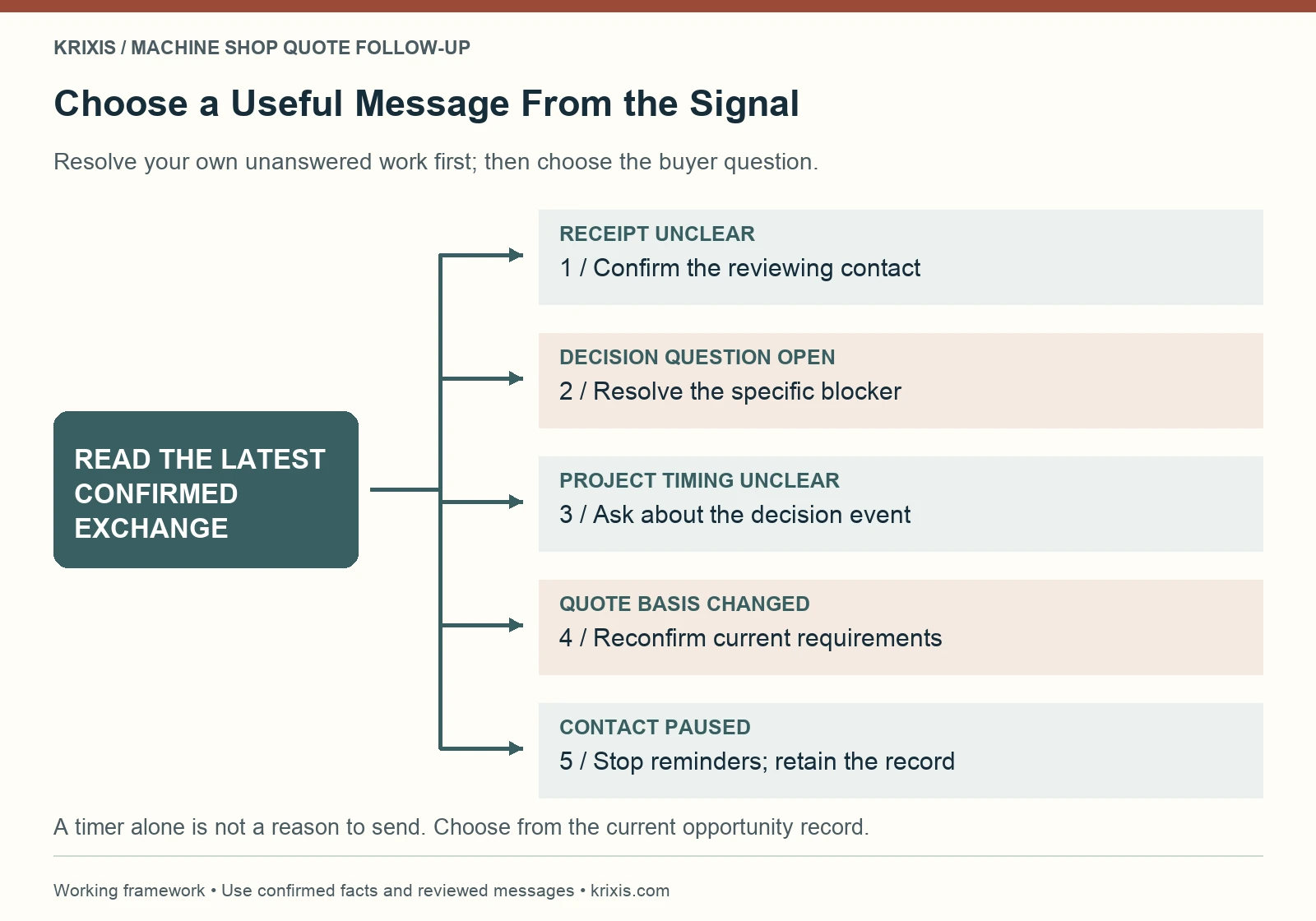
Start by reading the last meaningful exchange and the quote itself. An unanswered question from the buyer calls for your answer. An agreed project review date calls for a timely update. An uncertain delivery receipt calls for a different message from a confirmed design revision.
Use five working signals: receipt unconfirmed, a decision question open, the project schedule unclear, the quote basis changing, or contact paused. These describe what the next conversation should resolve. They do not imply that an opportunity is won or lost.
If more than one signal applies, choose the dependency that blocks progress. A buyer cannot meaningfully approve a quote based on an obsolete revision. A reminder to buy is premature while your estimator still owes an answer. Finish or assign the shop’s own action before asking the buyer for another one.
Keep confirmed facts separate from interpretations. “Buyer requested review after the design meeting” is evidence. “Buyer probably chose another supplier” is an assumption until you receive information supporting it. The distinction keeps the message appropriate and the pipeline record useful.
Keep a compact quote register
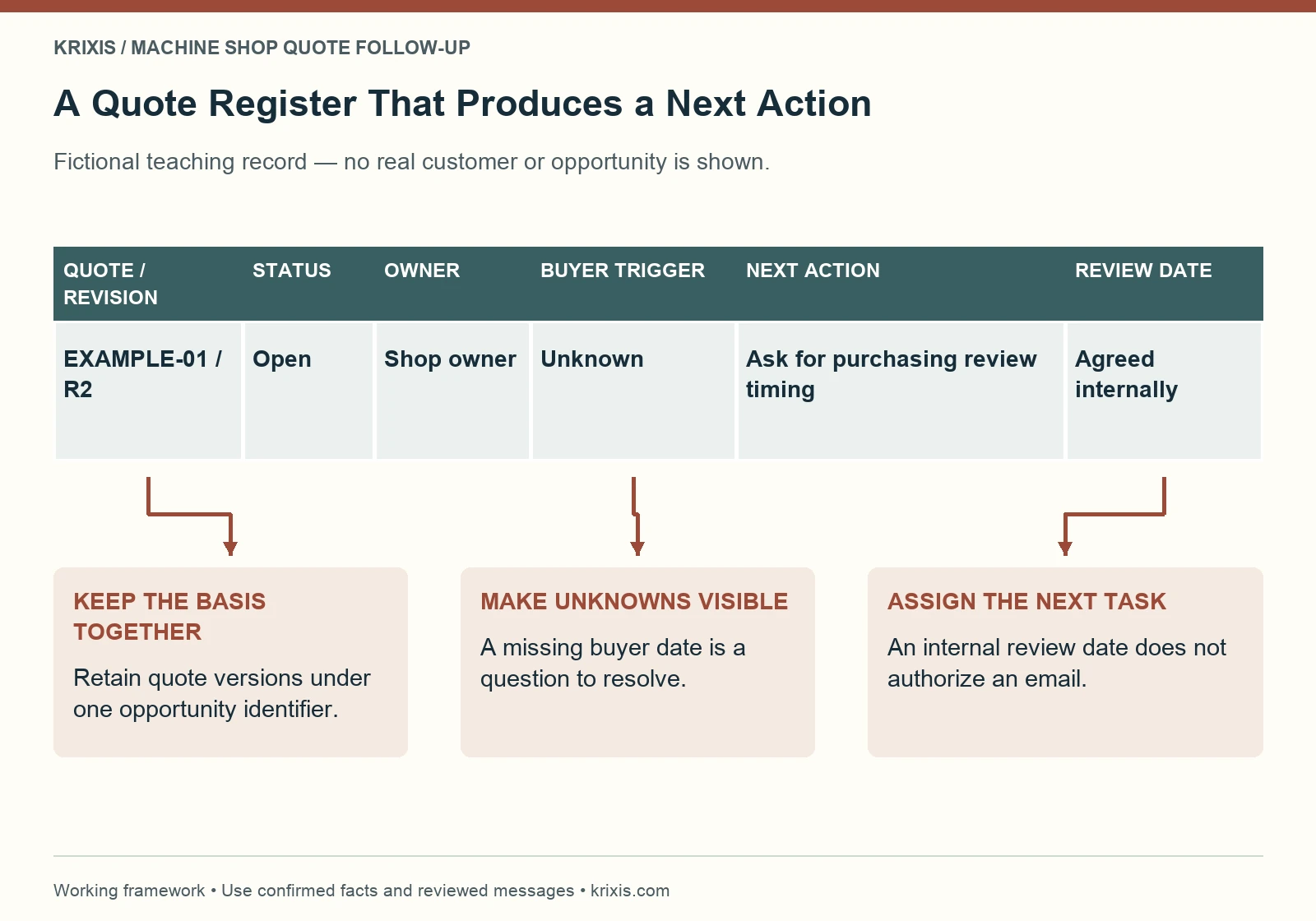
A quote register can begin in a spreadsheet or your existing machine shop CRM. Give each opportunity a stable identifier and retain its quote revisions under that record. A revised attachment should not silently become a second sales opportunity.
Record the current quote reference, relevant revision, sent date, owner, last confirmed buyer update, next action and next review date. Add the buyer’s expected decision event when known. Keep a link to the approved quotation and technical documents rather than scattering copies through unrelated tools.
Write actions as observable work. “Confirm whether the buyer’s purchasing review has moved” is more useful than “follow up.” If an estimator must first review a new drawing, assign that task to the estimator. Make it clear who can change the quote and who can send a customer message.
Quote tracking for machine shops should expose missing information. Use “decision date unknown” when that is the current evidence. An empty date, an overdue internal task and a buyer-requested pause are different conditions and should not produce the same reminder.
The RFQ qualification guide helps with work fit before estimating. This register follows what happens after the shop has issued a reviewed quote.
Five RFQ follow-up email templates
These are original draft templates for a machine shop contacting a buyer after a quote. Replace every bracket with verified information, remove statements that do not apply, and review the message before sending. They do not change the quote’s terms or authorize a price, delivery date or technical commitment.
1. Confirm the quotation reached the right person
Use this when delivery or responsibility is uncertain. Check your records first so you do not ask the buyer to solve an internal routing problem.
Subject: Quote [reference] for [project] — receipt check
Hello [name],
We sent quote [reference and revision] for [project] on [date]. Could you confirm that it reached the person reviewing this purchase?
If a different colleague owns the review, please let me know the appropriate route. I can provide the current quotation again through our agreed sharing method.
Thank you,
[name and role]
After a reply, update the reviewing contact and the next action. A successful email send does not prove a buyer read the quote or accepted its contents.
2. Resolve a question that is holding up the decision
Use this after a specific question has been identified. If your team owes the answer, provide that reviewed answer or a realistic update instead of asking the buyer whether they are ready to order.
Subject: Quote [reference] — next step on [confirmed topic]
Hello [name],
Our last exchange identified [specific open question] as the next item to resolve for quote [reference and revision].
Would [a short review call / confirmation of the stated requirement] help move that item forward? [Responsible person] can review the point with you through [approved contact route].
Please let me know which next step would be useful. Any change to the quotation will go through our normal review before we issue it.
[name and role]
Do not insert an answer that the estimator has not approved. Record the actual issue and who now owns it; a sent message is only one part of that work.
3. Ask about the buyer’s decision event
Use this when the buyer’s project schedule is unclear or a previously stated review date has passed. The purpose is to learn when a useful conversation should occur.
Subject: [Project] — purchasing review timing
Hello [name],
I am updating our follow-up plan for quote [reference]. When we last spoke, the next project milestone was [confirmed event, if known].
Is that still the event that will determine your purchasing timing, or has the plan changed? If the project is waiting, please suggest a suitable point for us to reconnect.
I can pause reminders until that point so our contact follows your actual schedule.
[name and role]
Keep “waiting on the buyer’s project” separate from “waiting on our technical answer.” Knowing the difference prevents unnecessary messages and makes internal priorities clearer.
4. Reconfirm the quote basis before further discussion
Use this when the buyer mentions a changed quantity, drawing revision, delivery requirement or another condition that may affect the offer. Do not silently carry the original price and timing into a changed request.
Subject: Quote [reference] — confirm the current request
Hello [name],
Our current quotation refers to [verified revision / quantity / scope]. Your recent message mentioned [specific change].
Could you confirm which requirement now governs the request? We will route the confirmed information to [responsible reviewer] and let you know whether a revised quotation is needed.
Please continue to refer to the existing quotation’s stated scope and validity while we review the change. We will confirm any new commitments in a reviewed update.
[name and role]
Use the shop’s approved wording for quote validity. A reminder must not invent an expiry, imply reserved capacity or create artificial urgency. If the original offer has expired, ask the responsible person how to reopen the discussion.
5. Pause contact without inventing a lost-order reason
Use this when the buyer asks for a pause or your reviewed communication plan calls for stopping reminders after unanswered attempts. An internal pause does not prove a competitor won the work.
Subject: [Project] — pausing follow-up for now
Hello [name],
I will pause further reminders about quote [reference] for now. If the project moves forward or you need a clarification, please reply in this thread or contact [approved route].
When the discussion resumes, we will confirm the current requirements and review the quotation’s status before making any new commitment.
Thank you for considering [shop name].
[name and role]
Record whether the pause was requested by the buyer or set internally. Retain the latest evidence and the re-entry condition. Do not mark the quote as lost solely because a reminder sequence ended.

Set timing from the opportunity
There is no single waiting period that fits every machining quote. A prototype review, a recurring production purchase and a project awaiting funding can have different decision events. Use the buyer’s stated timing, the quotation’s actual validity and the shop’s responsibilities to plan contact.
When sending the quote, ask for a useful next conversation rather than assuming one. If timing is unknown, assign a date to clarify it. That is an internal planning choice, not a claim that buyers require a particular number of messages before ordering.
Review due actions regularly. Prioritize answers your team owes, buyer-agreed conversations and records with unclear ownership. Move dates when evidence changes, and preserve the reason for moving them. Respect an explicit request to pause or stop contact.
The owner should be able to explain why a message is due and what new information it seeks. If the explanation is only that an automatic timer elapsed, review the record before sending.
Use AI to prepare a draft, then verify it
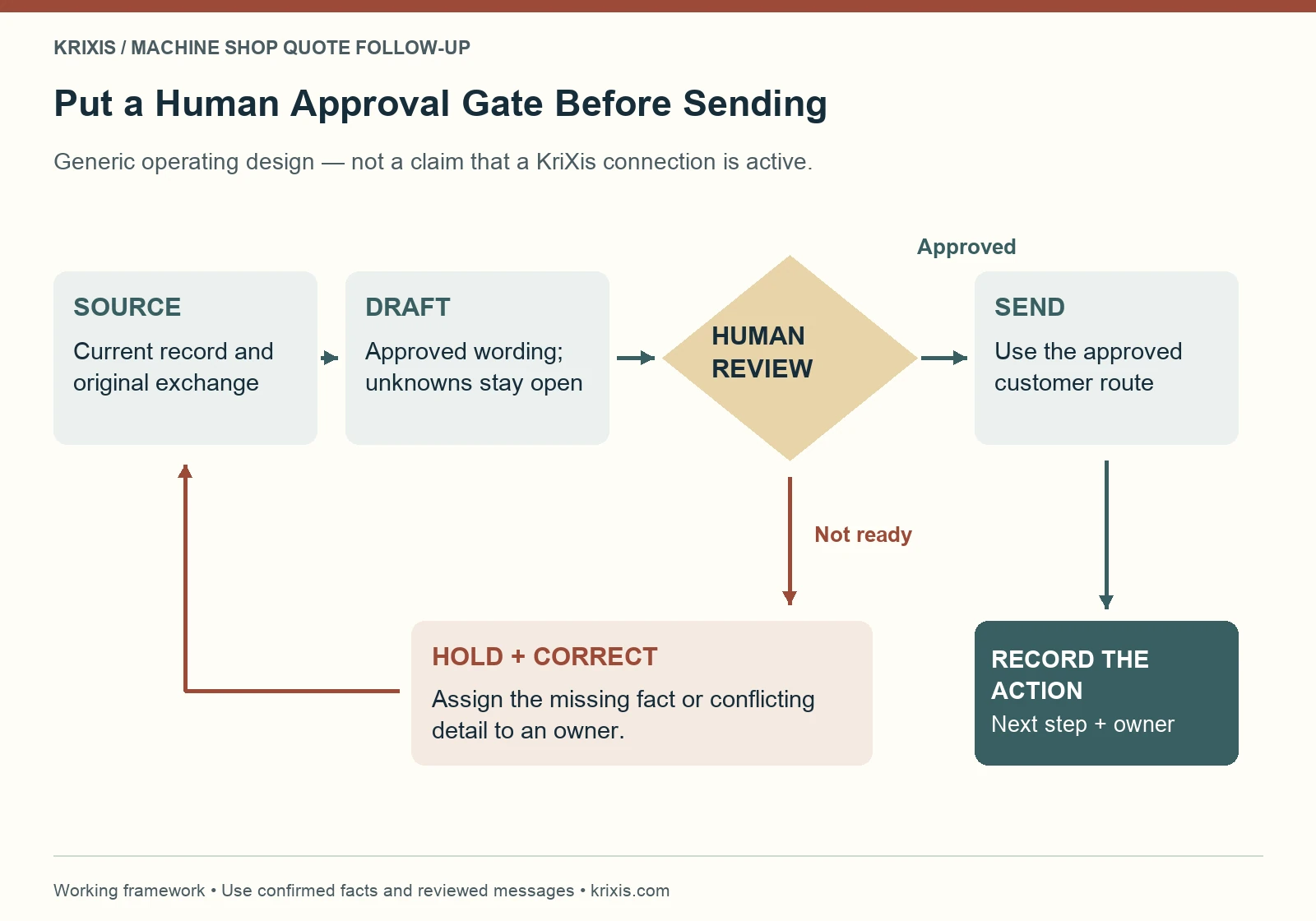
A reviewed assistant can help summarize the latest recorded exchange, identify missing fields and prepare a draft from an approved template. Its input should include the current quote reference, confirmed buyer information, allowed wording and a clearly defined task.
Require the reviewer to check the recipient, revision, quantities, dates, open question and next action against the original record. Missing information should remain an explicit question. Do not let a draft infer manufacturability, certification, price acceptance, available machine time or a delivery promise.
Define what happens when the source is incomplete, the draft conflicts with the record or a connection fails. Hold the message for review and assign a recovery action. A due date in a portal does not by itself prove that an email was created, sent or received.
The NIST AI Risk Management Framework Playbook offers an optional organizational reference for defining responsibilities and evaluating AI-related risks. The shop’s immediate operating requirement is concrete: identify the source, the reviewer and the approval step for each draft.
Our AI RFQ response guide explains the earlier intake handoff. Quote follow-up should use the same distinction between prepared administrative work and an approved customer commitment.

Measure whether the process is becoming clearer
Begin with operating questions your records can answer. How many open quotes have an owner and a specific next action? Which actions are overdue? Which buyer questions still need an answer from the shop? Which paused opportunities have a documented re-entry condition?
Keep contact attempts, buyer replies and confirmed outcomes separate. Several sent emails are not several buying decisions. A quote value is not an order value, and an order value is not collected revenue. Use your existing marketing measurement process to define those stages consistently.
If you compare outcomes over time, retain the review date and describe the population included. Open projects can mature later. Record an unknown reason as unknown rather than choosing “price” because it is convenient. The useful result is a better next decision, not a more flattering dashboard.
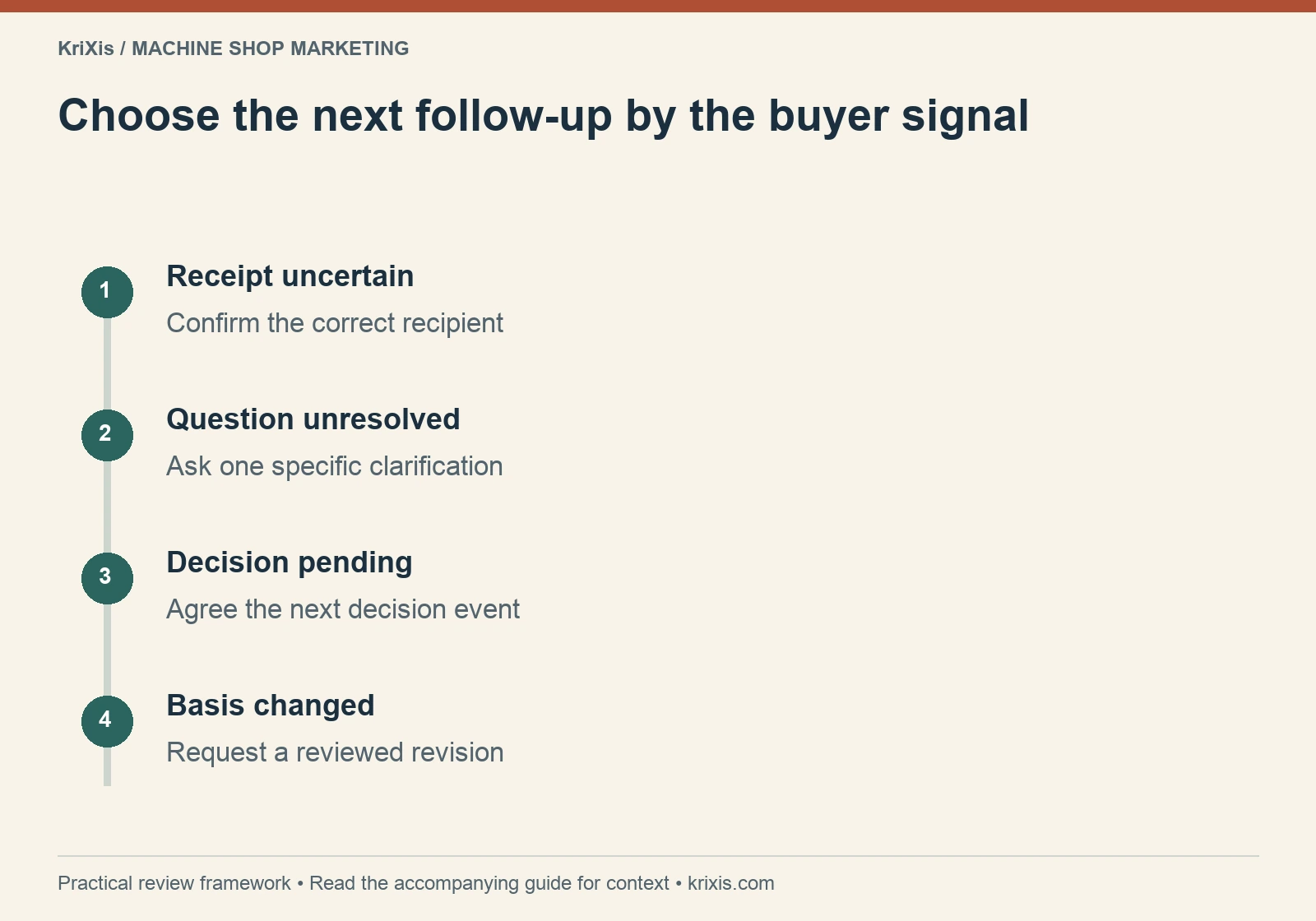
Read this graphic as text
- Receipt uncertain: Confirm the correct recipient
- Question unresolved: Ask one specific clarification
- Decision pending: Agree the next decision event
- Basis changed: Request a reviewed revision
Connect website evidence with the open conversation
Sometimes a buyer needs a clear explanation of a capability, a permissioned example or the route for asking a technical question. Link to the relevant capability page or case study when it answers the actual issue. Do not send a generic brochure link just to create another touchpoint.
If the same question repeatedly appears after quotes, review whether the website can explain that point more clearly. Keep technical claims with their responsible owner and preserve an approved inquiry route. Follow-up and website maintenance can then share a useful work item: answer a real buyer question with reviewed information.

Put the workflow to work with KriXis RFQ Growth
KriXis RFQ Growth is the flagship service direction connecting inquiries, follow-up and supported website work in one workspace. The public page describes a portal foundation for human-managed records, editable drafts, follow-up planning and reviewed reports, while the complete connected AI service is still in development.
Automatic inbox intake, connected AI assistance and other integrations need readiness and acceptance checks before a paid flagship rollout. The service page explains current availability and the separately scoped work. It does not offer autonomous engineering estimates, CAD analysis or unrestricted email management as the standard service.
Bring your public website, current inquiry workflow, typical workload and the person who can approve customer communications to a rollout consultation. Start with one recurring problem: an unowned quote, a missing review date or a repeated buyer question. KriXis can discuss the supported workflow and the connections still required before agreeing implementation scope.
A useful quote follow-up process leaves the team knowing what has been confirmed, what still needs a decision and what happens next. Choose one open record, select the appropriate message, review it and update the action that follows.


Trackbacks & Pingbacks
[…] wording after a quotation has been sent, use our machine shop quote follow-up templates and connect each draft with the current opportunity record. To discuss a managed workflow, review […]
Leave a Reply
Want to join the discussion?Feel free to contribute!