
Machine Shop RFQ Checklist: What Buyers Should Include
A machine shop RFQ checklist helps a buyer describe the work they want quoted and helps a shop identify what still needs clarification. Start with the part and revision, relevant files, material, quantities, requirements, timing and a responsible contact. Keep unknown information visible instead of asking an estimator to infer it.
For shop owners, the checklist is also useful website content. Share it beside your inquiry route so engineers and purchasing teams can prepare a clearer request. A useful brief does not replace technical review; it gives that review a dependable starting point.
This guide explains what an RFQ means in machining, what to include, how to distinguish a preliminary discussion from a quote-ready package, and how to hand the request to a named person. Use the free template to adapt these questions to your own shop’s supported work.

What is a machine shop RFQ?
A machine shop RFQ is a request for quotation: a buyer asks a supplier to review defined machining work and provide a quotation. The request brings the commercial question and technical references together. It should explain which items are being considered, what information controls the request, and what response the buyer needs.
An early feasibility conversation can be valuable before those details are settled. Label it accordingly. A request for a budgetary indication, a manufacturability discussion and a quotation against released requirements are different tasks. Ask which service the shop supports rather than treating every upload as a complete production RFQ.
Keep request receipt, technical clarification, quote issuance and order confirmation as separate workflow steps. Receiving a drawing does not establish that the shop has accepted its requirements. A website acknowledgment should confirm receipt and the next review step without inventing a price, delivery promise or approval.
There is no single file package that suits every supplier. For example, Protolabs documents the CAD formats supported by its own quoting platform. Check the receiving shop’s actual instructions before exporting files or assuming a platform-specific requirement applies everywhere.
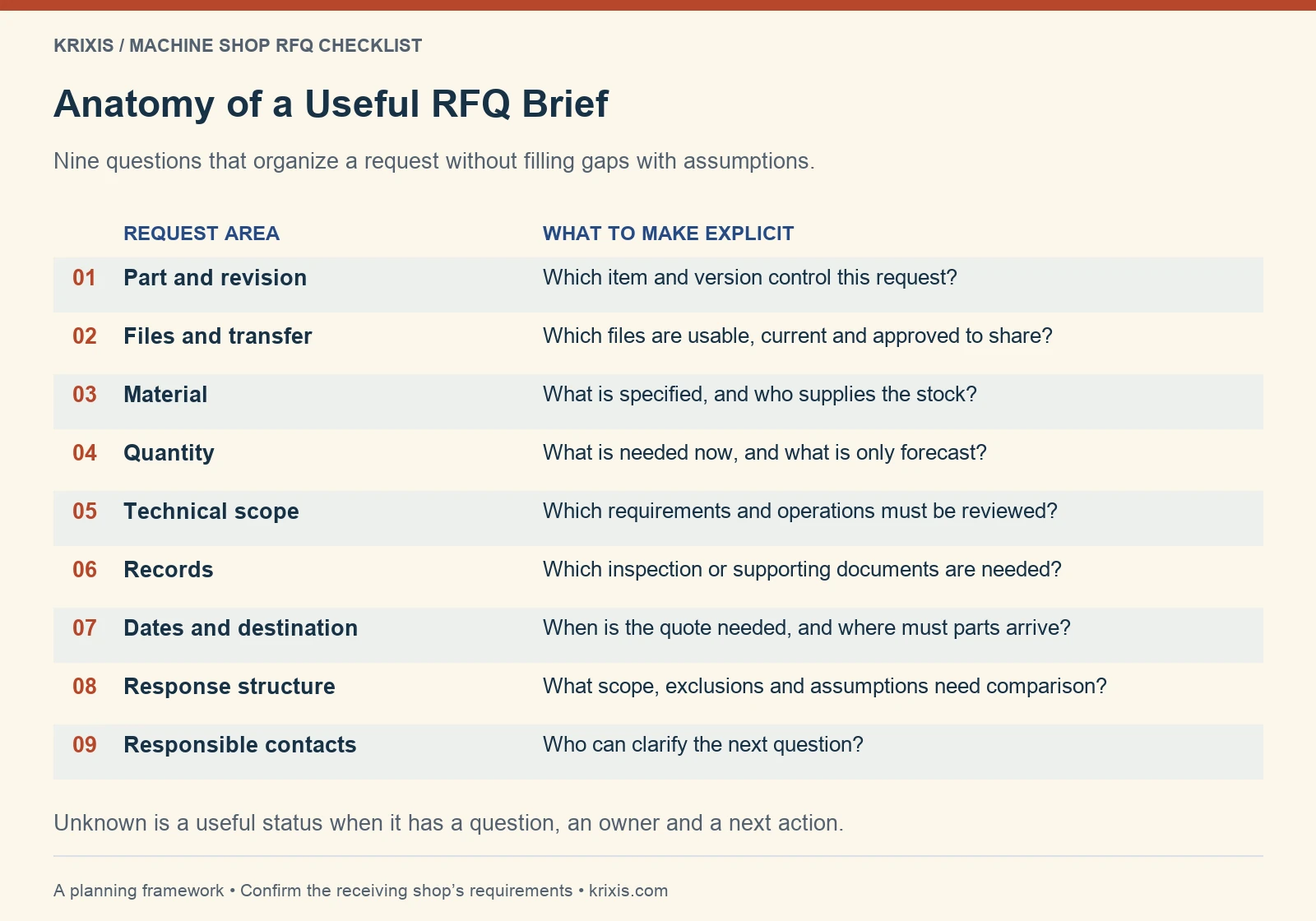
Build a machine shop RFQ checklist around nine questions
Use these questions as a conversation structure. Some requests need additional documentation; others can begin with a smaller, clearly labeled preliminary brief. The aim is to identify the information relevant to the next decision, not to fill every box with a guess.
1. Which part, assembly and revision should be reviewed?
Give each requested item a clear identifier. State the drawing revision and identify the corresponding model where one is provided. For an assembly, explain which components or operations belong in the requested scope. A supplier should not need to decide which attachment is the latest one from a crowded email thread.
List conflicts as questions. If a model, drawing and written note disagree, ask the responsible technical contact to resolve the discrepancy and identify the governing information. Do not quietly edit a controlled document or tell the shop to choose whichever version seems easiest.
2. Which files can the shop use and receive?
Follow the shop’s accepted file-format and size instructions. Where drawings and models are needed, provide the agreed versions together and include a short file list. Explain whether a file is released, preliminary or awaiting approval. A screenshot may help explain a question, but it should not silently stand in for the agreed product definition.
Keep the brief separate from a permission to share technical files. Confirm the intended recipient and transfer method before sending confidential information. If the public website does not offer an appropriate route, begin with non-confidential context and request the shop’s approved next step.

3. What material and supply responsibility apply?
State the specified material and condition using the information your authorized technical source provides. Identify whether the supplier should obtain stock or whether material will be supplied by the buyer. Include applicable material-document requirements rather than assuming the shop includes them in every quotation.
If the material is undecided, say so and ask whether the shop can support a preliminary discussion. Do not ask a marketing form, an AI summary or a buyer-facing checklist to select an alloy, approve a substitute or establish suitability for the application.
4. What quantity is actually being requested?
Separate the quantity to quote now from possible future demand. Identify prototype and production requests separately, and state any specific quantity breaks you need evaluated. A forecast should remain labeled as a forecast rather than appearing to be a committed purchase.
For a multi-part request, use one clear line per item with its quantity and revision. If the buyer wants both individual prices and an assembly or package total, ask for that structure explicitly. Avoid open-ended instructions such as “quote every possible quantity.”

5. Which technical requirements must the reviewer see?
Point the shop to the authorized dimensions, tolerances, threads, surface requirements and other relevant notes. Identify specific questions without rewriting engineering requirements in informal marketing language. If a function is important but its requirement is unresolved, route that question to the responsible technical owner.
Use a short scope summary to identify included operations, outside processes or assembly expectations. State whether finishing, heat treatment, marking, packaging or other work should be included, excluded or discussed. The shop should confirm its supported scope through its normal review.
6. What inspection records or supporting documents are needed?
State the records the buyer needs with the quotation or delivered work. Ask about the applicable inspection, material or traceability documentation and identify any requirement that needs clarification. Do not assume that a supplier’s general quality statement answers the requirements of a particular project.
The NIST MEP supplier-selection guide encourages buyers to understand supplier capabilities, quality documentation and communication systems. Use those conversations to check fit; a completed RFQ checklist does not establish a supplier’s certification or approval status.
7. Which dates mean what?
Separate the date a quotation is requested from the date parts are needed. Identify the delivery destination and any relevant project milestone. Ask the supplier to explain its proposed lead-time basis and what must happen before that clock begins.
If a date is a preference, a target or dependent on another decision, label it. “Required on site” and “ready to ship” are different expectations. Do not turn an unconfirmed project target into a published promise about machine availability or delivery.
8. How should the supplier present its response?
Specify the useful comparison fields: item and revision, quantities, included operations, stated exclusions, separate one-time charges where applicable, and the supplier’s assumptions. Ask for clarification when quotations use different scopes instead of comparing only the headline total.
Keep requested terms and accepted terms distinct in your records. The Thomas industrial RFQ tip sheets provide broader examples of structuring requests with contacts, quantities and response needs. This KriXis checklist is an independent planning resource, not the supplier’s quotation or order document.
9. Who can answer the next question?
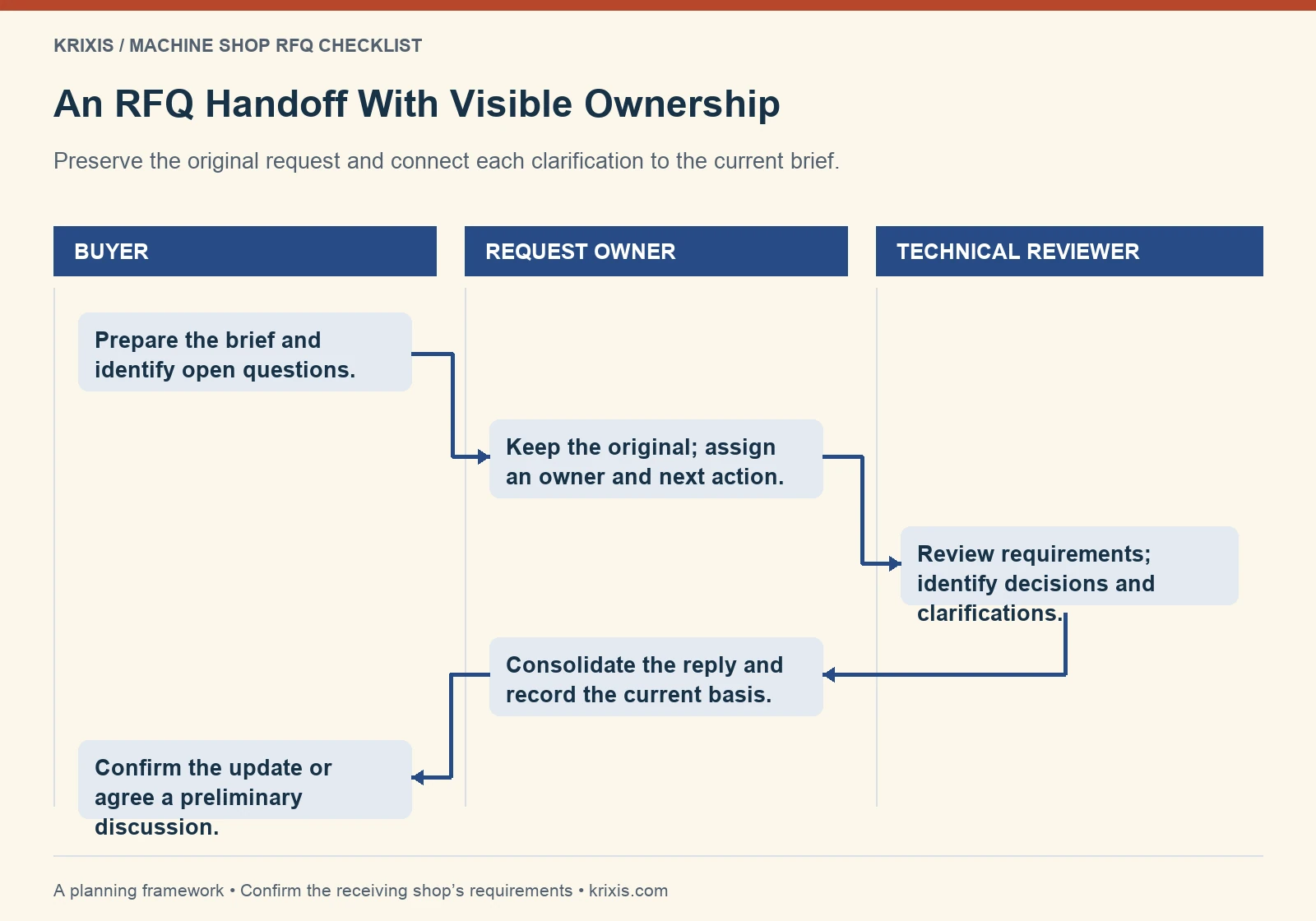
Include a business contact and the technical contact responsible for resolving requirements. Identify who is coordinating the request and the preferred reply route. For a shop receiving the inquiry, assign an internal owner who can acknowledge it, collect questions and route the technical review.
Keep changes in the same identifiable request record. When someone supplies a missing detail, record its source and the version it updates. An estimator should not have to reconstruct the current brief from several forwarded messages.
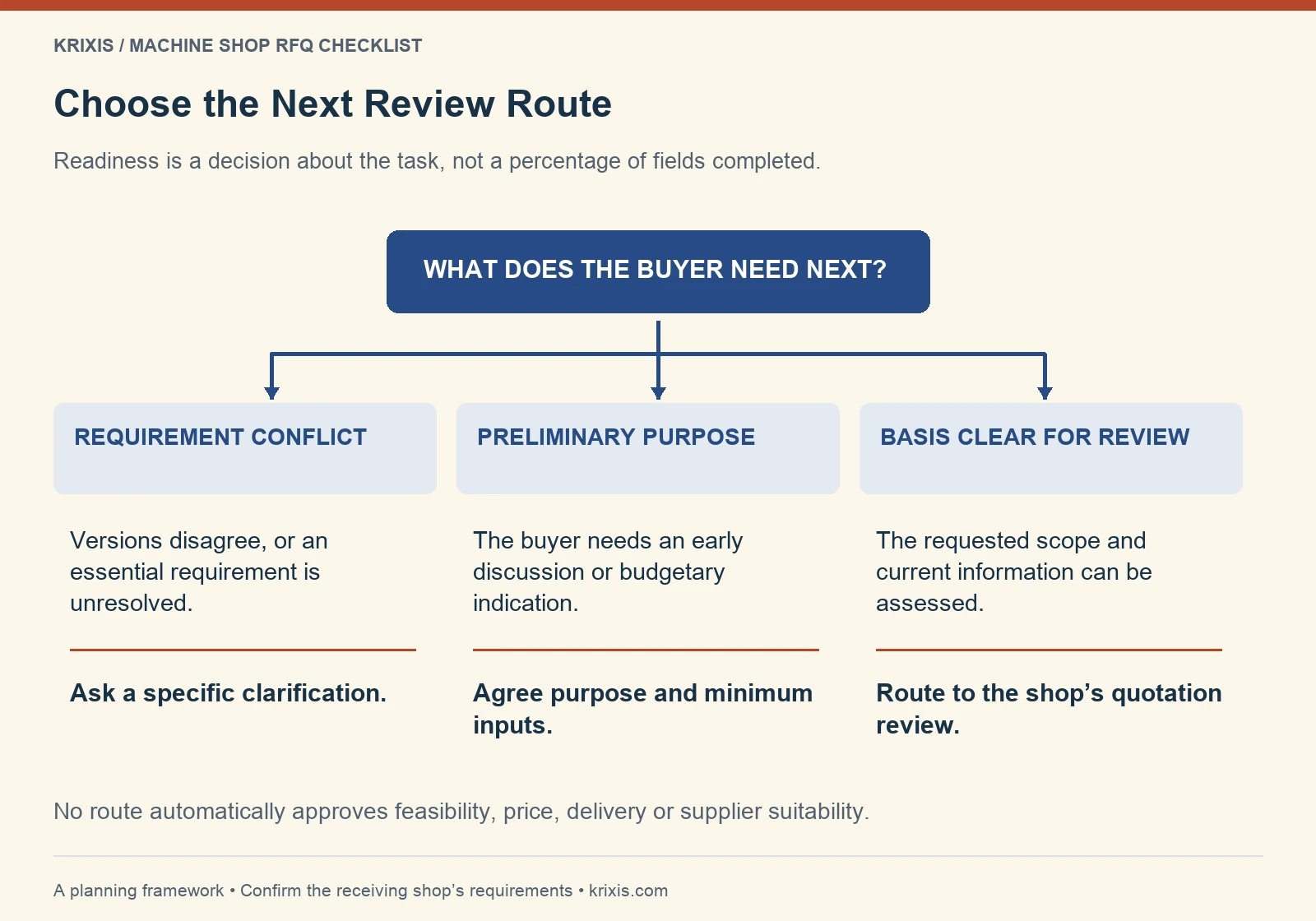
Decide whether the request is ready for quotation
Ready is a decision about the next task, not a score for how many fields are populated. If an essential requirement conflicts, hold that point for clarification. If the buyer wants early input, agree that preliminary purpose and the information the shop needs to support it.
Use three working routes: proceed to the shop’s quotation review, ask a specific clarification, or arrange an agreed preliminary discussion. None of these routes should automatically approve manufacturability, commercial fit or delivery. Your shop’s lead-qualification process addresses acceptance for review; this checklist organizes the buyer’s request.
Avoid requiring sensitive or unnecessary details just to allow a first conversation. Explain what is needed now, what can follow through an approved route, and what remains unknown. The requester should be able to understand why a question matters.
A fictional example of a clearer machining request
Consider this invented teaching example: a buyer writes, “Please quote the attached bracket. We may need more later.” One file is marked revision B, another revision C, and the email contains no present quantity or delivery destination. Those gaps call for questions, not an invented estimate.
A clearer working brief could say: “Item TRAIN-01, revision C, is the intended review basis. Confirm that the supplied drawing and model represent the same revision. Please quote an initial lot of 20. A possible later lot of 100 is a forecast only. The required delivery destination is stated in the brief; the delivery date remains to be confirmed.”
These names and quantities are fictional, not client evidence or a recommended purchasing pattern. The revised brief still does not settle material, inspection or other requirements. The next action is to identify the missing information and responsible contact, then agree whether the shop can begin the requested review.
The useful improvement is traceability: the reader knows which facts are confirmed, which are tentative and which questions block the next step. Do not describe the example as a completed quote or claim it produced a faster turnaround.
Put the checklist beside your website’s RFQ route
A shop can publish an accessible HTML explanation and offer a downloadable brief for people who prefer to prepare offline. Place a contextual link on relevant capability pages, near the inquiry action and in acknowledgment instructions where appropriate. Explain that the actual drawing-transfer route is separate.
Design the form around the first useful decision. Do not require someone to retype the entire worksheet into another long form. The RFQ form design guide covers labels, errors, file instructions and routing checks in more detail.
Give the public instructions an owner. Review accepted formats, contact routes and capability references when systems or supported work change. Remove an old template if it contradicts the live instructions, and make the current version easy to identify.
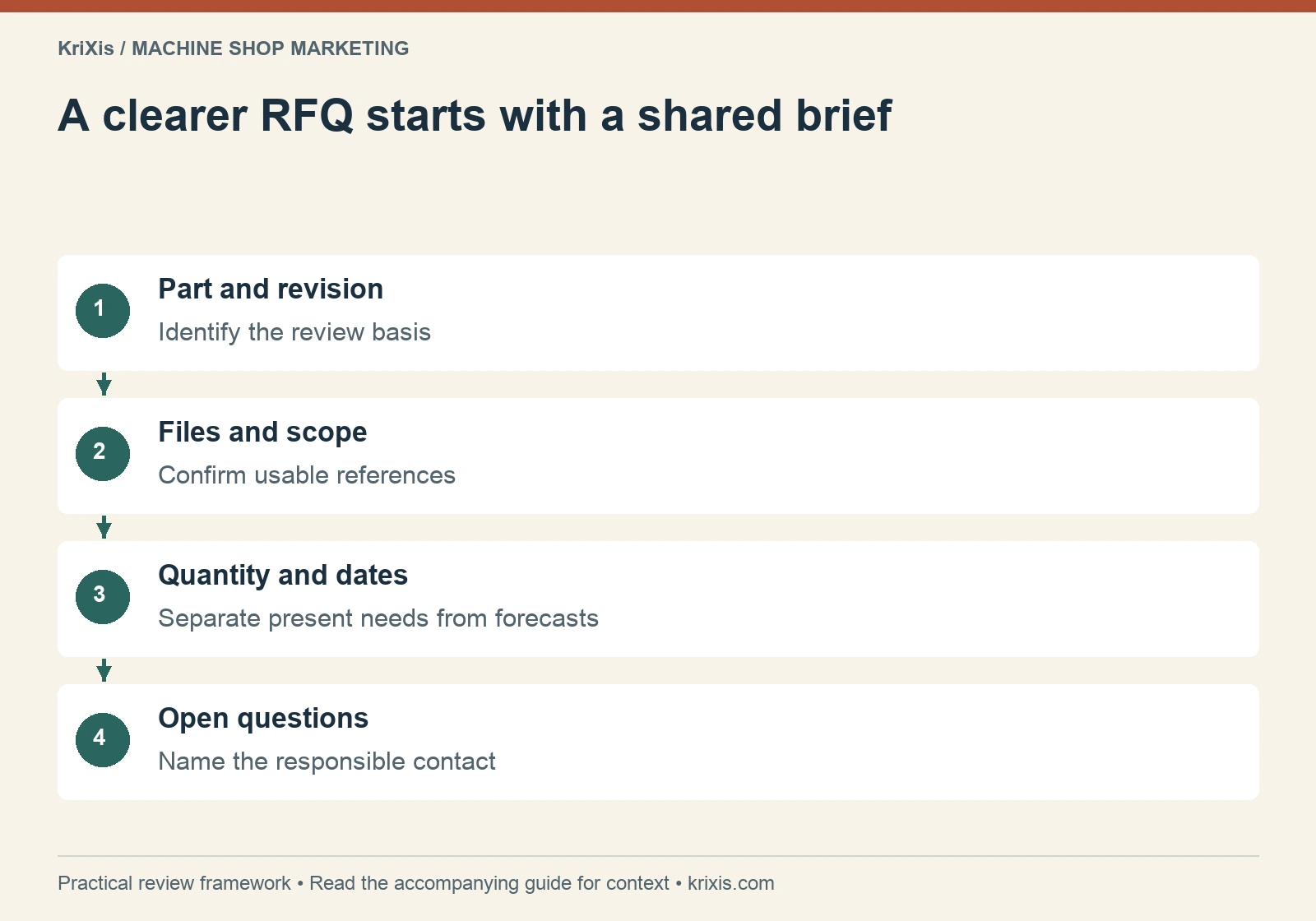
Read this graphic as text
- Part and revision: Identify the review basis
- Files and scope: Confirm usable references
- Quantity and dates: Separate present needs from forecasts
- Open questions: Name the responsible contact
Hand the request to a person and preserve the original
After receipt, keep the original request and identify the current brief, open questions, owner and next action in your CRM workflow. A confirmation screen should not be treated as proof that the inquiry reached estimating. Verify the intended route through an approved test process.
If a requirement changes during review, record the revision and ask whether a new quotation basis is needed. Keep the previous version identifiable. Once the shop has issued a reviewed quote, use the quote-follow-up guide to plan a relevant conversation around the buyer’s situation.
AI can help organize stated information or prepare a clarification draft when its use and inputs are approved. A reviewer must check the original request before a technical or commercial commitment is sent. A summary should preserve “unknown” instead of inventing a material, tolerance or delivery date.

Review the checklist using actual inquiry questions
Start with a small reviewed sample of requests and record the information repeatedly missing, the questions estimating asks and where responsibility becomes unclear. Choose one useful correction: a clearer instruction, a better example or an identified owner. Keep a dated version so the team knows what changed.
Measure missing-information categories and the completion of agreed actions separately from quote wins. More fields completed does not prove better-fit work, and a download is not a qualified RFQ. Search queries can reveal wording to explain, but they do not establish the searcher’s role or intent on their own.
For broader support, review KriXis RFQ Growth, the flagship direction connecting inquiries, follow-up and supported website work. Its service page describes the current foundation, rollout status and scope. Discuss your available systems and approval responsibilities before assuming a connection or automation is active.
Begin with one request and one next decision. A useful machine shop RFQ checklist makes the current requirements easier to understand, gives unknowns a clear owner and helps the buyer and shop agree what happens next.

Trackbacks & Pingbacks
[…] buyers prepare before you qualify the inquiry. Share the machine shop RFQ preparation checklist to collect current revisions, quantities and open questions while keeping qualification and […]
Leave a Reply
Want to join the discussion?Feel free to contribute!