Krixis Consulting
  • Services
    • Manufacturing Marketing Agency
      • Machine Shop SEO
      • Machine Shop Website Design
      • Machine Shop Lead Generation
  • Blog
  • Contact
  • Menu Menu
  • Link to X
  • Link to Facebook
  • Link to LinkedIn
  • Link to Pinterest
  • Link to Instagram

Tag Archive for: machine shop CRM

Machine Shop Marketing

How to Qualify Machine Shop Leads: An RFQ Scorecard and Follow-Up Playbook

An inbox full of quote requests can look like a healthy pipeline. It can also keep an estimator busy with work the shop cannot produce, undefined projects, and repeat requests that never become orders. RFQ volume alone does not tell you whether inquiries match your equipment, quality system, capacity, or business goals.

To qualify machine shop leads, decide what happens next: quote, clarify, route, hold for capacity, or decline with an explanation. The process should support consistent responses without making buyers complete a long application.

This guide gives shop owners and sales teams a practical way to separate hard fit requirements from judgment calls, score viable opportunities, and follow up after a quote. The scorecard is a starting template. Adapt its weights and thresholds to your own equipment, margins, capacity, and customer mix.

Estimator reviewing an engineering drawing and machined component at a machine shop

What makes a machine shop lead qualified?

A qualified lead is an opportunity your shop has reason to pursue, not merely an inquiry with complete contact fields. At minimum, there should be a real project, a reachable person, and enough information to decide whether a useful next conversation is possible. For a quote-ready RFQ, you also need a workable technical definition and commercial context.

Qualification is shop-specific. A prototype that fits a five-axis job shop may be poor work for a high-volume turning operation. A 10,000-part request may be attractive to one shop and impossible for another. Fit depends on the operation receiving it.

Use two decisions in order. First, test for nonnegotiable fit: process, part envelope, material, quality obligations, and any confidentiality or compliance requirement you must be able to meet. Second, prioritize the opportunities that pass using a flexible score. This prevents a high dollar estimate from masking a job you cannot safely deliver.

CNC machine and inspected aluminum component illustrating technical fit
Verify actual process, material, envelope, and inspection capabilities before accepting work.

Start with five fit gates

  1. Process and equipment. Can your current machines and partners perform the required operations? Record axis needs, part envelope, features, and required secondary processes. A broad label such as “CNC machining” is not enough to answer this.
  2. Material and production range. Can you source and machine the specified material, in the stated condition, at the intended prototype or production volume? Ask whether alternate materials or lot sizes are permitted rather than assuming they are.
  3. Tolerance and inspection. Can you verify the critical characteristics with your equipment, methods, and staff? If a requirement is unclear, route it for engineering review before promising a result.
  4. Quality and contractual obligations. Does the project require a certification, traceability package, controlled data handling, first article inspection, or customer approval process your shop can actually provide? Never imply a certification you do not hold.
  5. Capacity and timing. Can you review, quote, and—if awarded—produce within a credible schedule? A date is a constraint to discuss, not a number to accept automatically.

A gate can have three outcomes: fit, needs clarification, or outside current scope. “Needs clarification” deserves an owner and a question, not an automatic rejection. For example, a tight tolerance may apply to only one feature. A short call can resolve whether your inspection plan is adequate.
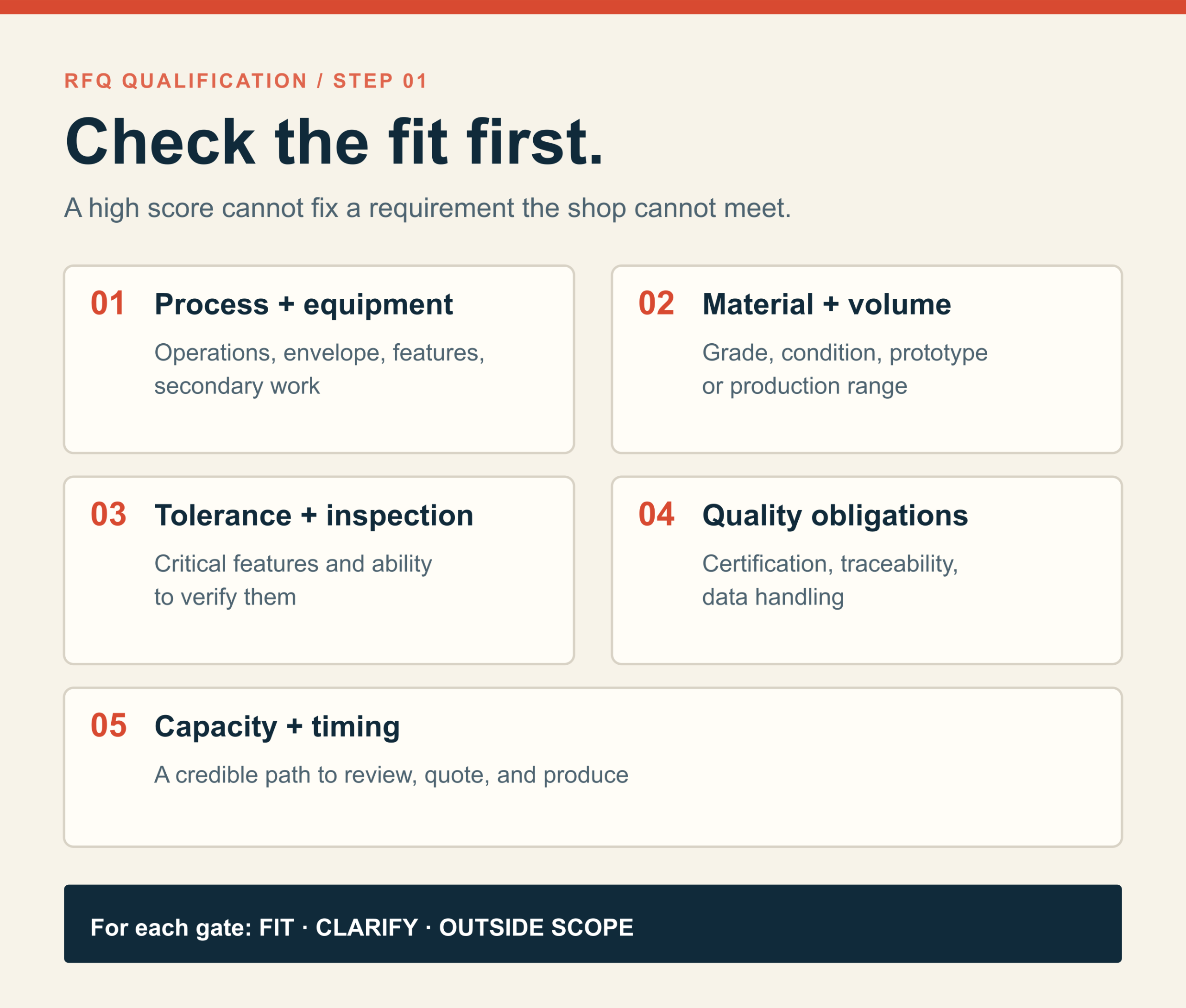
Five machine shop RFQ fit gates: process, material, tolerances, quality obligations, and capacity

Use a scorecard only after the gates

Once an inquiry passes the fit gates, a simple scorecard helps the team make consistent tradeoffs. Do not treat the result as an algorithmic quote decision. It is a triage aid that shows why an opportunity deserves more attention and what information is still missing.

Here is a sample 100-point model to adapt:

DimensionPointsWhat to look for
Technical match30Work fits proven processes, materials, tolerances, inspection, and partner network.
Commercial fit25Quantity, repeat potential, likely order value, and payment or purchasing terms fit your business.
Project readiness20Current revision, usable files, decision timeline, and a clear next step are available.
Capacity fit15The shop has a realistic window to quote and produce without disrupting committed work.
Relationship value10The buyer fits a target market, is a current customer, or offers a credible path to repeat work.

Suggested routing, not an industry benchmark: 75–100 points gets priority review; 50–74 gets a clarification or discovery step; below 50 gets a limited review or a polite decline if a required gate fails. A repeat customer, strategic account, or urgent problem can warrant an override. Record the reason, so the scorecard remains accountable to human judgment.

Avoid scoring a lead down because the buyer does not know machining terminology. An engineer may have a complete print but no purchasing authority; a founder may have a promising prototype and need help defining specifications. Ask which missing information changes your ability to quote. Do not make every unanswered field look like a disqualifier.
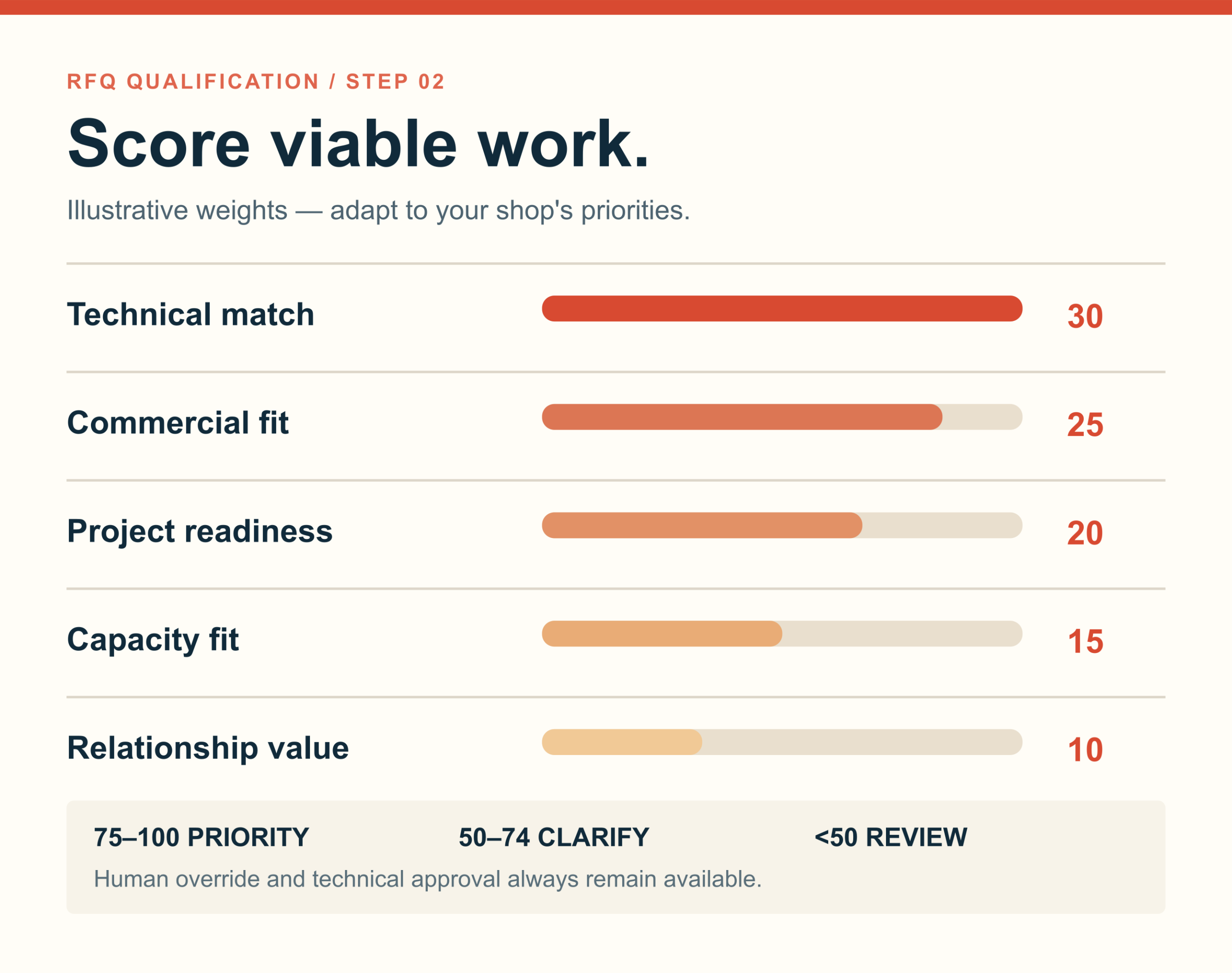
Sample 100-point RFQ scorecard: technical match 30, commercial fit 25, readiness 20, capacity 15, relationship 10

Example: two RFQs, different next steps

RFQ A: A purchasing manager submits a revised drawing, material specification, annual usage, first-order quantity, required documentation, and target date. The part fits a process your shop runs weekly. It passes the gates and earns a high score. Assign an estimator, acknowledge receipt, and give a realistic date for the next update.

RFQ B: A product team asks about a small prototype with an attractive long-term market, but sends an early model without critical tolerances or a controlled revision. The technical gate is not yet resolved. Send two or three specific questions and offer a short technical conversation. Quoting from assumptions would create more risk than value; discarding the lead would be premature.

Both inquiries deserve a response. They do not need the same response.

Collect enough information without building a form obstacle course

Your website’s RFQ path begins qualification. It should let buyers submit what they have and explain what the shop needs next. A “name, email, message” form pushes basic questions into the inbox. Demanding every technical detail can stop an early-stage buyer before a conversation begins.

Start with the essentials: contact name, company, business email, project description, process if known, estimated quantity, desired date, and an optional secure file upload or approved file-transfer method. Then use conditional fields for material, finish, quality documentation, and repeat volume when they matter to your work. Label optional information honestly. Explain which files you accept and what happens after submission.

For technical files, preserve the original attachment and revision. Ask the buyer to identify which drawing or model controls when multiple versions are sent. NIST’s model-based enterprise work illustrates why design data and its authority matter across supplier handoffs; a shop should not silently reconstruct requirements from a partial file. NIST describes the manufacturing data exchange problem in its Model-Based Enterprise Summit proceedings.

Sensitive drawings also need a deliberate handling path. Restrict access to the people reviewing the opportunity, use approved storage, and protect the accounts that hold the files. CISA recommends multifactor authentication for business systems that contain sensitive information. If a customer requires an NDA, export-control review, or other special handling, route that requirement before files circulate through ordinary marketing tools.

Estimator desk with a laptop, drawing, and sample part illustrating RFQ intake
The best first form captures a useful starting point and leaves room for a technical conversation.

Make the first review a repeatable workflow

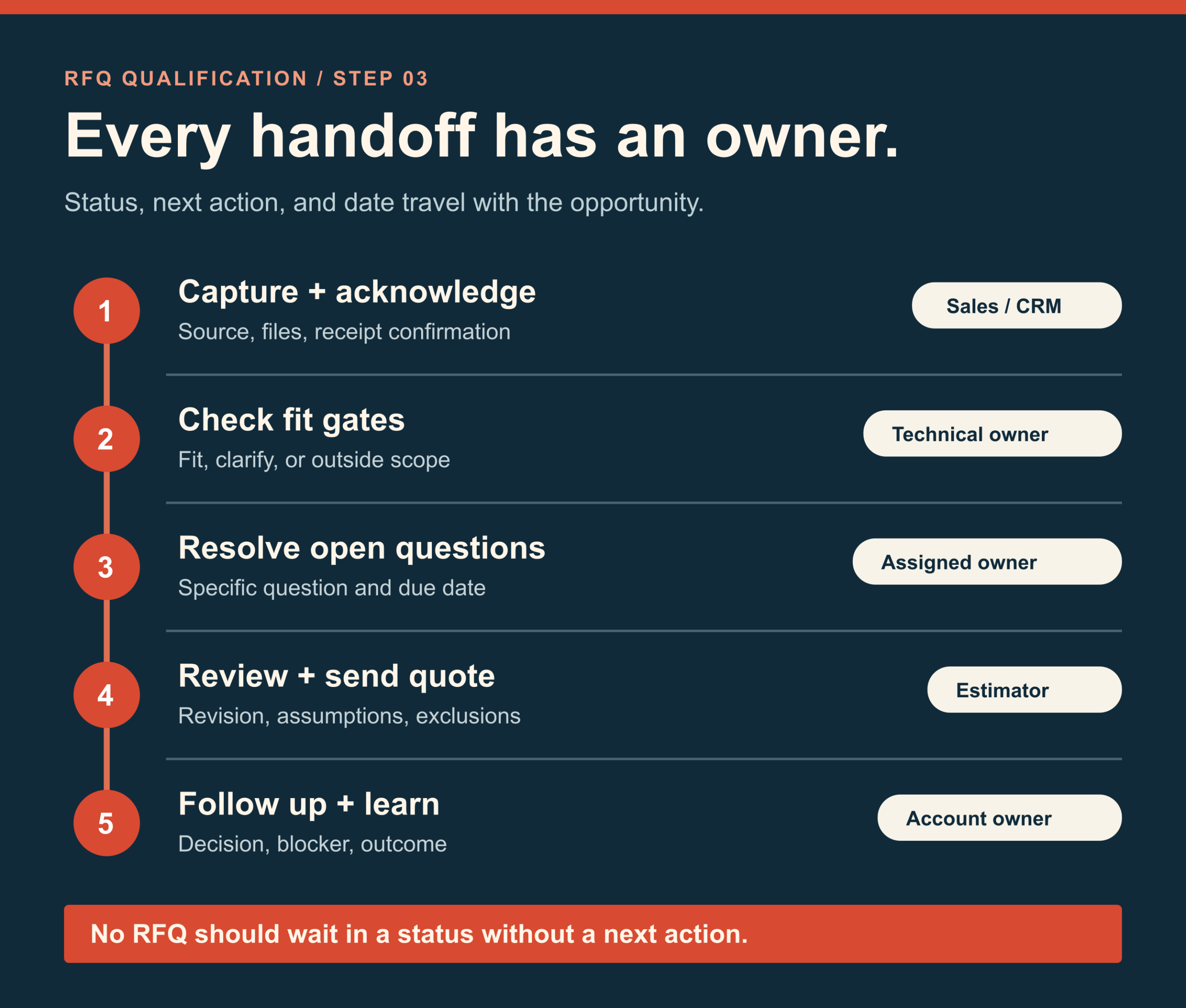
The qualification process should answer three questions quickly: Who owns this? What is missing? When will the buyer hear from us? A shared inbox alone does not answer them. A CRM or lead log does not need to be elaborate, but each RFQ should have a source, owner, status, last contact, next action, and outcome.

Use a short sequence:

  1. Capture and acknowledge. Record the original source—organic search, paid ad, referral, returning customer, or other channel. Confirm that the RFQ arrived, without promising a quote date before the team reviews it.
  2. Check the gates. A trained owner checks process, material, envelope, quality, capacity, and handling requirements. Mark uncertain facts as open questions.
  3. Assign the next action. Route fit leads to estimating. Route unclear leads to a named person for clarification. Route out-of-scope work to a courteous decline or a vetted referral, when appropriate.
  4. Score viable opportunities. Use the scorecard to set review order when several qualified RFQs compete for limited estimator time. Keep the score and the reasoning together.
  5. Set a follow-up date. Once a quote is sent, record when the team will check for feedback, the buyer’s decision timing, and any blocker identified.

Give each status a clear definition. “New” means unreviewed; “clarification needed” means a specific question is waiting on a specific person; “estimating” means the team has accepted the quote task; “quoted” means the buyer received a reviewed offer. These definitions prevent an inquiry from appearing active while nobody owns the next step.

Two manufacturing professionals reviewing a component and drawing during RFQ triage
Qualification should surface technical questions for a qualified person to resolve.
RFQ handoff workflow from inquiry and fit review to estimating, quote, buyer follow-up, and outcome tracking

Keep people in charge of technical and commercial promises

An intake tool can flag missing fields, organize files, and prepare a draft acknowledgement. It should not independently decide manufacturability, capacity, price, tolerance, certification, or delivery. Our separate guide to AI-assisted machine shop RFQ responses covers where automation can help while a person reviews the result.

The same rule applies without AI. A salesperson should be able to say, “We have your request and are reviewing the drawing,” without implying that the shop has accepted the work. A technical reviewer should be able to return a clear question before the buyer receives a price based on unstated assumptions.

Write responses that move the opportunity forward

The first response should make the buyer feel heard and establish the next action. It does not need a lengthy sales pitch. Use templates as a starting point, then tailor them to the actual project.

For a quote-ready RFQ: “Thanks for sending the drawing for [part/project] at revision [X]. We have the requested quantity and target date. [Name] is reviewing the technical requirements and will update you by [date]. If we identify a question that changes the quote basis, we will contact you before proceeding.”

For missing information: “We can review this for fit. Before we quote, could you confirm [specific question 1] and [specific question 2]? We have [files received], and want to make sure we use the correct revision. If a short call is easier, we can review those points together.”

For work outside the shop’s scope: “Thank you for considering us. This project requires [process or requirement] that we do not currently offer, so we should not quote it as though we can perform it. If the specification changes or you have a future project in [actual capability], we would be glad to review it.”

In each case, use a real owner and a real next date. Do not publish a blanket “24-hour quotes” promise unless your shop can deliver it for the RFQs that matter. A timely, specific update is more useful than an automatic message that says nothing about the project.

Follow up on quoted work without chasing blindly

Qualification does not end when the price goes out. A quoted project can stall because the buyer is waiting on internal approval, comparing suppliers, changing the design, or shifting the launch schedule. A follow-up should ask about the decision process and help resolve an obstacle, not simply ask whether the quote was received again.

At quote delivery, capture the revision quoted, quantity breaks, assumptions, exclusions, validity period, and buyer’s stated decision timing. Schedule a check-in based on that timing. If the buyer is still evaluating, ask whether price, lead time, documentation, or a technical point needs clarification. If the project is paused, record a future contact date rather than treating it as lost. If the order goes elsewhere, ask what you can learn, and distinguish price from capability, timing, and supplier qualification.

This history helps the next RFQ. It also helps marketing. A lead source that brings many form fills but few fit opportunities may be less valuable than a smaller source that consistently reaches your preferred work. KriXis’s machine shop lead generation service connects search and paid traffic with RFQ conversion and follow-up; this scorecard gives that system a clearer definition of “qualified.”

Estimator reviewing a part and workflow on a tablet during quote follow-up
A quote should have an owner, decision context, and next follow-up date.

Measure the pipeline you actually want

Do not stop at website traffic or form submissions. Track the path from inquiry to work your shop wants to accept. A simple monthly view can include:

  • Inquiries by source and the percentage that pass the hard fit gates
  • Time from receipt to first useful human response
  • Percentage of viable RFQs that reach a quote
  • Quote turnaround time by project type, measured from receipt of enough information
  • Quotes won, lost, paused, or still open, with the reason when known
  • Revenue and repeat work from awarded opportunities, tied back to source

Define the denominator before comparing months. A “quoted RFQ” should not include an auto-reply, and “response time” should distinguish acknowledgement from substantive review. Review sudden changes: a campaign may look worse after a form captures more early-stage buyers, or better after staff close incomplete requests without quoting.

If you lack a CRM, start with a shared spreadsheet and one accountable owner. Move to a more integrated system when the process is stable. KriXis has long emphasized connecting the front end of marketing to the back end of machine shop CRM; the qualification fields are what make that connection useful.

Put the system in place over 30 days

Week 1: Audit recent inquiries. Pull the last 20 to 30 RFQs if available, including won, lost, declined, and unanswered opportunities. Record source, technical fit, missing information, response time, quote status, and outcome. Use the review to identify the questions that genuinely determine fit for your shop.

Week 2: Agree on gates and ownership. Write the five gates in shop-specific language. Decide who can mark a job out of scope, who approves exceptions, and who owns clarifications. Choose a small set of statuses that everyone understands. Establish approved language for receipt, clarification, and decline.

Week 3: Pilot the scorecard. Have two people independently review several new RFQs and compare scores. Disagreement is useful: it shows where a dimension or weight needs a better definition. Do not let the point total overrule an engineer’s concern or a contractual requirement.

Week 4: Connect the website and reporting. Adjust the RFQ form only where the audit shows a real information gap. Test file handling and confirmation. Review the first month’s source-to-quote path and decide which marketing channels and page topics are bringing qualified work. The machine shop website design service explains how capability proof and a clear RFQ path fit together.

The goal is a usable routine. A team that records the same facts and assigns each next action will learn more than one with a dashboard nobody maintains.

Frequently asked questions

Should we require a drawing before talking to a lead?

Require enough information for the next decision, not necessarily a complete drawing for the first conversation. Some early-stage buyers are validating a concept or supplier fit. If a drawing is essential to price or feasibility, explain that and offer a clear path to submit it securely. Do not quote a technical requirement you have not reviewed.

What if a promising customer scores below our threshold?

Use the score to flag the reason, then allow a documented human override. A strategic buyer may have an incomplete first RFQ but strong long-term fit. Assign a discovery step instead of pretending the project is quote-ready or discarding it.

How often should we change the scorecard?

Review it monthly during the pilot, then when your capacity, capabilities, customer mix, or win patterns change. Compare scored leads with actual quotes and awarded work. If the model rewards activity that does not produce good jobs, change the model.

Improve the information that arrives before qualification with the machine shop RFQ form design guide. It explains first-contact fields, drawing-sharing instructions, receipt messages and the handoff to your estimator.

Turn better inquiries into better work

More leads only help when your shop can recognize the right opportunities and respond well. Begin with hard capability gates, use a flexible score for viable RFQs, assign every next step, and learn from the outcome. That is how a lead generation program becomes a reliable path to the work your shop wants.

If you want to connect your website, search visibility, RFQ intake, and follow-up, talk with KriXis about your machine shop’s growth goals.

Next, connect qualification to commercial outcomes with our machine shop marketing ROI guide. Use the free RFQ scorecard and ROI worksheet to build a consistent reporting baseline.

Sources and further reading

  • NIST: Model-Based Enterprise Summit proceedings — manufacturing data authority and supplier handoffs.
  • CISA: Require Multifactor Authentication — protecting systems with sensitive business data.
  • Google Search Central: SEO Starter Guide — guidance for clear, useful search content.

October 7, 2026/8 Comments/by Matthew Borza
https://www.krixis.com/wp-content/uploads/2026/10/machine-shop-rfq-lead-qualification-hero.webp 941 1672 Matthew Borza https://krixis.com/wp-content/uploads/2015/12/KriXis-Full-Logo-Trans-300x79.png Matthew Borza2026-10-07 07:08:462026-10-14 19:16:01How to Qualify Machine Shop Leads: An RFQ Scorecard and Follow-Up Playbook
Machine Shop Marketing

How Machine Shops Can Use AI to Respond to RFQs Faster—Without Risking Customer Data

An RFQ is not just a form submission. It may include drawings, material requirements, quantities, timing, quality requirements, and the first signal that a buyer is looking for a long-term supplier. When it sits unanswered, gets routed to the wrong person, or loses its context between inboxes, a real opportunity can quietly disappear. An AI RFQ response for machine shops starts by making that first handoff clear.

AI RFQ response for machine shops can improve that handoff—but it should not replace engineering judgment, promise a price, or make technical decisions without review. The practical opportunity is simpler: use AI to organize incoming requests, prepare a complete internal summary, draft a human-reviewed response, and ensure the follow-up happens.

For a shop trying to turn more website visits into qualified conversations, that is a meaningful improvement. It connects the front end of marketing with the back end of the sales process, which is the same principle behind a well-configured machine shop CRM.

AI RFQ response for machine shops: where RFQ response breaks down

Most quoting delays are not caused by a lack of effort. They come from incomplete information and scattered processes. A buyer may submit a drawing through a website form, add a short note, and expect the shop to know what matters next. The request then lands in a general inbox, is forwarded manually, and waits while someone determines whether the job fits the shop’s capabilities.

The common points of failure are predictable:

  • An inquiry arrives outside normal hours and receives no acknowledgement.
  • The form misses a drawing, quantity, material, or target date.
  • A capable lead is mixed in with low-fit or incomplete requests.
  • A salesperson or estimator has to reread an email thread to recover context.
  • A quote is sent, but no one has a dependable reminder to follow up.

None of these require an autonomous sales robot. They require a clearer workflow.

The best AI role: prepare the work, not approve it

For most shops, AI is most useful as a controlled assistant. It can perform repeatable, low-risk tasks around the RFQ while a qualified person retains responsibility for feasibility, pricing, lead time, quality requirements, and the final customer communication.

A disciplined AI-supported workflow can look like this. An AI RFQ response for machine shops should make the next human decision easier, not obscure it:

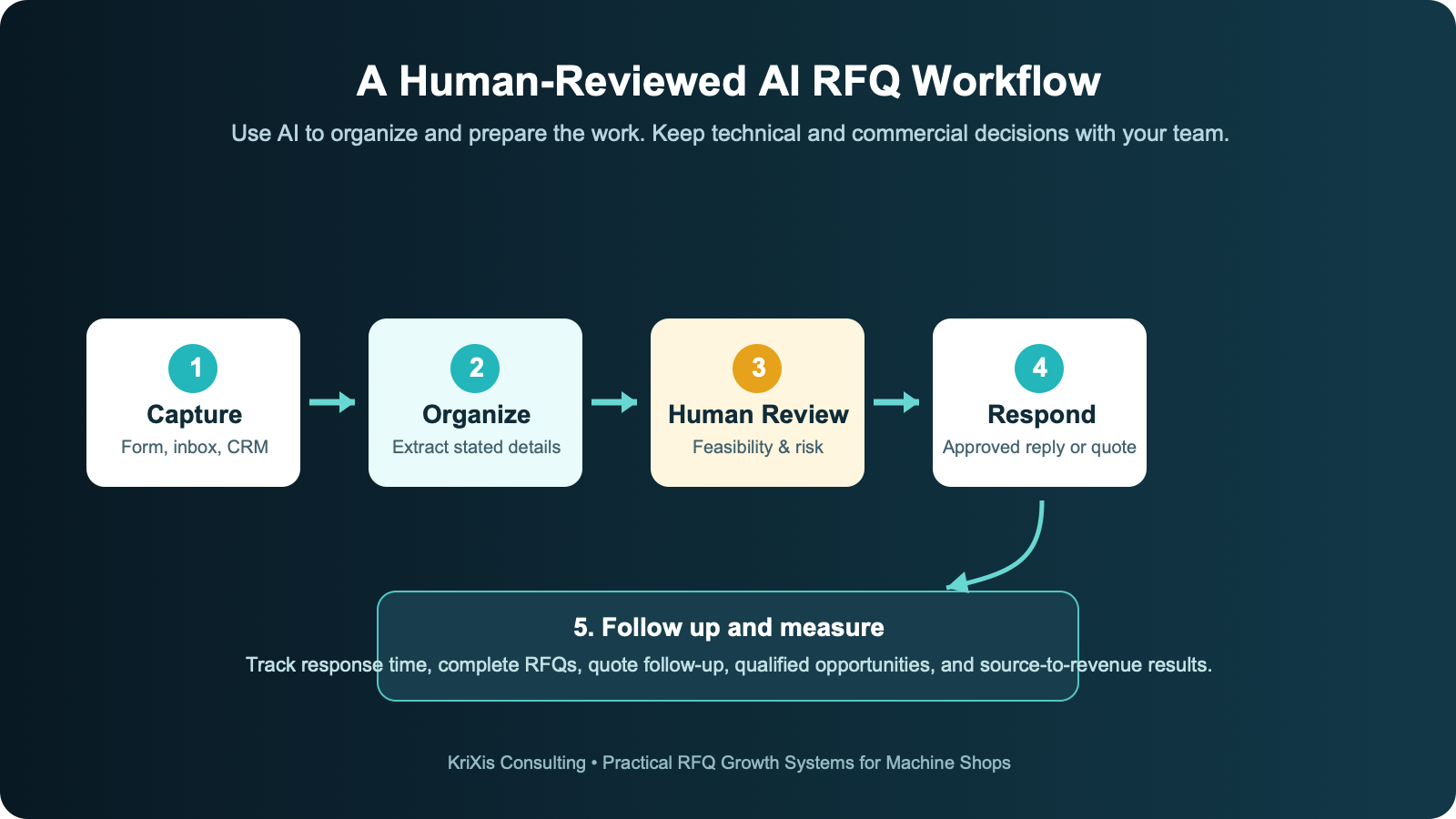
  1. Capture the RFQ in one place. Route website forms, designated email inboxes, and relevant messages into the shop’s CRM or lead system. Preserve the original source and attachments.
  2. Create a structured internal summary. AI can extract stated details—such as process, material, quantity, target delivery date, industry, and attached files—into a reviewable summary. It should clearly mark information it could not find rather than inventing an answer.
  3. Check for missing information. A draft response can ask for the specific items needed to begin a review: drawing revision, material, quantity, tolerance, certification, finish, delivery requirement, or other shop-defined fields.
  4. Route by rules the shop controls. For example, send repeat customers, a particular process, or a defined size range to the right estimator. Route out-of-scope work to a review queue rather than automatically rejecting it.
  5. Draft the acknowledgement and follow-up. AI can prepare a concise, professional response using approved language. A team member reviews it before it is sent.
  6. Keep the opportunity visible. Create follow-up tasks after the quote is delivered, document buyer responses, and report on the source and outcome of each lead.

That process reduces administrative friction without turning a sensitive technical decision into a black box.

A practical RFQ intake checklist

Before implementing any automation, decide what a qualified request means for your shop. The website form and internal workflow should make it easier for buyers to provide useful information, not create an obstacle course.

For many machining RFQs, a practical intake checklist includes:

  • Contact name, company, email, and phone number
  • Part drawing, model, or clear description of the work
  • Process or capability needed, if known
  • Material and any required finish
  • Quantity, including prototype versus production context
  • Critical dimensions, tolerances, or inspection requirements
  • Required certifications or industry requirements
  • Target delivery date or project timeline
  • Any confidentiality requirement or NDA process

Not every request will contain every item. The goal is to capture what is present, identify what is missing, and make the next human conversation more productive.

What should never be left to an AI tool alone

An AI assistant can be helpful around a quoting workflow, but it cannot know a shop’s actual capacity, tooling condition, supplier availability, machine constraints, or risk tolerance unless those facts are deliberately supplied and maintained. Even then, a responsible shop should keep human approval in the loop for decisions that affect the customer.

Do not let an AI tool independently:

  • Commit to a price, delivery date, capacity, or certification status
  • Interpret an ambiguous drawing as a final engineering requirement
  • Claim that a job is manufacturable or meets a tolerance
  • Send customer drawings, controlled technical data, or confidential information to an unapproved system
  • Reject a lead solely on an automated score without a review path

The right standard is simple: automate the preparation and reminders; keep technical and commercial commitments with accountable people.

Protect customer information in an AI RFQ response for machine shops

Customer drawings and RFQ data may be commercially sensitive. Before connecting an AI tool to a website, inbox, or CRM, document what data is allowed to enter the system, who can access it, how long it is retained, and whether the provider’s terms fit the shop’s obligations to customers.

Start with a limited pilot. Use a small set of non-sensitive or permissioned inquiries, require a human review before any outbound message, and track errors. Keep the original RFQ available so an estimator can compare the AI summary against the source material. The NIST Generative AI Profile is a useful framework for thinking through these controls, including risk management across the AI lifecycle.

For many shops, the first phase should work only with the contact details and text supplied in a form—not the drawing itself. Once the workflow is proven and the security review is complete, the team can decide whether it is appropriate to extend the system.

AI does not replace the RFQ path on your website

AI follow-up cannot compensate for a website that makes it hard for a buyer to understand the shop’s capabilities or submit a request. The site still needs accurate process pages, real capability proof, clear contact options, and a useful RFQ form.

KriXis’s Machine Shop SEO in 2026 guide explains how a buyer-focused site connects search visibility, technical credibility, and conversion. This is especially important as buyers use more detailed search queries and AI-assisted research. Google’s guidance remains clear: the foundation is helpful, reliable, people-first content and sound technical SEO—not a special AI markup trick. Google’s AI features guidance confirms that the same technical and content fundamentals apply.

In other words, build the website and the RFQ process for people first. Use AI to make the internal response process more consistent.

How to launch an AI RFQ response for machine shops in 30 days

The best first version is intentionally narrow. Do not try to automate every sales process at once.

Week 1: Map the current path

Follow three to five recent RFQs from source to outcome. Record where each request came from, who touched it, when it received a response, what information was missing, and whether it received a follow-up after a quote was sent. This baseline reveals the actual bottleneck.

Week 2: Define the rules and approved language

Create a shop-specific intake checklist and routing rules. Write approved acknowledgement and information-request templates. Decide which decisions always require a human review. This is the work that makes automation trustworthy.

Week 3: Pilot with one channel

Start with website RFQ forms or a dedicated inquiries inbox. Have AI create an internal summary and a draft response, but require staff approval before the draft is sent. Correct problems immediately and update the rules rather than working around them.

Week 4: Measure the result

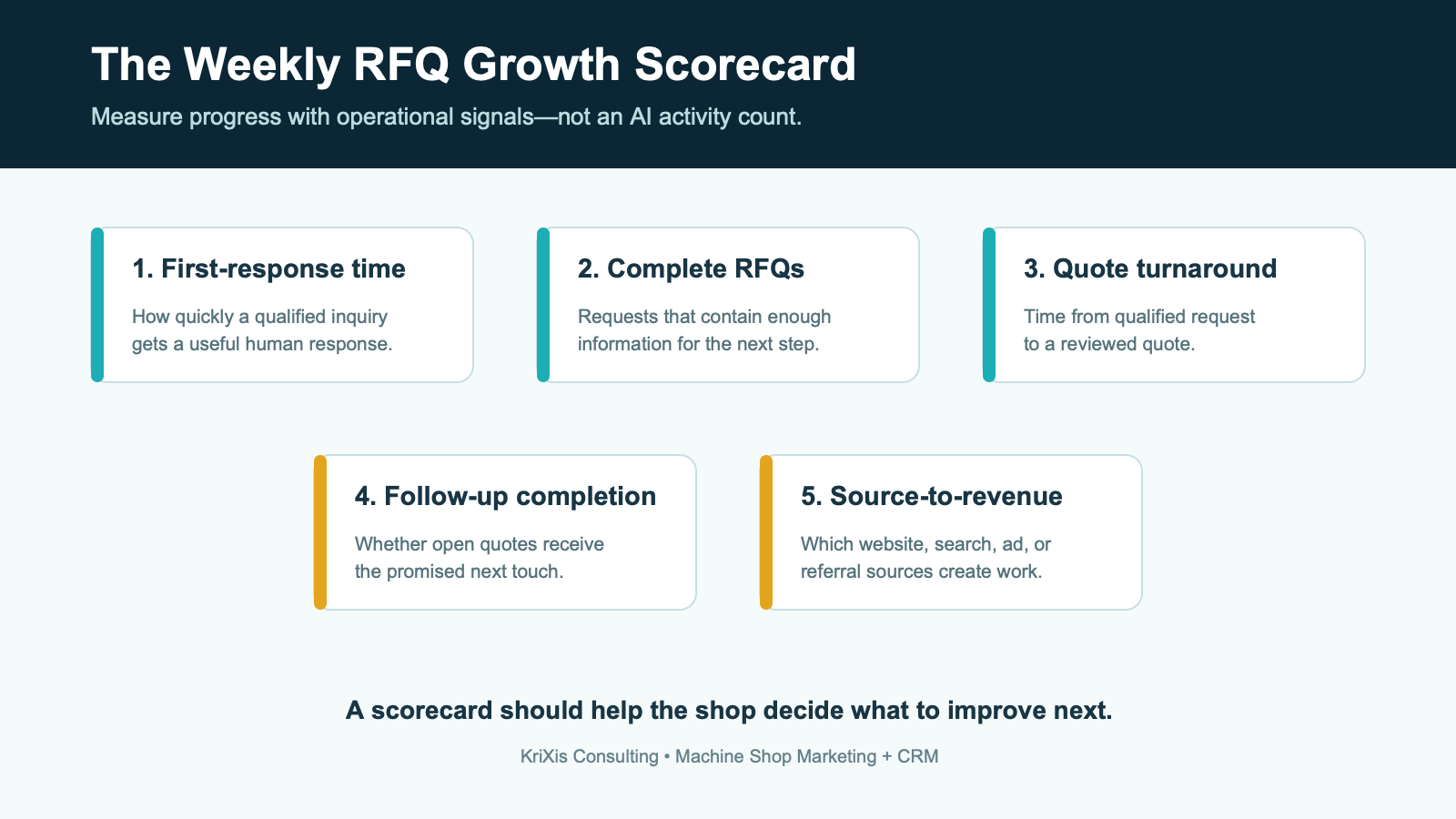
Review first-response time, completeness of intake, qualified RFQs, quote turnaround, follow-up completion, and the source of closed opportunities. Those metrics are more useful than counting how many messages AI drafted.

The outcome to aim for

The purpose is not to sound more automated. It is to make a serious buyer feel that the shop is organized, responsive, and able to understand the work. A better RFQ process gives estimators more time for the judgment that matters and gives marketing a clearer connection to revenue.

If your shop is investing in SEO, paid ads, or capability content, make sure the inquiry path and follow-up system can hold onto the opportunities that work creates. KriXis helps manufacturers connect website visibility, RFQ conversion, and CRM follow-up into one measurable growth system. Start a conversation with KriXis.

Sources

  • Google Search Central: AI features and your website
  • Google Search Central: guidance on generative AI content
  • NIST: Generative AI Profile

Why faster response matters before the quote is written

Speed is not a promise that every quote will arrive instantly. Good manufacturing work deserves careful review. Speed means that a buyer quickly knows the request reached the right team, understands what information is needed next, and is not left guessing whether the shop is interested. That early clarity is especially valuable for procurement teams managing several suppliers at once.

A short, accurate acknowledgement can do more for trust than a generic “we received your message” email. It should identify the next step, distinguish a request for missing information from a commitment to quote, and make it easy for the buyer to reply with the needed document or detail. The person reviewing the job can then focus on the work that genuinely needs expertise: machine fit, process route, tooling, inspection, subcontract work, scheduling, and commercial risk.

AI can make that first handoff more consistent because it is good at organizing repeatable information. It is not a substitute for the estimator. Think of it as the person who prepares a clean job folder, labels the attachments, highlights unanswered intake fields, and drafts the first note—then places it in front of an accountable employee for review.

Machine shop estimator reviewing an RFQ checklist before approving a quote response
AI should prepare the work around an RFQ; the shop’s people remain responsible for technical and commercial judgment.

Build the workflow around the buyer’s questions

Every RFQ workflow should begin with the questions a serious buyer needs answered. Can this shop make the part? Does it understand the requirements? Is there a practical next step? Who owns the conversation? A good process supports those questions even when the buyer’s original message is brief.

Create a small, approved knowledge base for the team. This is not a public marketing brochure copied into an AI prompt. It is a controlled reference set: standard acknowledgement language, lists of the information needed for different job types, routing rules, definitions of out-of-scope work, trusted CRM fields, and escalation contacts. Keep it factual and easy to update. If the shop changes a capability, certification, service area, or response policy, update the source before using it in automation.

Use categories that match real shop decisions. A five-axis prototype request, production CNC turning inquiry, repair job, and aerospace part with documentation requirements may all need different reviewers and different questions. The more the workflow reflects the shop’s actual operating model, the less likely it is to produce an impressive-looking but unusable summary.

Use a clear “missing information” branch

One of the highest-value uses of AI is drafting a respectful request for information. Rather than assume a material, tolerance, finish, or quantity, the system can flag the omission and present a concise list for the buyer. The message should explain why the information matters: for example, that it helps the team determine the right process or provide a useful quote. Avoid long generic questionnaires. Ask only for the next detail the team truly needs.

Keep the original language from the buyer visible alongside the summary. This makes it easy for an estimator to catch a nuance that a system may have missed, such as a revised drawing, a request for partial delivery, a special inspection note, or an unusual material callout.

Choose the first automation carefully

Do not start by connecting every inbox, shared drive, and ERP record. Begin with one low-risk, high-volume step where the outcome is easy to inspect. For many shops, that is website form intake. The form already has a defined structure, the source is clear, and the information is intended for the sales conversation.

A useful first automation might create a CRM record, preserve the original form submission, assign the lead owner, list the supplied fields, flag missing items, and prepare an internal task. The only external message is a human-approved acknowledgement. Once that path works reliably, the team can test a dedicated RFQ email inbox, quote follow-up reminders, or reactivation of prior buyers.

Set success criteria before the pilot starts. For example: every web inquiry appears in the CRM, an owner is assigned, missing fields are correctly flagged, and no unreviewed technical claim is sent to a customer. If the system does not meet those conditions, improve the workflow before broadening it.

Make the data structure useful to people

The quality of an AI-assisted workflow depends on the quality of the information it receives. A CRM should not become a pile of summaries that no one trusts. Use a small set of fields that the sales and estimating teams will actually review: source, buyer company, primary contact, capability or process requested, material, quantity, industry, stated timeline, status, lead owner, next action, and outcome.

Separate facts from interpretation. “Buyer stated 500 pieces in 6061 aluminum” is a fact. “High-value production opportunity” is an interpretation and should be labeled as such. When a summary is uncertain, it should say “not stated” or “needs review.” This preserves confidence in the system and prevents an AI-generated guess from turning into a sales assumption.

It also creates better marketing intelligence. When source, capability, and outcome are consistently recorded, a shop can see whether a service page, paid campaign, referral partner, or industry topic is producing inquiries that the team can actually quote and win. That is much more useful than traffic alone. KriXis’s digital marketing services are built around connecting visibility to measurable business activity.

Human-reviewed AI RFQ workflow for machine shops from capture through follow-up
AI organizes the request, while people review and approve the work that affects customers.

Set guardrails before the system touches customer data

Guardrails are not a technical afterthought; they are part of the customer experience. A buyer who trusts a shop with a drawing or project detail expects it to be handled carefully. Before introducing an AI tool, identify the data categories the shop receives and decide what is permitted in each system.

At a minimum, document who can access RFQ information, which vendor accounts are approved, how long the information is kept, what happens when an employee leaves, and how the team handles an NDA or customer-specific requirement. Review the tool’s data-use and retention terms with the person responsible for customer commitments. If there is uncertainty about controlled information, export-controlled work, or a client restriction, keep that data out of the pilot until qualified advice and a clear policy are in place.

Use least privilege. A marketing assistant may need to see lead source and a follow-up status but not every attached drawing. An estimator may need the complete job package. Role-based access is often more valuable than adding another feature because it limits unnecessary exposure while keeping the process usable.

Create an exception queue

Not every RFQ belongs in the normal flow. The workflow should flag requests that are incomplete, have unusual requirements, appear to contain sensitive data, or fall outside defined rules. A visible exception queue is better than silently routing a request to the wrong person or allowing the system to make a confident-looking assumption.

Give the team an easy way to correct the system. If an AI summary mislabels a process, fails to recognize an attachment, or suggests the wrong follow-up question, staff should be able to mark the correction. Review those corrections weekly. They show where the form, routing rules, or reference material needs improvement.

Design human review so it does not become a bottleneck

“Human in the loop” should not mean copying and pasting every message from one screen to another. It means building a review interface that makes the correct decision easier. Place the original inquiry, attached files, extracted facts, unanswered fields, suggested owner, and draft reply in one view. Make the reviewer choose an action: approve, edit, request information, reassign, or close as not a fit. Record the reason when appropriate.

Approved response templates help. For example, a standard acknowledgement can confirm receipt without promising pricing or delivery. A separate template can request missing information. A third can explain that a job is not within the shop’s current capability. Each message should be plain, professional, and tailored by a reviewer to the buyer’s actual request.

Technical decisions should have clear ownership. If an estimator needs a programmer, quality lead, or production manager to assess a requirement, the workflow should create the right internal task rather than encouraging a sales person to guess. AI can summarize the question for the specialist; it cannot replace the specialist’s sign-off.

Connect follow-up to real buyer value

Follow-up should not be a stream of automated “just checking in” notes. The best follow-up offers a useful next step: clarification on a requirement, an updated delivery question, a request to confirm a revision, a scheduling conversation, or a concise reminder that the quote is available. Use the shop’s actual sales cycle and buyer type to determine the timing.

AI can help create the task and prepare a draft, but a salesperson should decide whether the message is timely and relevant. When a buyer replies, preserve that context in the CRM so the next person does not restart the conversation from zero. This is where a connected CRM changes the experience from a marketing lead to a managed opportunity.

Measure your AI RFQ response for machine shops weekly

A useful scorecard tells the team where the system is weak. If response time is slow, investigate ownership and routing. If too many inquiries are incomplete, improve the RFQ form and the information-request template. If quote follow-up is inconsistent, make the next action visible. If a traffic source creates many low-fit requests, refine the associated marketing message or landing page.

Do not use the scorecard to claim that AI “caused” revenue before there is enough evidence. Use it to identify operational improvements and connect them to outcomes over time. Compare performance against the shop’s own baseline, not a generic industry promise. The goal is a more reliable process, not a vanity dashboard.

Machine shop AI RFQ response scorecard for response time, complete RFQs, quote turnaround, follow-up, and source-to-revenue
Five measures that make RFQ workflow improvements visible.

Questions to ask before choosing an AI or automation partner

Tools can be useful, but the vendor conversation should begin with the workflow, not a feature list. Ask how the tool handles data, whether outputs can be reviewed before they are sent, how it integrates with the CRM, what is logged, how access is controlled, and how the team can correct an error. Ask which parts of the process remain under the shop’s control.

  • Can we preserve the original RFQ and attachments alongside the generated summary?
  • Can we require human approval for every outbound buyer message?
  • Can the system state what it does not know rather than fabricating a field?
  • Can we limit access by role and remove access promptly when needed?
  • Can we audit routing, edits, and approvals later?
  • Can the workflow keep source attribution through to qualified opportunity and revenue?

If the answer to those questions is unclear, the solution may be too immature for a customer-facing quoting workflow. Start with a smaller use case or choose a partner that can explain the controls in plain language.

A practical next step: AI RFQ response for machine shops

Choose one RFQ source and map it from first contact to final outcome. Identify where the request loses context, where a buyer waits unnecessarily, and where staff spends time moving information rather than assessing the work. Then design the smallest change that improves that point. For many shops, that is a structured web form, a connected CRM record, a human-reviewed acknowledgement, and a clear follow-up task.

Once the fundamentals are reliable, AI can make the system faster and more consistent. It should reinforce the shop’s professionalism—not create new uncertainty. The shops that benefit most will be the ones that pair capable technology with accurate capability information, accountable people, and a clear process for turning interest into a useful RFQ conversation.


September 29, 2026/1 Comment/by Matthew Borza
https://www.krixis.com/wp-content/uploads/2026/09/krixis-ai-rfq-response-machine-shop-hero.png 941 1672 Matthew Borza https://krixis.com/wp-content/uploads/2015/12/KriXis-Full-Logo-Trans-300x79.png Matthew Borza2026-09-29 05:56:522026-10-11 02:03:48How Machine Shops Can Use AI to Respond to RFQs Faster—Without Risking Customer Data

Categories

  • Digital Marketing
  • Machine Shop Marketing
  • Machine Shop Of The Week
  • Manufacturing Marketing
  • Personal Branding
  • small business digital marketing
  • small business web design
  • web design

Our Latest Posts

  • Scattered request sheets pass through an opening into an organized estimating tray
    Machine Shop RFQ Form Design: From First Click to Estimator HandoffOctober 14, 2026 - 7:11 pm
  • Folded blue routes connect a brass question mark with page panels and a silver cube
    Machine Shop Content Strategy: A Complete Buyer-to-RFQ PlaybookOctober 13, 2026 - 7:03 am
  • Manufacturing engineer and content planner comparing a housing, fixture plate and adapter
    Machine Shop Industry Pages: Build Pages Buyers Can UseOctober 12, 2026 - 7:13 pm
  • Manufacturing professionals planning a website beside a machined aluminum housing
    Machine Shop Website Redesign: An SEO Migration ChecklistOctober 11, 2026 - 7:15 pm
  • Generic machined bracket and project folder with manufacturing professionals in a CNC shop
    How to Write Machine Shop Case Studies Buyers Can UseOctober 10, 2026 - 7:58 am

Be The First To Read Our Posts

Matthew Borza – President

KriXis Consulting measures success using tangible data. This is our MBA mindset. Our constant growth is due to the utilization of evidence-based strategies to deliver what matters most, ROI.

Scroll to top Scroll to top Scroll to top

This site uses cookies. By continuing to browse the site, you are agreeing to our use of cookies.

Accept settingsHide notification onlySettings

Cookie and Privacy Settings


How we use cookies

We may request cookies to be set on your device. We use cookies to let us know when you visit our websites, how you interact with us, to enrich your user experience, and to customize your relationship with our website.

Click on the different category headings to find out more. You can also change some of your preferences. Note that blocking some types of cookies may impact your experience on our websites and the services we are able to offer.

Essential Website Cookies

These cookies are strictly necessary to provide you with services available through our website and to use some of its features.

Because these cookies are strictly necessary to deliver the website, refusing them will have impact how our site functions. You always can block or delete cookies by changing your browser settings and force blocking all cookies on this website. But this will always prompt you to accept/refuse cookies when revisiting our site.

We fully respect if you want to refuse cookies but to avoid asking you again and again kindly allow us to store a cookie for that. You are free to opt out any time or opt in for other cookies to get a better experience. If you refuse cookies we will remove all set cookies in our domain.

We provide you with a list of stored cookies on your computer in our domain so you can check what we stored. Due to security reasons we are not able to show or modify cookies from other domains. You can check these in your browser security settings.

Google Analytics Cookies

These cookies collect information that is used either in aggregate form to help us understand how our website is being used or how effective our marketing campaigns are, or to help us customize our website and application for you in order to enhance your experience.

If you do not want that we track your visit to our site you can disable tracking in your browser here:

Other external services

We also use different external services like Google Webfonts, Google Maps, and external Video providers. Since these providers may collect personal data like your IP address we allow you to block them here. Please be aware that this might heavily reduce the functionality and appearance of our site. Changes will take effect once you reload the page.

Google Webfont Settings:

Google Map Settings:

Google reCaptcha Settings:

Vimeo and Youtube video embeds:

Other cookies

The following cookies are also needed - You can choose if you want to allow them:

Accept settingsHide notification only