
Machine Shop Quote Win/Loss Analysis
A machine shop quote win/loss analysis starts with decisions you can verify. If a buyer awards a job elsewhere, record what the buyer actually said. If the buyer has gone quiet, keep that uncertainty visible. If your team issued three revisions for the same RFQ, count the buyer's decision once. Those distinctions make it possible to tell whether you need to change how you estimate, how you explain the scope or which jobs you pursue.
Start with a small set of quotes your team can review together. Use this guide to define a decision, calculate a rate that your shop can reproduce and turn the review into one practical change.
Decide what counts as one quote opportunity
Use the buying decision as the unit of analysis. A purchase request may cover one part, several parts awarded together or several items the buyer can award independently. Define the unit before looking at the outcome. If a buyer requests a revised lead time or a different quantity for the same decision, keep the revisions under the same record. Save the original issue date and the latest relevant revision separately.
For a split award, begin with what the buyer actually decides. Suppose a fictional buyer is free to award two separately quoted components to different shops. In that case, the components can be two opportunities, and each gets its own outcome. If the buyer chooses one supplier for a bundled package, use the package as a single opportunity. Separate part-level analysis can still show which item drove the price or required the most estimating effort.
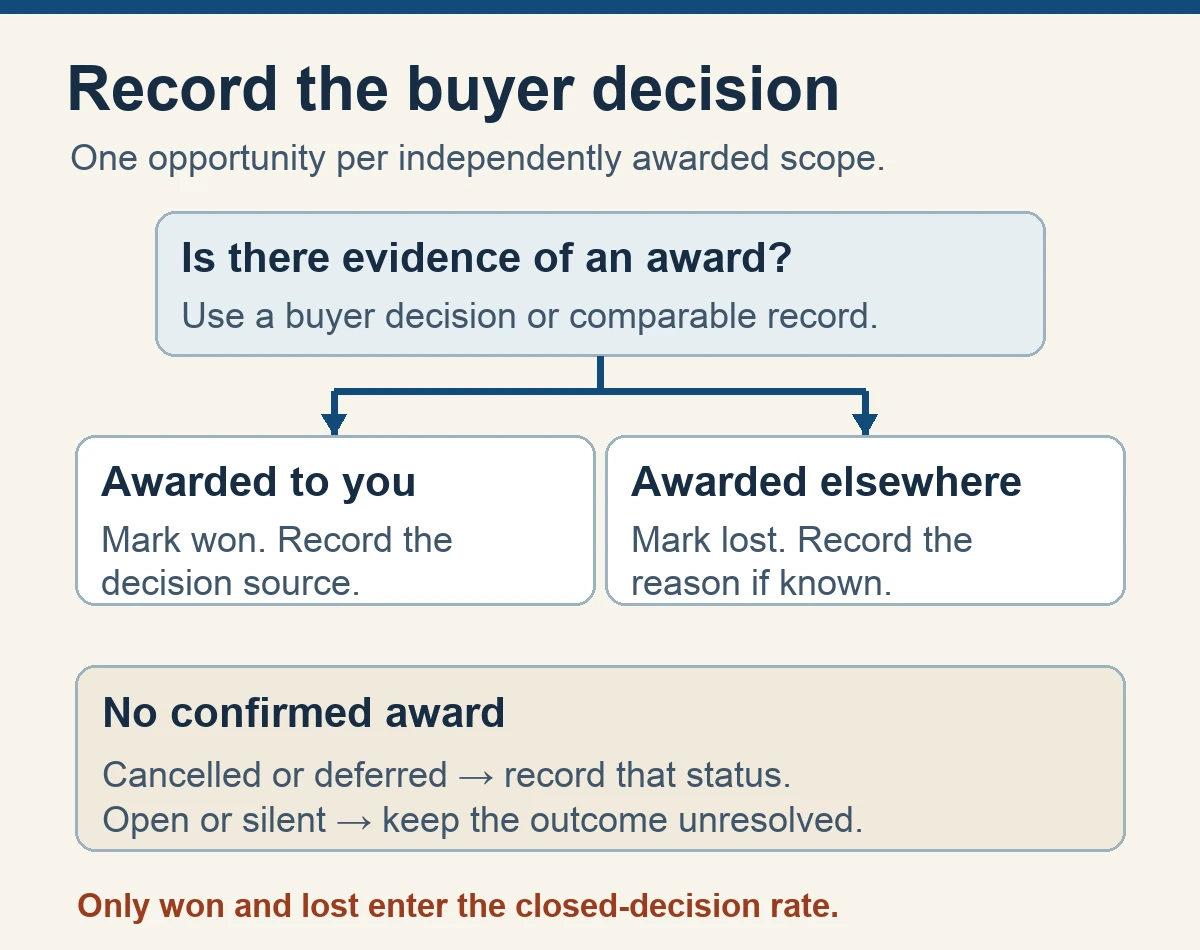
Record a win when your team has the agreed award evidence. A purchase order, a verified award notice or another defined business record can serve that purpose. Mark a loss when the buyer confirms the job was awarded elsewhere or your team has comparable evidence that your shop lost the buying decision. Put a cancelled or deferred program into its own status, with a follow-up date if there is one. Keep open, expired and silent quotes visible so someone can review them without having to infer an outcome.
Keep the presales funnel alongside this view. A request your shop declined before issuing a quote is helpful for measuring RFQ fit. It belongs in an intake or qualification report. The machine shop lead qualification guide explains how to document those early decisions. For win/loss review, begin with work the shop actually quoted.
Decide how to handle the jobs that reopen. If the buyer issues a distinct RFQ after cancelling a project and the award can be decided independently, create a new opportunity and cross-reference the old one. If the same buyer simply asks for another revision before a decision, continue the existing record. Keep the date and reason for any change in status so someone can reconstruct what your team knew at the previous review.
A short rule can settle most disagreements before the meeting. For example, decide whether an awarded package is closed when purchasing sends a formal notice or when an order arrives. Apply that rule consistently and carry genuinely unclear cases forward with an owner.

Put outcomes and reasons in different fields
An outcome tells you what happened. A reason tells you what someone knows about the decision. Keep those as separate fields even if you record both in one note. A closed loss can have an unknown reason. An open quote can have a useful buyer objection without a final decision.
Start with a short reason list that the estimating team can apply consistently. A price or commercial reason can cover the total price, minimum order quantity or terms. Timing can include the required delivery date, the offered lead time or the time it took to return a quote. Capability can include process, materials, quantity fit or a requirement your shop could not support. Other reasons can cover a required quality or documentation step, an incumbent supplier, or an incomplete understanding of the scope. Use a separate outcome for program cancellation, deferral or silence.
Define boundaries between similar reasons. A buyer who says “the other quote includes inspection documentation” has given more useful information than a generic price label would capture. Record the evidence in a short note and choose the most specific category your team can support. Sometimes a price difference is real but the packages still differ. Ask whether material, outside processing, inspection, quantities and delivery terms were comparable before interpreting a price comment.
Keep an evidence field. A buyer's direct comment, a purchasing notice, an internal inference and a missing response carry different weight. Include the date and a reference your team can find inside the approved system. If an estimator believes lead time mattered, record that as a hypothesis unless the buyer or decision record confirms it. A usable reason code makes the next review easier without flattening the uncertainty.
NIST Manufacturing Extension Partnership guidance on supplier selection describes how buyers evaluate capabilities, total cost and quality documentation. Use those dimensions as prompts when reviewing quote notes. A buyer's actual feedback determines which one applies to a given loss.
Calculate the rate with an explicit denominator
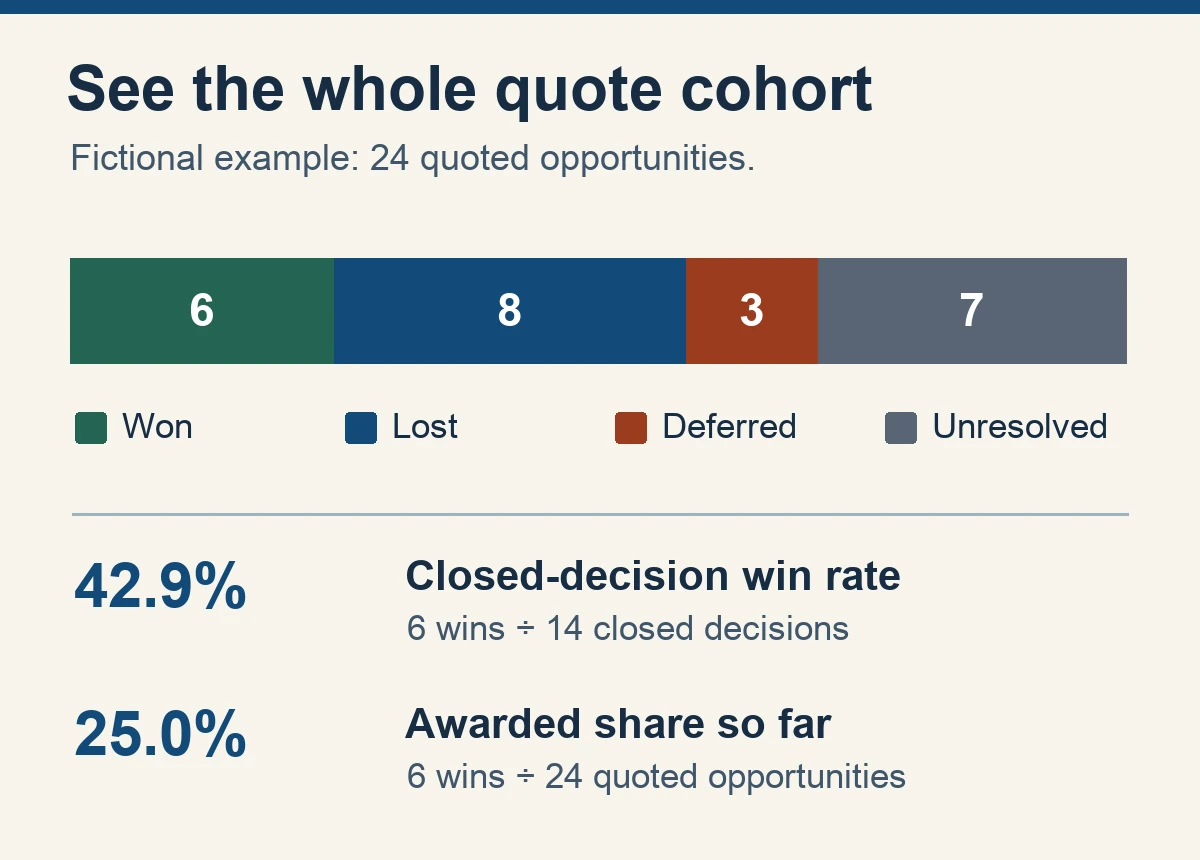
For this guide, the closed-decision win rate is won opportunities divided by won plus lost opportunities. Report the numerator and denominator with the percentage. That is the same closed-opportunity principle described in Salesforce's win rate reporting guidance. In your shop's report, define which statuses count as wins and losses and show the other statuses alongside the rate.
Pick the question before choosing the reporting window. A decision-date view asks what the shop won or lost during a period, including decisions on quotes prepared earlier. An issue-date cohort follows the quotes sent during a period and shows what has happened by a stated review date. The second view helps compare similar batches, but a recent batch can still have many undecided items. If you use both, label them plainly and compare each view with the same kind of view.
Consider a fictional cohort of 24 opportunities quoted during one month. At review, 6 were won, 8 lost, 3 cancelled or deferred and 7 remain open or without a decision. The closed-decision win rate is 6 divided by 14, or about 42.9%. The share of the full cohort awarded to the shop so far is 6 divided by 24, or 25%. Keep the seven unresolved opportunities visible so readers understand why the numbers can change.
Use the same distinction when reviewing value. If the shop wants an amount-weighted rate, define a consistent quote value for each win and loss before adding the amounts. Keep booked order value in its own field if it differs from the quoted opportunity value. An award that covers a single line from a package can make the two measures diverge. A large decision can dominate the value view, so keep the count view beside it and describe any exceptional opportunity.
Compare groups with their counts. Six wins out of ten resolved repeat orders can sit beside two wins out of four prototype decisions, but neither small group can establish a long-term advantage. If a group has no known wins or losses, show “no closed decisions” and list how many opportunities are still pending. When there is a thin sample, use the review to decide what evidence to collect next.
Ask for one fact the buyer can share
Use a short closeout question when the buyer can answer it. For example, “Thanks for the update. If you’re able to share one thing that mattered most to the sourcing decision, was it the offered delivery date, scope, price or something else?” Choose a question that follows the conversation. A buyer evaluating a new supplier may care about a qualification step, while a repeat buyer might be comparing a specific delivery commitment.
If the buyer says the decision is on hold, ask when it would be useful to check back. If the buyer chooses another shop, thank them and record the feedback as they gave it. Avoid asking for confidential quotes, internal scoring or details the buyer cannot share. If they do not reply, note the last follow-up and follow the shop's own cadence. The quote follow-up guide provides examples for buyer communication while a decision is open.
Collect a little evidence about wins too. Ask what helped the buyer move forward when doing so fits the relationship. A clean inspection plan, a well scoped feasibility call or a clear delivery assumption may matter more to the buyer than the feature your team thought made the difference. Preserve a useful observation in the opportunity record. Ask separately before using a buyer's name, words or project details as marketing material.
Fictional teaching example: three buyers mention lead time. One needed parts for a fixed assembly date, one needed a faster response to the RFQ, and one wanted certainty about a special outside process. They have given three different signals. A shop could test whether it can communicate the outside-process schedule better without promising a shorter production lead time across every job.

Find patterns among comparable jobs
Review the outcome data alongside the work the shop is set up to win. Start with one split that might change a decision, such as new versus existing customers, prototype versus repeat production, or a process you actively market. Keep the unit, window and reason rules consistent. Leave unknown segments marked unknown. Avoid drawing conclusions about the source of a quote if tracking connects only part of the path. Use the RFQ conversion tracking guide when that gap starts at intake.
Look for evidence you can act on. If repeat work is doing well while one-off parts consume disproportionate quoting time, examine which website promises and intake questions attract those inquiries. Check whether the buying opportunity was ever a fit for the shop. Clearer machine shop capability pages can help buyers see the supported process, typical work and where to ask for clarification before sending a package.
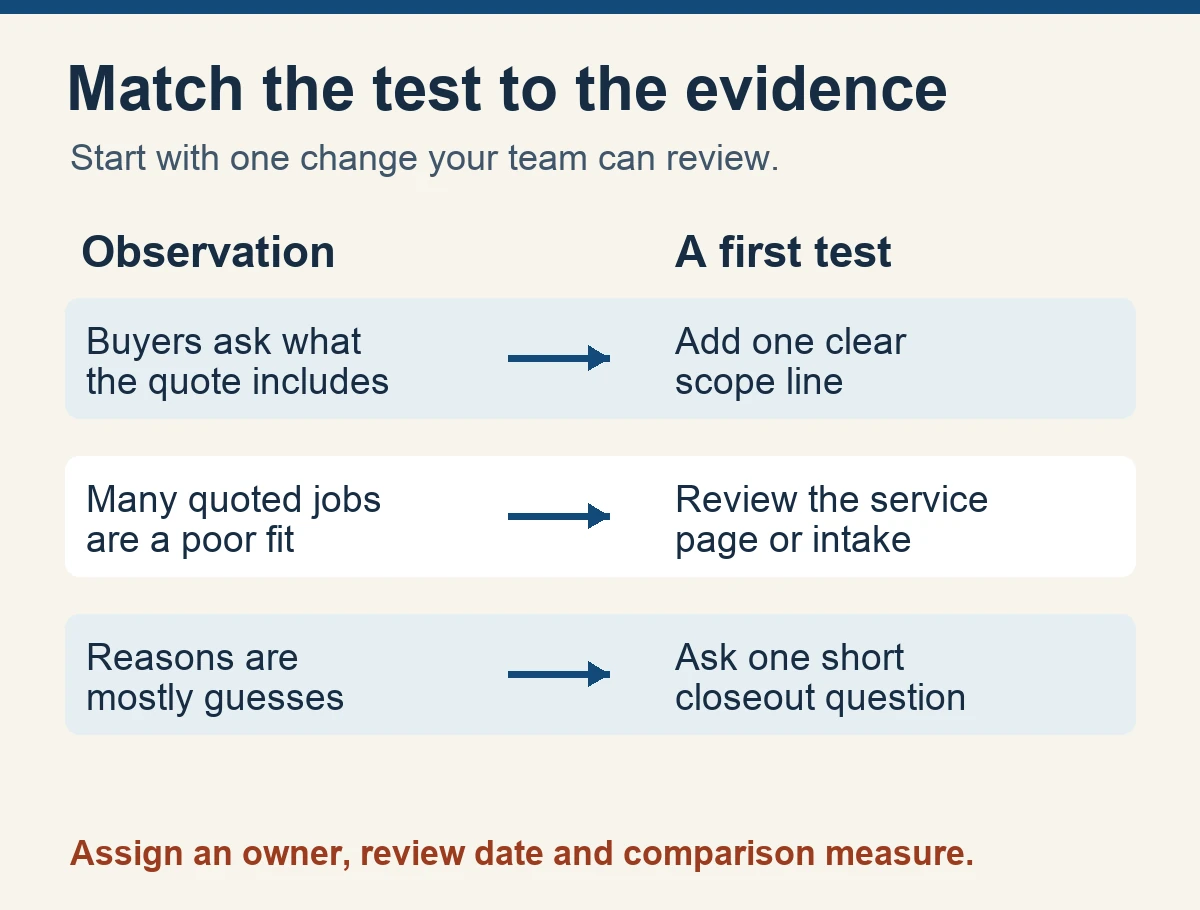
If several buyers say they could not tell whether a requirement was included, review the estimate and quote presentation together. Compare the quoted assumptions with what estimating discussed internally. Add one line for the scope that caused confusion. For example, say whether a particular inspection report is included, available subject to review or outside the current quote. Ask the estimator to approve the wording and check it against the requirements for that job.
If promising work stalls while the shop waits for buyer details, look at where the question appears in the workflow. Some requests need a clearer intake checklist. Others need an owner to ask a focused question promptly. The machine shop RFQ checklist gives buyers a way to prepare a usable package. The conversion tracking article helps test whether the request reaches the team.
Also pay attention to ambiguous patterns. If two estimator notes say price and both buyers were silent, a discount would test an assumption without first checking its origin. Review the account conversation, scope and awarded work where known. If evidence stays thin, improve reason collection for the next batch. A few well documented losses can be more useful than a long list of guessed reasons.
Run a short review and assign one change
Bring the estimator, the person who owns follow-up and someone who can change the relevant page, intake form or template. Review outcomes first. Ask whether the team counted the same type of opportunity throughout the period. Then look at the few records behind the strongest pattern. End with one change, an owner, a date to review it and the evidence that will help you decide whether to keep it.
Here is a fictional example. A shop learns that buyers often ask whether a particular outside process is included. The estimator adds a short scope line to one quote template. A second person checks that the line matches the estimating assumptions and avoids promising unsupported delivery dates. The shop records how often buyers ask the same clarification question on comparable quotes in the next review period. It also records estimating effort and known outcomes when available. A lower question count may indicate better scope clarity. A stronger causal claim would require more evidence than one small before-and-after comparison.
Write the decision in plain terms. “Alex will add an inspection deliverable line to repeat turning quotes next week and compare clarification requests after a month” gives the next reviewer enough to revisit the change. If the new line makes quoting slower or creates more confusion, adjust it. Track one change at a time when practical so the team can tell what each test changed.
Use the same meeting to route findings the team cannot act on immediately. An owner can record capacity or staffing issues for an operations review. The marketing team can hold a page change until estimating confirms what it can offer. A quote about a cancelled project can be closed or revisited at an agreed date. Put open questions next to their owners so the review produces fewer ambiguous records next time.

You can start without a new CRM or a large dashboard. Record a small, comparable batch, keep the unanswered quotes visible and agree on which buyer evidence would change your next decision. If the review exposes a gap between inquiry intake, estimating and quote follow-up, KriXis RFQ Growth describes the related services and where they fit.

Trackbacks & Pingbacks
[…] a decision is known, use the quote win/loss analysis guide to record the outcome and source of the buyer […]
Leave a Reply
Want to join the discussion?Feel free to contribute!