
Machine Shop Lead Generation: A 90-Day Plan for Better RFQs
KriXis editorial guide · About 13 minutes to read
Machine shop lead generation works best when the shop can explain which work it wants, help a buyer evaluate fit, and respond consistently when an inquiry arrives. More traffic cannot compensate for an unclear capability page or an RFQ that sits in an unattended inbox.
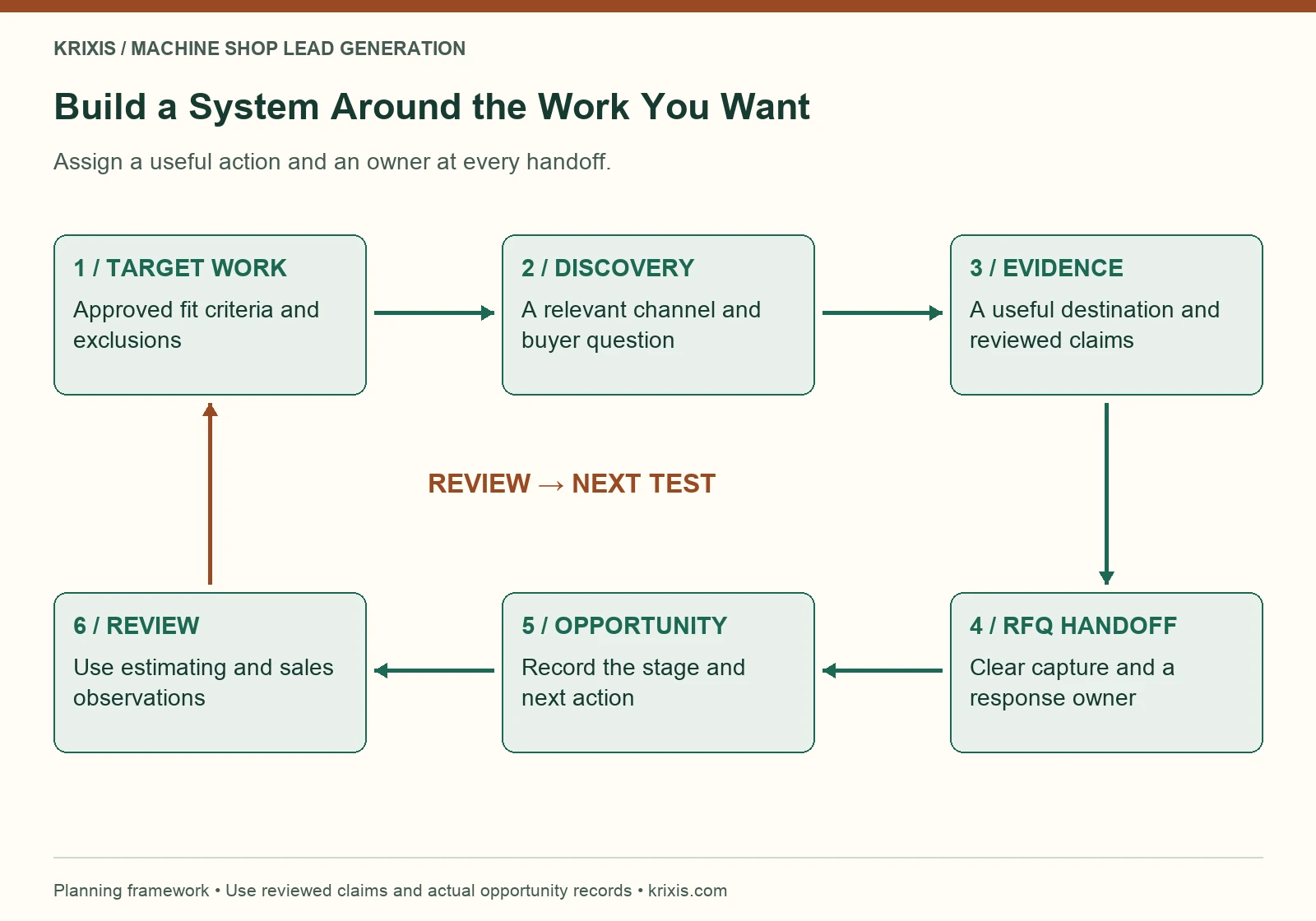
Start with a narrow, testable plan. Choose one useful type of work, connect it to a specific audience and page, and follow the inquiry through qualification and quoting. Expand after you understand what the first route produces.
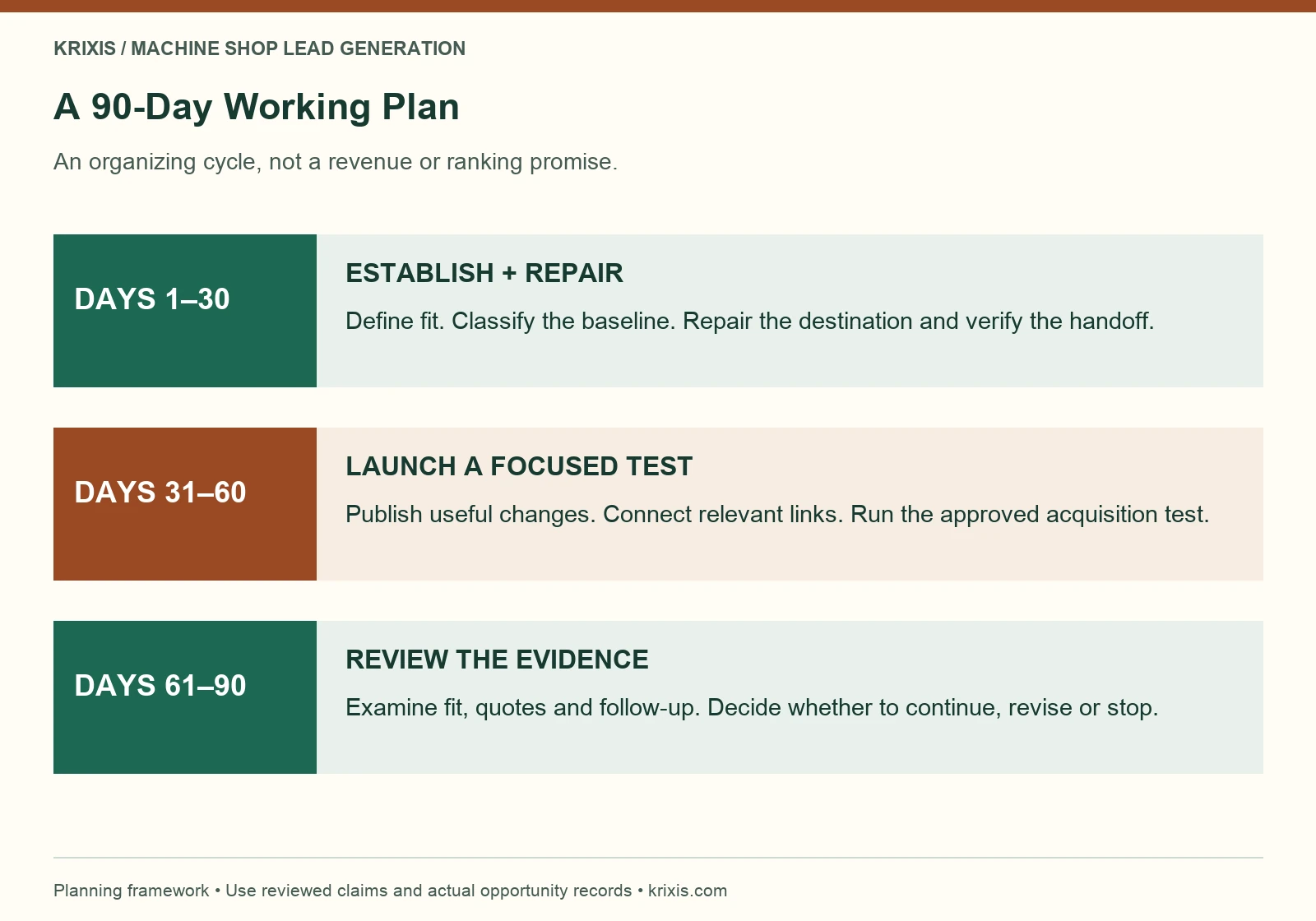
This guide lays out a practical 90-day planning cycle for an owner, sales lead and estimator. Ninety days is an organizing framework, not a promise that SEO, a new campaign or a buyer’s purchasing cycle will produce revenue within that period.

Define the work you actually want to win
Write a short target-work brief before selecting a channel. Include the processes, materials, part-size range, quantities and project conditions your team wants to evaluate. Add exclusions where appropriate. Have the responsible technical person review anything that will become a public capability claim.
Separate current capacity from long-term capability. A shop may be able to produce a type of part but have no suitable capacity during the buyer’s required window. Marketing should not turn an outdated capacity note into a delivery commitment.
Make the brief useful to sales: “We want inquiries for this process and general work profile, subject to technical review” is more actionable than “We want more manufacturing customers.” Avoid selecting an industry label that implies an approval or certification you do not hold.
Use the brief to decide what an initial inquiry should contain and what belongs in later review. The RFQ qualification guide provides a fuller scorecard. Here, the purpose is to focus acquisition before additional inquiries consume estimating time.
Establish a baseline before adding another channel
Review recent inquiries with the people who received them. Record the source when known, the work requested, whether the opportunity fit, what happened next and why it stopped. Mark missing information as unknown instead of assigning a convenient source afterward.
Keep distinct stages: inquiry received, qualification pending, qualified for review, quote issued, won, lost or deferred. A contact-form submission is not automatically a qualified RFQ. Agree who can change each stage and what evidence they need.
Look for the immediate constraint. If the website attracts appropriate buyers but the form fails, repair the capture route. If many inquiries concern work you do not perform, examine your claims and targeting. If suitable inquiries stall after quoting, examine follow-up before buying more visits.
Connect this baseline to your marketing ROI process. Keep the sample period, missing records and outstanding sales cycles visible. A small, incomplete dataset can suggest a useful test without supporting a reliable growth forecast.
Build one complete route from search to inquiry
Choose a buyer question that closely matches the target work. The destination should explain the relevant capability, limits, evidence and inquiry instructions. Avoid sending every search visitor to a home page that makes them find the subject again.
A useful route might connect a process search to a reviewed capability page, then to quality information and a clear RFQ action. A referral may start with a specific project question and need an approved example before the buyer contacts you. Plan for both paths.
Our capability page blueprint explains the destination’s content. The website navigation guide explains how to connect it with related pages. Neither step requires creating dozens of near-identical pages.
Give the route an owner, a destination URL and a defined next action. Test the live experience on a phone and with a keyboard. Confirm that links, contact details and RFQ instructions work before sending a campaign into the route.
Use Search Console to choose an achievable content test

Review non-branded queries that relate to your actual services. Look for a relevant query with impressions, a plausible destination and a question the page does not yet answer well. Inspect which URL receives the impressions before deciding to write another page.
An existing service page may need a clearer explanation, while a distinct informational question may deserve a supporting article. Give the article its own job: explaining a process, checklist or decision. Link it to the service page when a reader wants implementation help. Repeating the same sales copy at a second address adds little value.
Google’s Search Console performance documentation explains clicks, impressions, CTR and average position. Treat average position as a report metric, not a fixed rank every buyer sees. Record the date range, query, landing page and change you intend to test.
Choose usefulness over a keyword list. An impression shows that the site appeared in a result; it does not tell you total market demand or guarantee that a longer article will win the click. Google’s helpful-content guidance emphasizes content that serves the reader’s task.
Select channels according to the constraint
Organic search can support buyers looking for a process, material or supplier answer. It needs useful reviewed pages, discoverable links and time for evaluation. Use the machine shop SEO playbook for the broader search foundation.
Paid search can test a tightly defined intent when the destination and inquiry process are ready. Start with a scope and spending limit your business approves. Review actual search terms, the resulting inquiries and the work fit, rather than treating ad clicks as success.
Google Ads explains how negative keywords exclude unwanted searches. For example, a shop that does not sell used machinery should examine whether its campaign is attracting equipment shoppers. Review exclusions carefully so they do not accidentally remove useful buyer intent.
Referrals, relevant supplier relationships and existing customer conversations can produce a different route. Make the introduction specific to the work sought and follow the recipient’s preferences. Avoid assuming a purchased contact list is a qualified audience. Select a small number of channels that the team can operate and measure well.
Give engineers and sourcing teams useful evidence
A buyer should be able to understand what you do without interpreting a collection of slogans. Explain the process, the information needed for technical review and the limits of any published example. Use clear headings and descriptive links to deeper information.
Keep equipment and quality information consistent with the main capability page. A current equipment list can help explain resources. A quality page can explain what information is available and how to request it. Neither should imply universal suitability for a buyer’s part.
Use approved examples where they answer a genuine question. Explain the work context and what can be publicly supported. Do not turn an illustrative image into supposed client proof, invent a performance result or publish customer information without the appropriate approval.
Ask an estimator to review the route as a buyer would. Which question still requires an email? Which wording could create an expectation the team cannot meet? Resolve those issues before expanding the campaign. Better evidence can make the next conversation more useful even when the visitor does not inquire immediately.
Capture enough detail for a useful first response
Make the RFQ action visible from relevant pages and explain what happens next. Ask for the information your team needs to route the inquiry, but avoid turning the first contact into an unnecessary administrative exercise.
Distinguish a preliminary question from a formal quote request. A buyer who is still assessing fit may not have a complete package. Give them a sensible way to ask the question while preserving a clear route for a detailed RFQ.
Publish only the drawing-sharing instructions your business has approved. Do not claim that an ordinary email address or generic form provides a security capability you have not verified. Keep technical commitments, restricted information and document decisions with the responsible people.
Test the complete RFQ form and handoff, including validation, receipt, routing and the fallback contact route. A thank-you screen alone does not prove that the correct employee received the submission. Assign a human owner and verify the handoff using your approved testing process.
Connect the source to the CRM without inventing certainty
Record how the inquiry arrived and preserve the buyer’s own explanation when available. Keep known campaign data, the landing page and a self-reported referral source as separate fields. They may describe different moments in the same buying journey.
Use consistent campaign names for links you control. Google’s campaign URL guidance explains source, medium and campaign parameters. Do not place personal information, drawing identifiers or confidential project details in tracking URLs.
Define measurement events around actual actions. If your implementation uses GA4, its recommended events reference distinguishes lead-related events. A website inquiry event and a later qualified opportunity need different evidence and may come from different systems.
The machine shop CRM guide covers ownership and follow-up. Keep unknown sources unknown, deduplicate repeat inquiries and retain the opportunity’s next action. Attribution helps organize observations; it does not prove that one click caused the eventual order.
Read this graphic as text
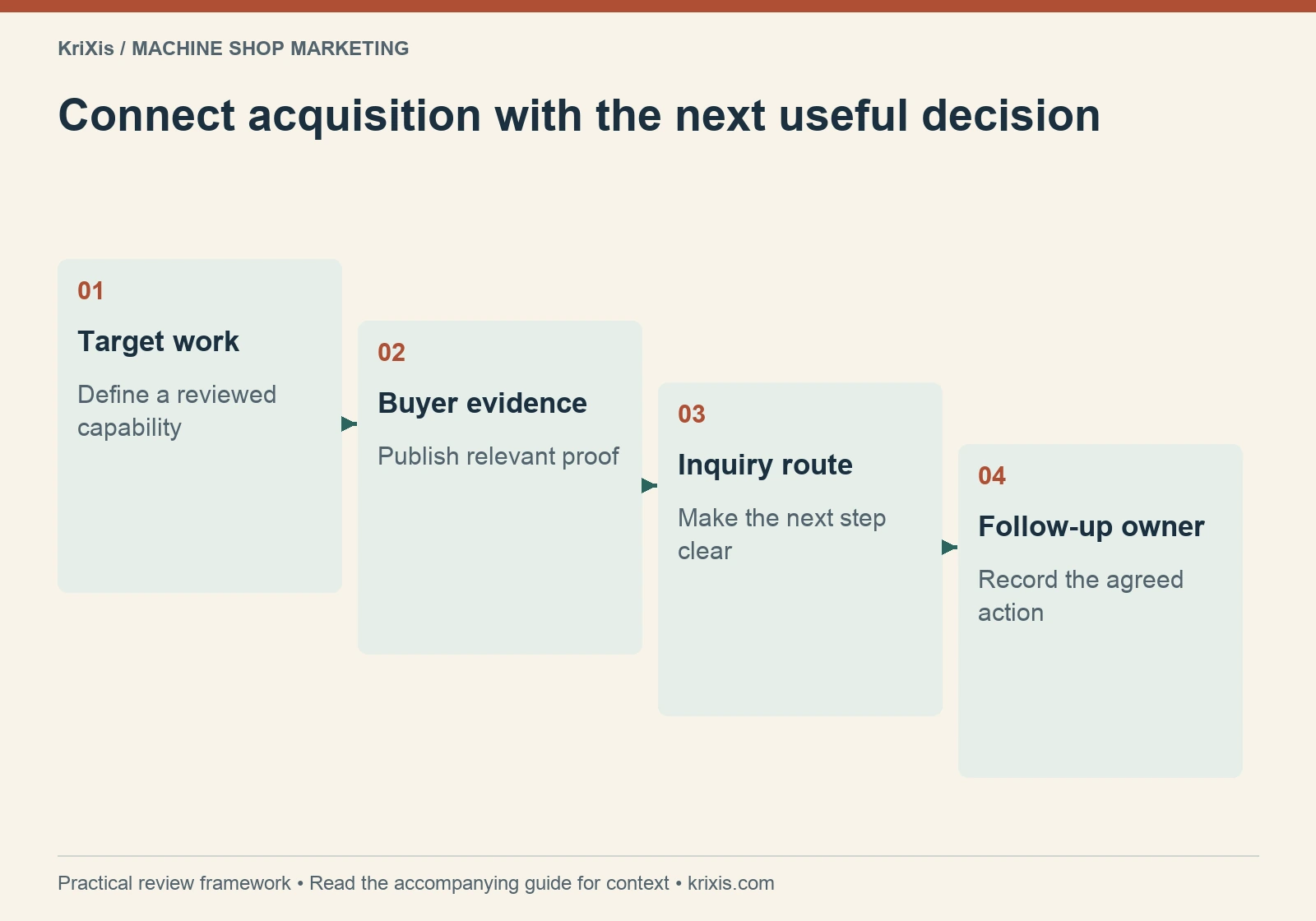
- Target work: Define a reviewed capability
- Buyer evidence: Publish relevant proof
- Inquiry route: Make the next step clear
- Follow-up owner: Record the agreed action
Run the plan in three 30-day stages
Days 1–30: establish fit and repair the route
Approve the target-work brief, classify the recent inquiry baseline and select one priority buyer task. Review its destination, evidence and RFQ handoff. Fix broken links, unclear claims and missing ownership first. Establish the source and stage fields your team will maintain.
Days 31–60: launch a focused acquisition test
Publish the useful page improvements or supporting article. Add relevant incoming links from existing content. If a paid or relationship-based test fits the plan, launch it within its agreed scope. Record the dates, audience, destination and changes so the review has context.
Days 61–90: evaluate the work, not just the visits
Review inquiries with estimating and sales. Identify fit, quote decisions, open questions and follow-up completion. Compare like-for-like periods where practical and explain differences in timing or sample size. Continue, revise or stop the test based on observed evidence and the business’s capacity to respond.

Diagnose weak results before changing everything
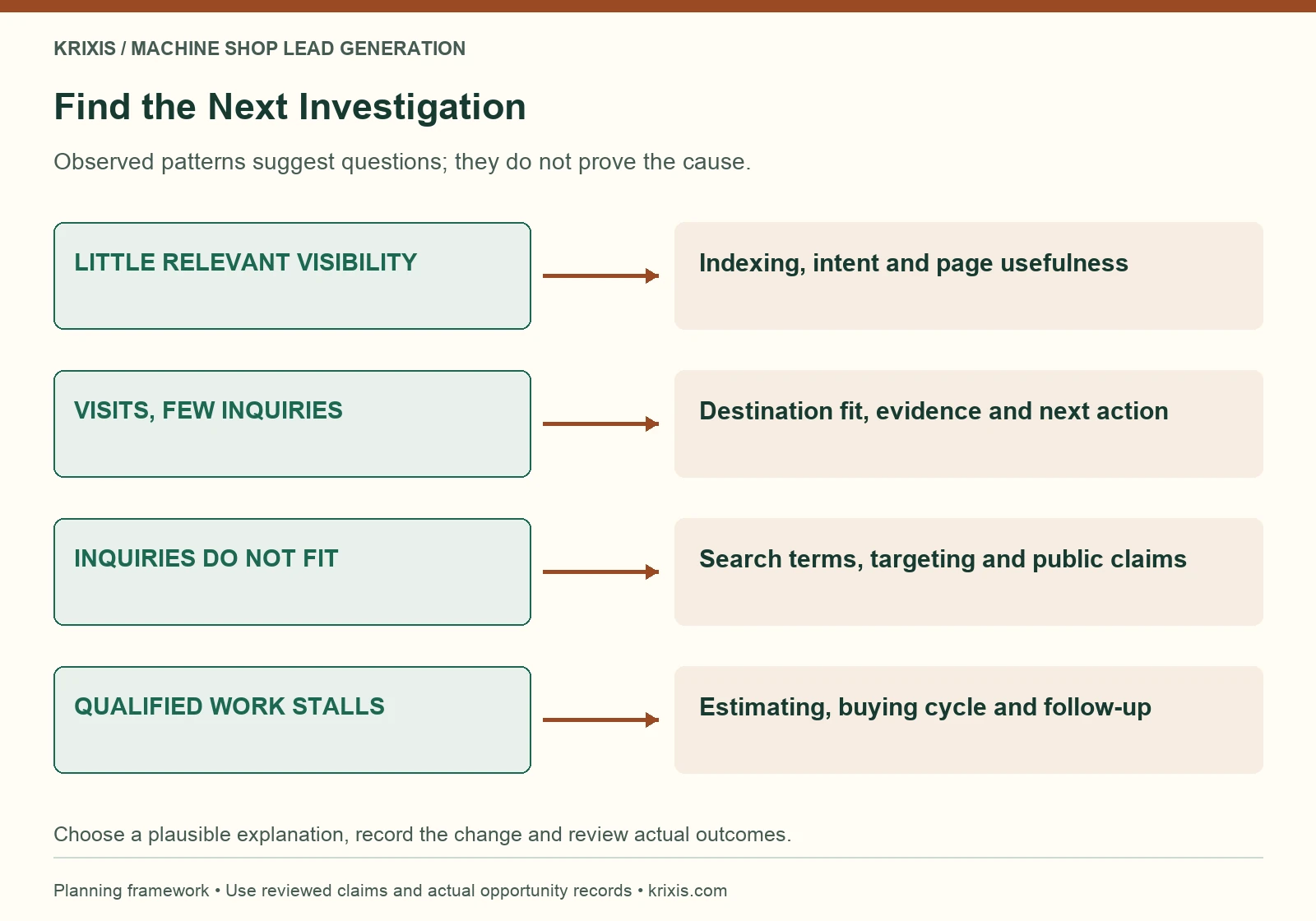
Use the pattern in the records to choose the next investigation. Little relevant visibility may call for reviewing indexing, search intent and the page’s usefulness. Visits without inquiry activity may call for checking destination fit, evidence and the next action. Inquiries without suitable work may point toward targeting or expectation problems.
Qualified inquiries without quotes need a conversation with estimating. Quotes without decisions need an examination of the buying cycle and follow-up, not an automatic accusation that marketing failed. Several factors can produce the same pattern, so test a plausible explanation instead of declaring a cause from one metric.
Fictional teaching example: a shop’s campaign receives visits and inquiries, but the estimator records that most ask for a process the shop does not offer. The next useful action is to inspect the search terms, ad wording and destination claims. Increasing the campaign budget would not resolve that observed mismatch.
Keep a short change log. Make one meaningful adjustment where practical, record what changed and review it after enough relevant activity has occurred. Avoid claiming an improvement from a handful of visits or an unfinished quoting cycle.

Review a small scorecard every week
Track inquiries, qualified opportunities, quotes, decisions and the next follow-up action by source where known. Add response ownership and the reasons work did not fit. Use counts alongside rates so a small denominator is visible.
Agree the qualification definition before comparing channels. A channel that produces many incomplete messages is different from one that produces a few relevant conversations. Neither can be judged solely by the website’s form total. Keep open opportunities separate from losses and avoid assigning revenue before a real outcome is recorded.
At the end of the cycle, keep the useful route, repair the clearest remaining constraint and choose the next test. For implementation help across search, destination pages and follow-up, explore KriXis machine shop lead generation. The aim is a process the shop can operate consistently and improve with real evidence.


Trackbacks & Pingbacks
[…] improve how suitable inquiries reach this qualification process, use our machine shop lead generation plan for a 90-day acquisition test, destination-page checks and source […]
Leave a Reply
Want to join the discussion?Feel free to contribute!