Krixis Consulting
  • Services
    • Manufacturing Marketing Agency
      • Machine Shop SEO
      • Machine Shop Website Design
      • Machine Shop Lead Generation
  • RFQ Growth
  • Blog
  • Contact
  • Portal Sign In
  • Menu Menu
  • Link to X
  • Link to Facebook
  • Link to LinkedIn
  • Link to Pinterest
  • Link to Instagram
Machine Shop Marketing

How to Measure Machine Shop Marketing ROI: From RFQ to Won Work

By Matthew Borza, KriXis · Published October 9, 2026 · About 13 minutes to read

More website traffic can look encouraging while the estimating team sees little useful change. Perhaps inquiries increased, but most need a process you do not offer. Perhaps good RFQs arrived, but nobody recorded where they came from. Perhaps quotes are still open when the monthly report declares the campaign unsuccessful.

Measuring machine shop marketing ROI starts by connecting discovery, qualification, quoting, and commercial outcomes. The aim is a defensible answer to two questions: which activities bring work worth pursuing, and where does that work stop progressing?

This guide gives owners and sales teams a practical measurement system, a worked example, and a monthly review process. The examples are fictional planning illustrations. They are not KriXis client results or machining industry benchmarks.

Machine shop owner and estimator reviewing opportunity records and a machined part
In this guide

  • Start with the work your shop wants to win
  • Track six stages from discovery to delivered work
  • Capture source information without slowing intake
  • Use website analytics for successful actions
  • Calculate a compact set of useful metrics
  • Work through a fictional machine shop example
  • Match reporting periods to the sales cycle
  • Use attribution to inform decisions, with its limits visible
  • Run a monthly review with sales and estimating
  • Diagnose the bottleneck before increasing spend
  • Build a reliable baseline in the next 30 days
  • Common questions about machine shop marketing ROI

Build your baseline before changing the budget

Use a browser-based worksheet to calculate your baseline and record one next action.

Get the free RFQ scorecard and ROI worksheet

Start with the work your shop wants to win

Define the business goal before selecting dashboard metrics. A shop with open capacity may need new production accounts. A fully booked operation may prefer repeatable work, a healthier customer mix, or fewer unsuitable requests. Those goals lead to different definitions of success.

Write a short description of a suitable opportunity: processes, materials, part sizes, quantities, quality requirements, commercial conditions, and timing. Ask estimating and operations to review it. The description must reflect current capability and capacity rather than an idealized service list.

Our machine shop lead qualification guide provides a scorecard for this decision. Use the same acceptance criteria when reviewing sources. Otherwise, one channel can appear stronger simply because its inquiries received a more generous assessment.

Also decide what counts as a new opportunity. One buyer may send three revisions of the same RFQ. Count that as one opportunity with a revision history, not three new leads. Keep customer accounts, projects, quote revisions, and purchase orders distinguishable.

Track six stages from discovery to delivered work

Use a small set of stages that everyone can explain. Website activity provides context; the opportunity record supplies the operational history.

  1. Discovery: a relevant visit, referral, event interaction, or other introduction.
  2. Inquiry received: a real request reached the team, excluding spam and internal tests.
  3. Qualified RFQ: the request meets the agreed criteria for estimating review.
  4. Quote issued: an actual quotation was sent, with its version and date recorded.
  5. Won order: the customer accepted the offer through your normal order process.
  6. Delivered outcome: revenue and the agreed cost or contribution measure are available.

Missing information is a status that needs an owner and a next action. It is not automatically a rejection. Keep declined, lost, canceled, and on-hold work distinct, and record “unknown” when the reason is unknown.
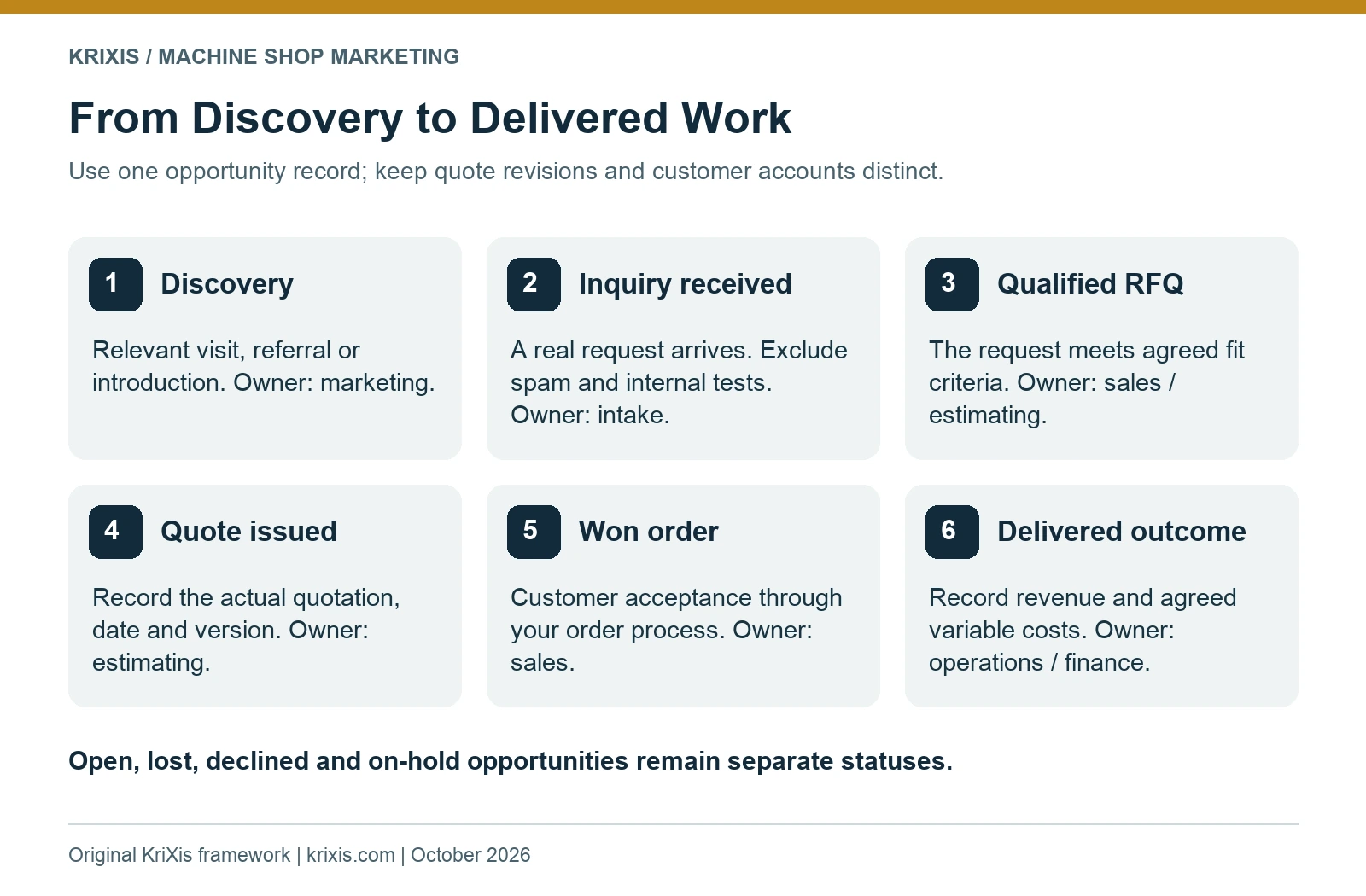
Six measurement stages from discovery to delivered work, with responsible teams
Discovery, inquiry, qualified RFQ, quote, won order and delivered outcome. View full-size infographic

A quoted amount is potential work, while a won order is a commercial commitment. Neither is identical to recognized revenue or cash collected. Choose the financial measure with the person responsible for your accounts and label it consistently in the report.

If you need a shared place to maintain these records, our machine shop CRM workflow explains ownership and stage rules. A maintained spreadsheet can also be a practical starting point for a small team.

Capture source information without slowing intake

Create one opportunity record when the inquiry arrives. At minimum, record its ID, receipt date, source, requested capability, qualification status, owner, quote date, outcome, and next action. Add financial values only when the business can support them.

Keep the first known source and later influences separate. A buyer might discover a capability article, return directly, speak to a colleague, and then submit an RFQ. The last visit alone would miss useful context. Conversely, an existing customer reading a new article does not make all subsequent account revenue newly acquired by marketing.

Ask a simple optional question such as “How did you first hear about us?” Use consistent categories and allow an unknown answer. Record the response as self-reported context, not independently proven attribution.

Estimator organizing RFQ folders beside a laptop and stainless steel component

Use tagged links for campaigns you control, such as a newsletter or a paid advertisement. Google’s campaign URL guidance explains how source, medium, and campaign parameters support reporting. Use a naming convention the team can maintain. Never put an email address, customer name, drawing identifier, or other sensitive detail into the URL.

When a source is missing, preserve the gap. Guessing “organic search” because a buyer found the website creates misleading precision. Review unknown records monthly and correct the collection process where possible.

Use website analytics for successful actions

A button click, a form start, and a successfully received inquiry are different events. Measure each only if it answers a useful question. Validate the submission path by checking the confirmation and the intended inbox or CRM record with clearly marked test data.

Before comparing marketing channels, use the GA4 RFQ conversion tracking guide to verify accepted requests and check for duplicate events.

Google Analytics recommends lead lifecycle events including generate_lead, qualify_lead, and close_convert_lead. Its recommended events documentation provides the current definitions. Later stages require an appropriate connection to your sales process; they do not appear simply because tracking code is installed.

Choose website key events carefully. A resource download can indicate interest, but it should remain separate from a qualified RFQ. A reporting setup that combines downloads, telephone clicks, and received RFQs into one “lead” number can obscure performance.

Keep ordinary analytics events free of names, email addresses, phone numbers, form-message text, and technical drawings. Google’s guidance on avoiding personally identifiable information applies to the information you send. Store project details in approved business systems and review the actual implementation before enabling integrations.

Find the gaps between your website and sales records

Get help defining your measurement gaps and the next practical improvement.

Request a machine shop marketing measurement review

Calculate a compact set of useful metrics

Two distinct workpiece lots in separate workshop trays
Keep inquiry, quote and won-work records distinct before comparing outcomes.

Begin with six measures. Define the date range, denominator, and source rules beside them so future reports are comparable.

Qualification rate = qualified RFQs ÷ valid inquiries × 100. This indicates how well incoming demand matches the agreed criteria. Review it alongside the number of accepted opportunities. A perfect percentage based on one inquiry tells a limited story.

Quote rate = quoted opportunities ÷ qualified RFQs × 100. Use a sufficiently mature group of opportunities. Low quote rate may reflect missing information, estimating capacity, technical review, or a deliberate decision to decline.

Quote win rate = won opportunities ÷ decided quoted opportunities × 100. In this definition, decided means won or lost. Report open and canceled quotes separately. An alternative definition can use all quotes, but the report must explain it and avoid comparing the two approaches as though they were identical.

Use the machine shop quote win/loss analysis to define one quoted opportunity, document the decision and choose an improvement to test.

Cost per qualified RFQ = allocated marketing cost ÷ qualified RFQs. Include the costs covered by the decision: agency fees, advertising, relevant tools, and agreed internal marketing effort. Document how shared costs are allocated. This measure does not capture all estimating effort or prove the opportunity is profitable.

Cost per acquired customer = allocated acquisition cost ÷ new customers acquired. Count customer accounts rather than orders. Define the period and allocation policy, especially when a campaign creates opportunities that convert months later.

Observed contribution ROI = (attributed contribution − marketing cost) ÷ marketing cost × 100. Define contribution as revenue less the agreed variable costs for the work. If incremental contribution cannot be established, describe this as an attribution-based estimate, not proof of causal lift or accounting profit.
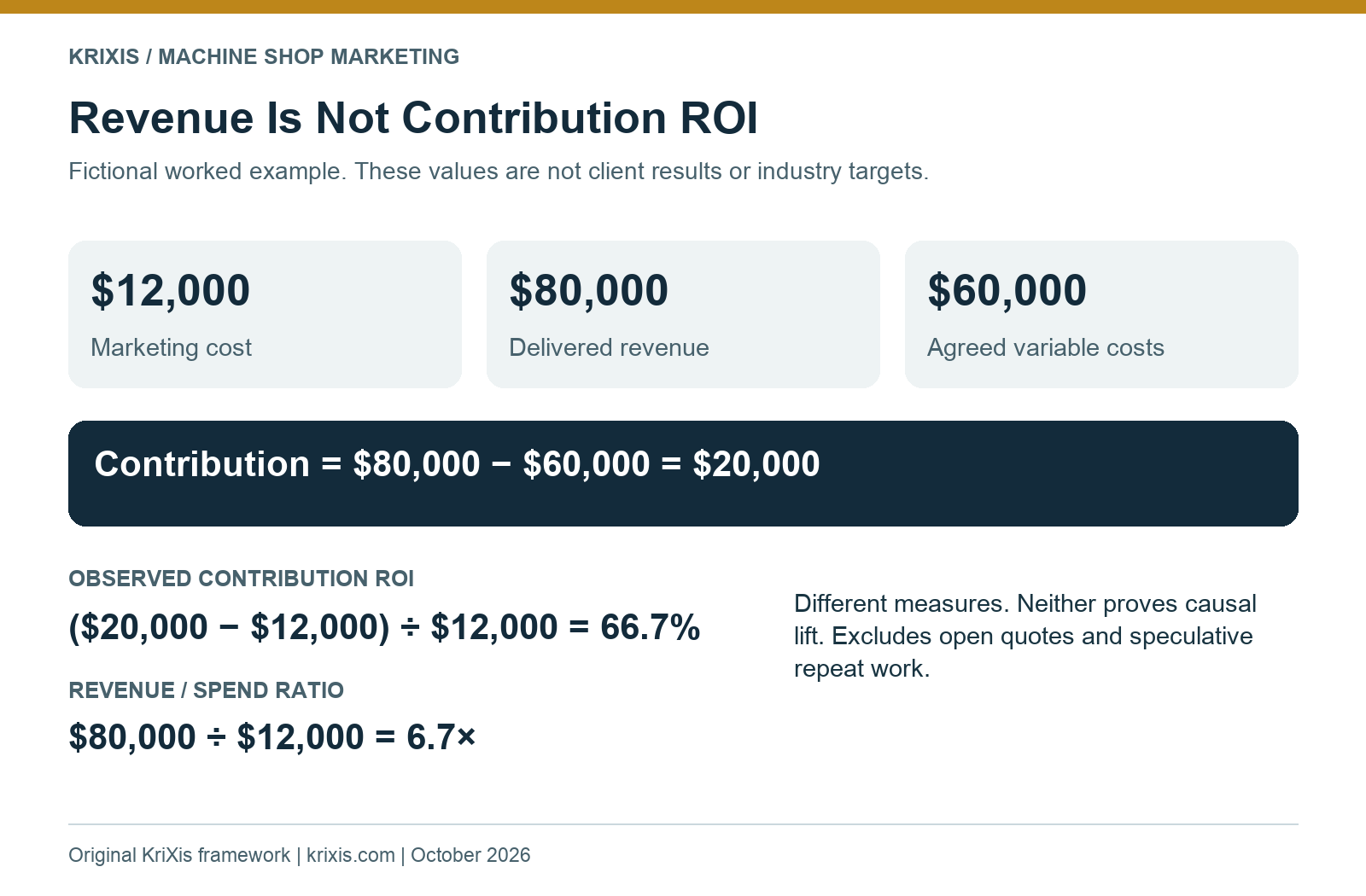
Fictional example comparing 66.7 percent contribution ROI with a 6.7 times revenue to spend ratio
Fictional example: $80,000 revenue less $60,000 variable costs gives $20,000 contribution; after $12,000 marketing cost, observed contribution ROI is 66.7%. View full-size infographic

A revenue-to-spend ratio can supplement these measures: attributed revenue divided by marketing cost. Label it as a ratio. It is not the same calculation as contribution ROI because it does not subtract production costs.

Work through a fictional machine shop example

Suppose a shop spends $12,000 on a defined acquisition program and tracks the resulting opportunity group. It receives 30 valid inquiries, accepts 18 for estimating, and issues 12 quotes. Eight quotes have decisions: four wins and four losses. Four quotes remain open.

The qualification rate is 18 ÷ 30, or 60%. The quote rate is 12 ÷ 18, approximately 66.7%. The decided-quote win rate is four ÷ eight, or 50%. Cost per qualified RFQ is $12,000 ÷ 18, approximately $667. None of those figures is a recommended target.

Assume the four won opportunities represent four new customer accounts. Acquisition cost per customer is $3,000 under the stated allocation. If two orders instead belonged to the same new account, the denominator would change. Record the actual account structure rather than using the order count automatically.

Now assume delivered work associated with those wins produces $80,000 in recognized revenue and $60,000 in the agreed variable costs. Contribution is $20,000. Observed contribution ROI is ($20,000 − $12,000) ÷ $12,000, approximately 66.7%. Revenue divided by spend is approximately 6.7 times. Presenting the latter as “670% ROI” would blur two different measures.

This example leaves open quotes unresolved and excludes speculative repeat orders. It also depends on the attribution and cost assumptions. A different production mix, delayed delivery, or inaccurate source data could change the result substantially.

Use the same definitions in your own review

Use a browser-based worksheet to calculate your baseline and record one next action.

Open the free scorecard and worked ROI example

Match reporting periods to the sales cycle

Use two complementary views. A calendar view shows work occurring this month: spending, received inquiries, quotes issued, orders won, and delivered contribution. A cohort view follows opportunities first received in a specified period as they mature.

Without the cohort view, January spending can be compared with January orders from last year’s relationships. That can make a good acquisition program appear weak or give it credit for work it did not originate.

Choose a review interval from your actual opportunity history. Track days from inquiry to qualification, qualification to quote, and quote to decision. Separate materially different work types when they have different buying cycles. There is no universal manufacturing waiting period that makes a campaign ready for a final verdict.

Show open pipeline separately from completed outcomes. A probability-weighted pipeline can support planning when its assumptions are grounded in your records, but it remains an estimate. Do not add pipeline value to realized revenue to create a larger return figure.

Use attribution to inform decisions, with its limits visible

Start with a simple written attribution policy. For example, assign new opportunities to their first known discovery source, record supporting influences, and mark uncertainty. Apply the same policy across channels before comparing them.

Buyers may cross devices, decline tracking, use private browsing, or contact you by phone. These gaps make perfect attribution unlikely. Keep self-reported answers, campaign evidence, and CRM history available without claiming that each proves causation.

A higher observed return does not establish that marketing caused every order. Existing relationships, customer demand, pricing, available capacity, and production performance also matter. If the business needs stronger evidence of incremental effect, design a comparison appropriate to the available data rather than inventing a counterfactual after the results arrive.

For ordinary monthly decisions, imperfect but consistently defined evidence can still help. Document which source categories need better collection and which conclusions are preliminary.

Keep your definitions beside the results

Use a browser-based worksheet to calculate your baseline and record one next action.

Download the free measurement worksheet

Run a monthly review with sales and estimating

Set a short meeting with the owner, marketing lead, sales contact, and estimating representative. Send the scorecard beforehand. Bring a small set of opportunity records that illustrate the main issue, using approved access controls.

Machine shop team reviewing an opportunity scorecard together

First, check the data. Confirm that tests and spam are excluded, revisions are not duplicated, source labels are consistent, and won work has the right financial status. If the data is incomplete, assign a correction before making a strong performance claim.

Second, examine fit. Which channels create suitable projects? Which create repeated requests for unsupported materials, sizes, quantities, or documentation? Ask whether capability pages or campaign targeting accurately describe the operation.

Third, inspect the handoffs. How long do accepted RFQs wait? Are missing-information requests assigned? Are quotes followed up according to the buyer’s decision timing? A marketing report should make these delays visible so the responsible team can resolve them.

Finally, choose one action, an owner, a due date, and a measure of success. Examples include clarifying a capability limit, repairing form delivery, recording loss reasons, or standardizing the handoff to estimating. Review the action at the next meeting.
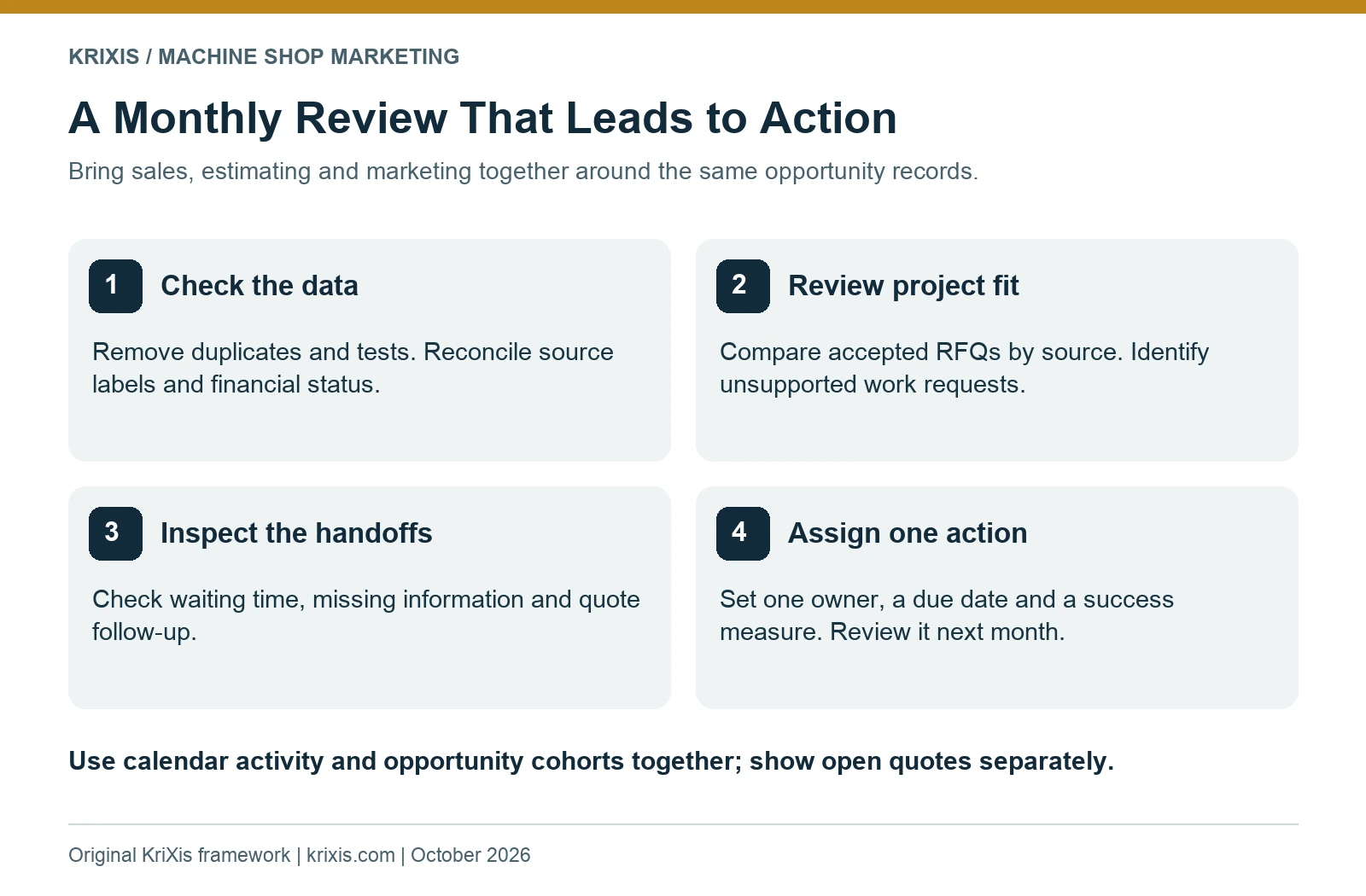
Four monthly review steps: check data, review fit, inspect handoffs and assign an action
Review data quality, project fit and handoffs, then assign one owner, due date and success measure. View full-size infographic
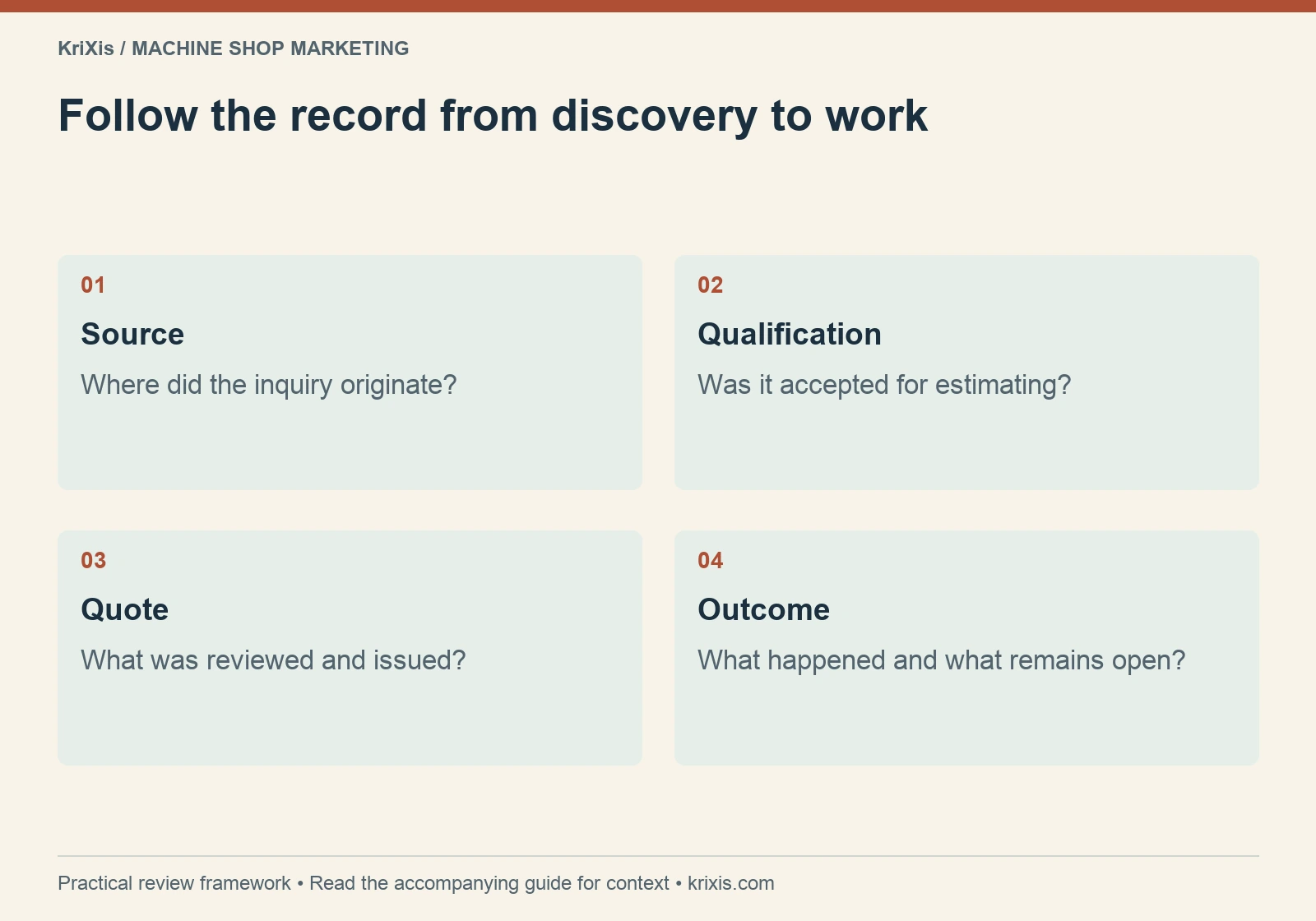
Follow the record from discovery to work — source, qualification, quote, outcome
Use this sequence to organize the review described in the guide. View full-size infographic
Read this graphic as text
  • Source: Where did the inquiry originate?
  • Qualification: Was it accepted for estimating?
  • Quote: What was reviewed and issued?
  • Outcome: What happened and what remains open?

Diagnose the bottleneck before increasing spend

If relevant visits rise but valid inquiries do not, review capability clarity and the inquiry path. Our machine shop website design service focuses on helping buyers evaluate fit and take the next step.

If inquiries increase but qualification falls, review targeting and the work your content implies you accept. If qualified RFQs wait without quotes, investigate capacity and missing information. If suitable quotes repeatedly lose, review the buyer’s feedback, timing, commercial terms, and technical requirements.

Quality professional inspecting an aluminum housing before delivery

If won orders do not produce healthy contribution, inspect the job economics with operations and finance. More demand cannot resolve an unfavorable production mix by itself. The response may involve refining preferred work or reviewing assumptions before scaling acquisition.

KriXis’s machine shop lead generation services connect discovery, website conversion, and follow-up. The measurement review helps identify which part of that process needs attention first.

Build a reliable baseline in the next 30 days

In week one, agree on opportunity definitions, fit criteria, source categories, and the financial basis. In week two, test the inquiry path and start recording new opportunities consistently. In week three, reconcile a recent sample with sales and estimating. In week four, produce the first scorecard and assign one improvement.

Treat that first month as a baseline-building exercise. It can reveal broken delivery, incomplete records, or poor fit quickly. It may not provide enough decided or delivered work to support a meaningful ROI conclusion.

Continue following the original cohort as it matures. Preserve unknown values and document revisions to the calculation. A useful measurement system becomes more informative as the team maintains it.

Turn the scorecard into a practical improvement plan

Get help defining your measurement gaps and the next practical improvement.

Request your marketing measurement review

Common questions about machine shop marketing ROI

Should we measure RFQs or revenue?

Measure both at their appropriate stages. Qualified RFQs help evaluate current demand and fit, while delivered revenue and contribution help assess completed outcomes. Show the relationship and timing rather than combining them into one score.

What is a good cost per qualified RFQ?

There is no universal target. It depends on project economics, quote success, customer value, estimating effort, and your capacity. Use your own history and clearly stated assumptions to decide what is acceptable.

Can we start without a CRM?

Yes. A consistently maintained record with defined stages and an assigned owner can establish a baseline. Move to a CRM when collaboration, volume, reminders, or reporting needs justify it.

Does downloading the worksheet count as a qualified lead?

No. A download indicates resource interest. A qualified RFQ requires the agreed project and fit criteria to be reviewed. Keep those actions separate in reporting.


October 9, 2026/5 Comments/by Matthew Borza
https://www.krixis.com/wp-content/uploads/2026/10/machine-shop-marketing-roi-hero.webp 1024 1536 Matthew Borza https://www.krixis.com/wp-content/uploads/2015/12/KriXis-Full-Logo-Trans-300x79.png Matthew Borza2026-10-09 21:09:442026-11-17 15:19:38How to Measure Machine Shop Marketing ROI: From RFQ to Won Work
Machine Shop Marketing

How to Qualify Machine Shop Leads: An RFQ Scorecard and Follow-Up Playbook

An inbox full of quote requests can look like a healthy pipeline. It can also keep an estimator busy with work the shop cannot produce, undefined projects, and repeat requests that never become orders. RFQ volume alone does not tell you whether inquiries match your equipment, quality system, capacity, or business goals.

To qualify machine shop leads, decide what happens next: quote, clarify, route, hold for capacity, or decline with an explanation. The process should support consistent responses without making buyers complete a long application.

This guide gives shop owners and sales teams a practical way to separate hard fit requirements from judgment calls, score viable opportunities, and follow up after a quote. The scorecard is a starting template. Adapt its weights and thresholds to your own equipment, margins, capacity, and customer mix.

Estimator reviewing an engineering drawing and machined component at a machine shop

What makes a machine shop lead qualified?

A qualified lead is an opportunity your shop has reason to pursue, not merely an inquiry with complete contact fields. At minimum, there should be a real project, a reachable person, and enough information to decide whether a useful next conversation is possible. For a quote-ready RFQ, you also need a workable technical definition and commercial context.

Qualification is shop-specific. A prototype that fits a five-axis job shop may be poor work for a high-volume turning operation. A 10,000-part request may be attractive to one shop and impossible for another. Fit depends on the operation receiving it.

Use two decisions in order. First, test for nonnegotiable fit: process, part envelope, material, quality obligations, and any confidentiality or compliance requirement you must be able to meet. Second, prioritize the opportunities that pass using a flexible score. This prevents a high dollar estimate from masking a job you cannot safely deliver.

CNC machine and inspected aluminum component illustrating technical fit
Verify actual process, material, envelope, and inspection capabilities before accepting work.

Start with five fit gates

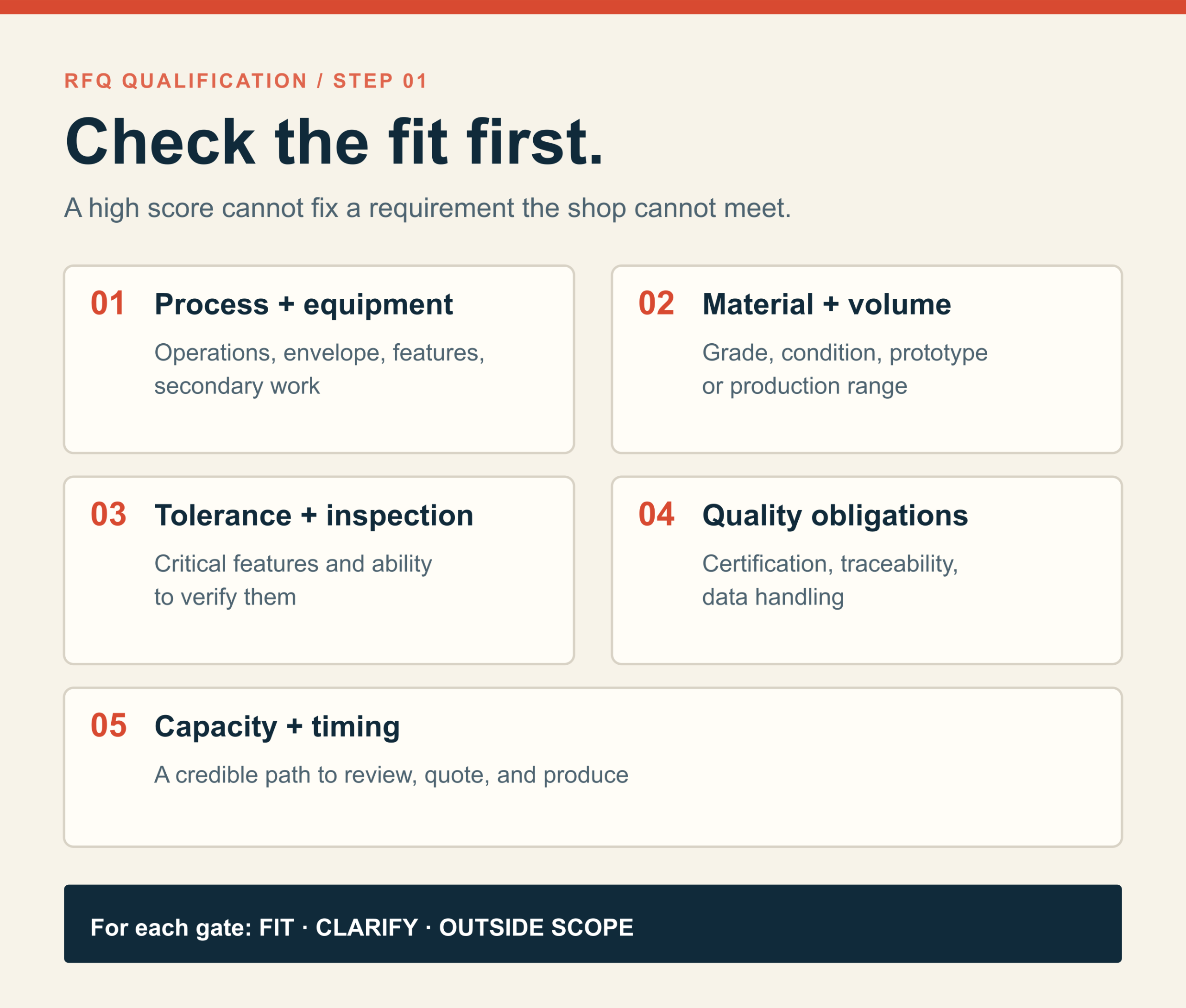
  1. Process and equipment. Can your current machines and partners perform the required operations? Record axis needs, part envelope, features, and required secondary processes. A broad label such as “CNC machining” is not enough to answer this.
  2. Material and production range. Can you source and machine the specified material, in the stated condition, at the intended prototype or production volume? Ask whether alternate materials or lot sizes are permitted rather than assuming they are.
  3. Tolerance and inspection. Can you verify the critical characteristics with your equipment, methods, and staff? If a requirement is unclear, route it for engineering review before promising a result.
  4. Quality and contractual obligations. Does the project require a certification, traceability package, controlled data handling, first article inspection, or customer approval process your shop can actually provide? Never imply a certification you do not hold.
  5. Capacity and timing. Can you review, quote, and—if awarded—produce within a credible schedule? A date is a constraint to discuss, not a number to accept automatically.

A gate can have three outcomes: fit, needs clarification, or outside current scope. “Needs clarification” deserves an owner and a question, not an automatic rejection. For example, a tight tolerance may apply to only one feature. A short call can resolve whether your inspection plan is adequate.

Five machine shop RFQ fit gates: process, material, tolerances, quality obligations, and capacity

Use a scorecard only after the gates

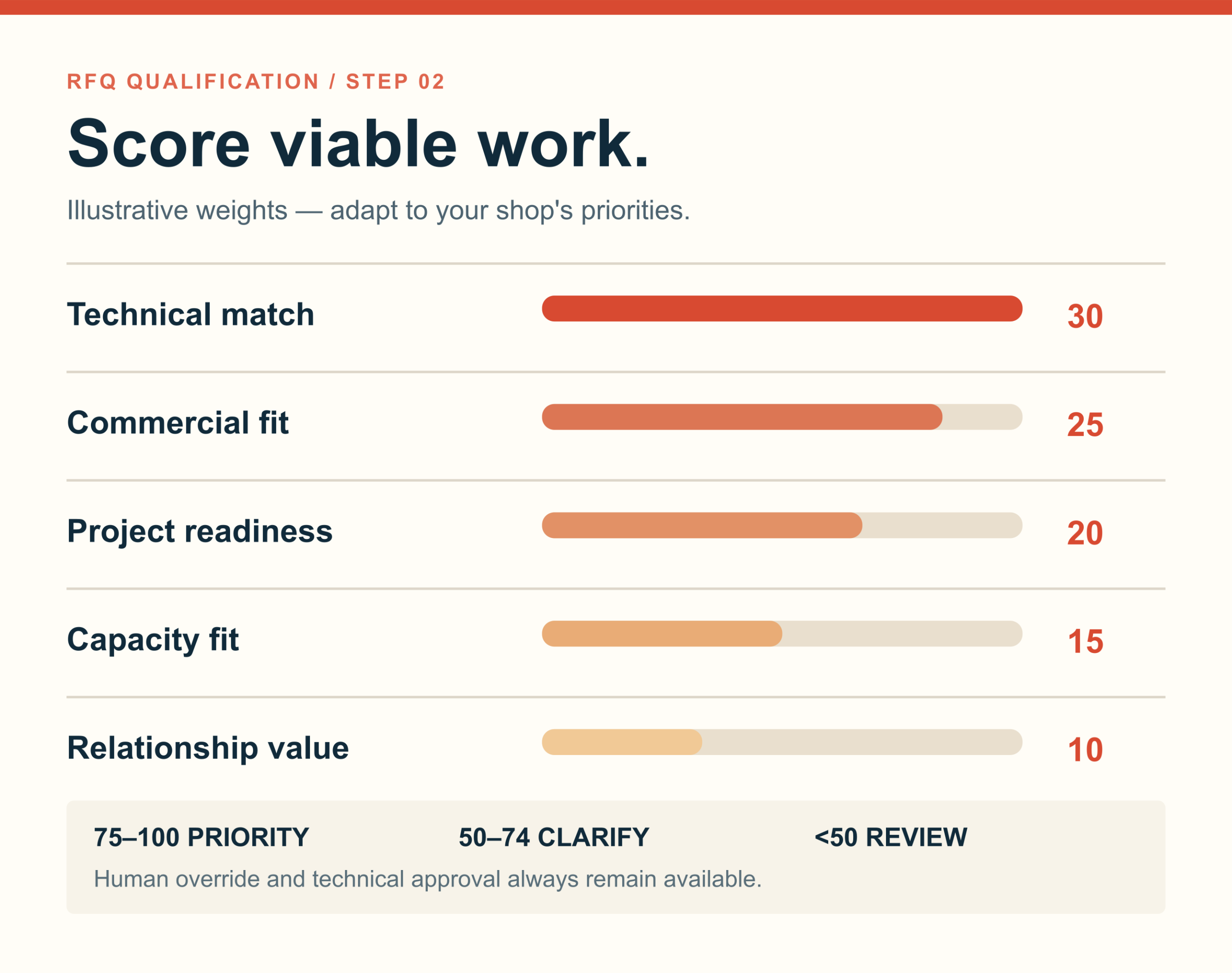
Once an inquiry passes the fit gates, a simple scorecard helps the team make consistent tradeoffs. Do not treat the result as an algorithmic quote decision. It is a triage aid that shows why an opportunity deserves more attention and what information is still missing.

Here is a sample 100-point model to adapt:

DimensionPointsWhat to look for
Technical match30Work fits proven processes, materials, tolerances, inspection, and partner network.
Commercial fit25Quantity, repeat potential, likely order value, and payment or purchasing terms fit your business.
Project readiness20Current revision, usable files, decision timeline, and a clear next step are available.
Capacity fit15The shop has a realistic window to quote and produce without disrupting committed work.
Relationship value10The buyer fits a target market, is a current customer, or offers a credible path to repeat work.

Suggested routing, not an industry benchmark: 75–100 points gets priority review; 50–74 gets a clarification or discovery step; below 50 gets a limited review or a polite decline if a required gate fails. A repeat customer, strategic account, or urgent problem can warrant an override. Record the reason, so the scorecard remains accountable to human judgment.

Avoid scoring a lead down because the buyer does not know machining terminology. An engineer may have a complete print but no purchasing authority; a founder may have a promising prototype and need help defining specifications. Ask which missing information changes your ability to quote. Do not make every unanswered field look like a disqualifier.

Sample 100-point RFQ scorecard: technical match 30, commercial fit 25, readiness 20, capacity 15, relationship 10

Example: two RFQs, different next steps

RFQ A: A purchasing manager submits a revised drawing, material specification, annual usage, first-order quantity, required documentation, and target date. The part fits a process your shop runs weekly. It passes the gates and earns a high score. Assign an estimator, acknowledge receipt, and give a realistic date for the next update.

RFQ B: A product team asks about a small prototype with an attractive long-term market, but sends an early model without critical tolerances or a controlled revision. The technical gate is not yet resolved. Send two or three specific questions and offer a short technical conversation. Quoting from assumptions would create more risk than value; discarding the lead would be premature.

Both inquiries deserve a response. They do not need the same response.

Collect enough information without building a form obstacle course

Your website’s RFQ path begins qualification. It should let buyers submit what they have and explain what the shop needs next. A “name, email, message” form pushes basic questions into the inbox. Demanding every technical detail can stop an early-stage buyer before a conversation begins.

Start with the essentials: contact name, company, business email, project description, process if known, estimated quantity, desired date, and an optional secure file upload or approved file-transfer method. Then use conditional fields for material, finish, quality documentation, and repeat volume when they matter to your work. Label optional information honestly. Explain which files you accept and what happens after submission.

For technical files, preserve the original attachment and revision. Ask the buyer to identify which drawing or model controls when multiple versions are sent. NIST’s model-based enterprise work illustrates why design data and its authority matter across supplier handoffs; a shop should not silently reconstruct requirements from a partial file. NIST describes the manufacturing data exchange problem in its Model-Based Enterprise Summit proceedings.

Sensitive drawings also need a deliberate handling path. Restrict access to the people reviewing the opportunity, use approved storage, and protect the accounts that hold the files. CISA recommends multifactor authentication for business systems that contain sensitive information. If a customer requires an NDA, export-control review, or other special handling, route that requirement before files circulate through ordinary marketing tools.

Estimator desk with a laptop, drawing, and sample part illustrating RFQ intake
The best first form captures a useful starting point and leaves room for a technical conversation.

Make the first review a repeatable workflow

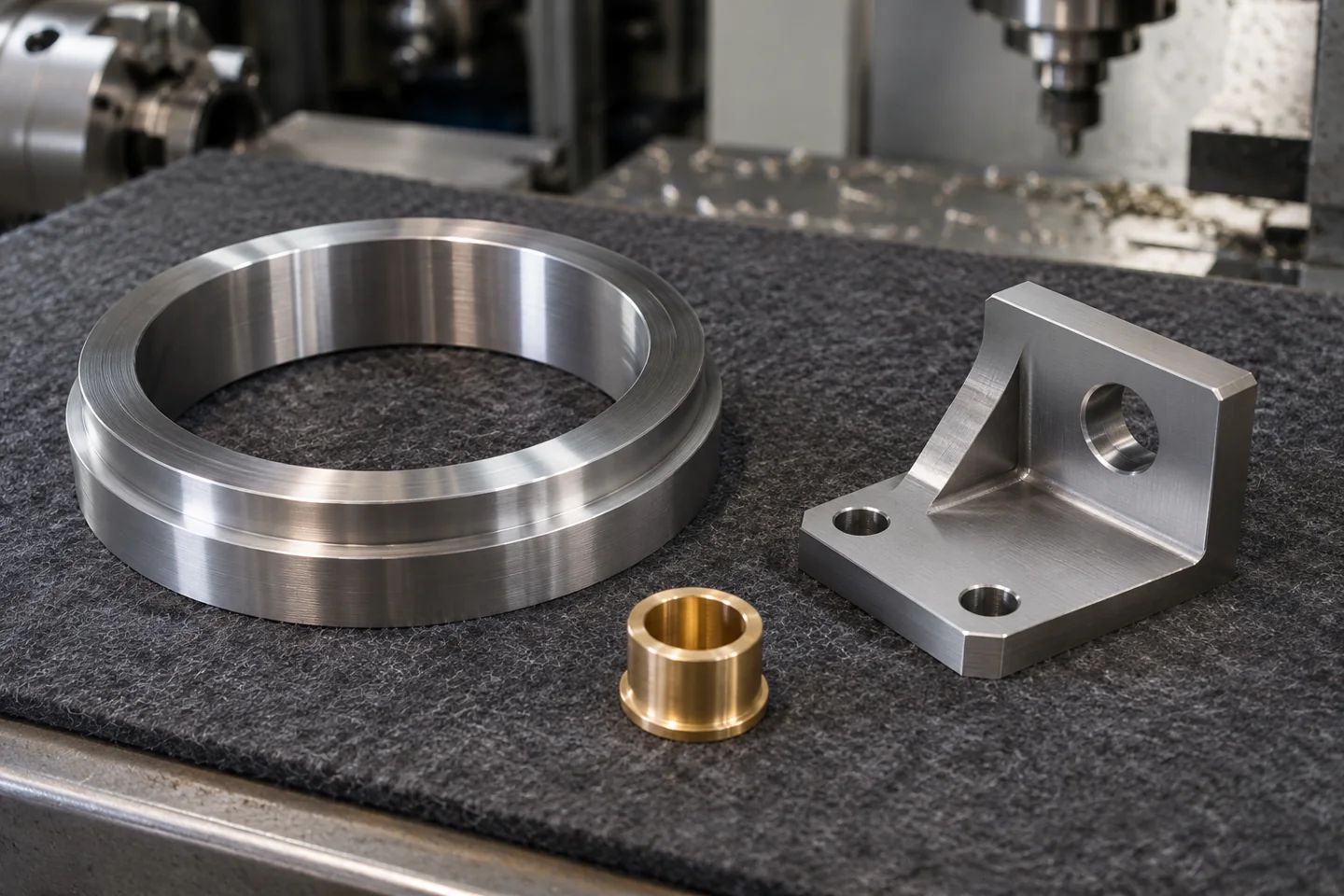
Turned ring, miniature bushing and steel bracket separated on a mat
Different requests call for a fit review before the next action is assigned.

The qualification process should answer three questions quickly: Who owns this? What is missing? When will the buyer hear from us? A shared inbox alone does not answer them. A CRM or lead log does not need to be elaborate, but each RFQ should have a source, owner, status, last contact, next action, and outcome.

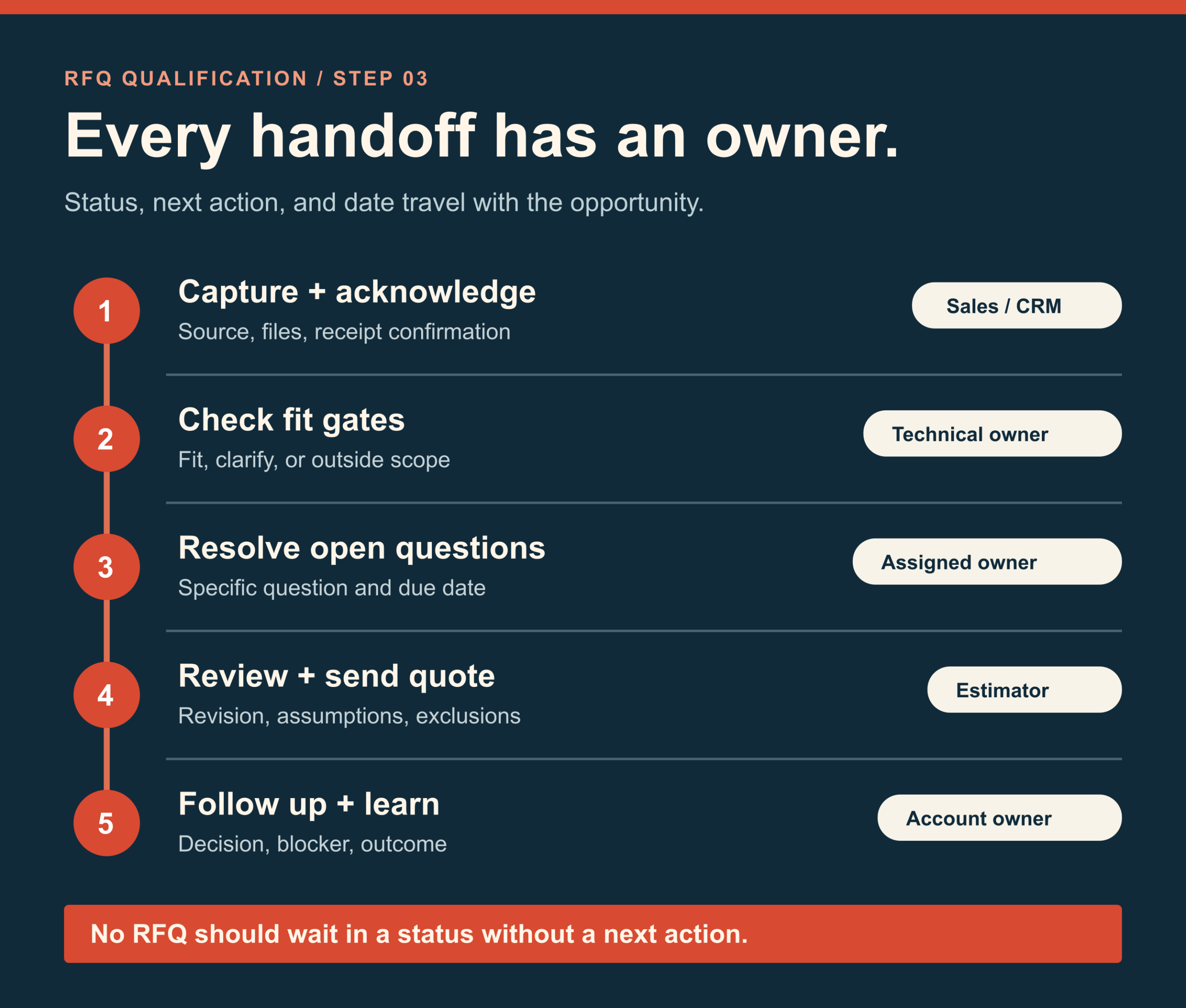
Use a short sequence:

  1. Capture and acknowledge. Record the original source—organic search, paid ad, referral, returning customer, or other channel. Confirm that the RFQ arrived, without promising a quote date before the team reviews it.
  2. Check the gates. A trained owner checks process, material, envelope, quality, capacity, and handling requirements. Mark uncertain facts as open questions.
  3. Assign the next action. Route fit leads to estimating. Route unclear leads to a named person for clarification. Route out-of-scope work to a courteous decline or a vetted referral, when appropriate.
  4. Score viable opportunities. Use the scorecard to set review order when several qualified RFQs compete for limited estimator time. Keep the score and the reasoning together.
  5. Set a follow-up date. Once a quote is sent, record when the team will check for feedback, the buyer’s decision timing, and any blocker identified.

Give each status a clear definition. “New” means unreviewed; “clarification needed” means a specific question is waiting on a specific person; “estimating” means the team has accepted the quote task; “quoted” means the buyer received a reviewed offer. These definitions prevent an inquiry from appearing active while nobody owns the next step.

Two manufacturing professionals reviewing a component and drawing during RFQ triage
Qualification should surface technical questions for a qualified person to resolve.
RFQ handoff workflow from inquiry and fit review to estimating, quote, buyer follow-up, and outcome tracking

Keep people in charge of technical and commercial promises

An intake tool can flag missing fields, organize files, and prepare a draft acknowledgement. It should not independently decide manufacturability, capacity, price, tolerance, certification, or delivery. Our separate guide to AI-assisted machine shop RFQ responses covers where automation can help while a person reviews the result.

The same rule applies without AI. A salesperson should be able to say, “We have your request and are reviewing the drawing,” without implying that the shop has accepted the work. A technical reviewer should be able to return a clear question before the buyer receives a price based on unstated assumptions.

Write responses that move the opportunity forward

The first response should make the buyer feel heard and establish the next action. It does not need a lengthy sales pitch. Use templates as a starting point, then tailor them to the actual project.

For a quote-ready RFQ: “Thanks for sending the drawing for [part/project] at revision [X]. We have the requested quantity and target date. [Name] is reviewing the technical requirements and will update you by [date]. If we identify a question that changes the quote basis, we will contact you before proceeding.”

For missing information: “We can review this for fit. Before we quote, could you confirm [specific question 1] and [specific question 2]? We have [files received], and want to make sure we use the correct revision. If a short call is easier, we can review those points together.”

For work outside the shop’s scope: “Thank you for considering us. This project requires [process or requirement] that we do not currently offer, so we should not quote it as though we can perform it. If the specification changes or you have a future project in [actual capability], we would be glad to review it.”

In each case, use a real owner and a real next date. Do not publish a blanket “24-hour quotes” promise unless your shop can deliver it for the RFQs that matter. A timely, specific update is more useful than an automatic message that says nothing about the project.

Follow up on quoted work without chasing blindly

Qualification does not end when the price goes out. A quoted project can stall because the buyer is waiting on internal approval, comparing suppliers, changing the design, or shifting the launch schedule. A follow-up should ask about the decision process and help resolve an obstacle, not simply ask whether the quote was received again.

At quote delivery, capture the revision quoted, quantity breaks, assumptions, exclusions, validity period, and buyer’s stated decision timing. Schedule a check-in based on that timing. If the buyer is still evaluating, ask whether price, lead time, documentation, or a technical point needs clarification. If the project is paused, record a future contact date rather than treating it as lost. If the order goes elsewhere, ask what you can learn, and distinguish price from capability, timing, and supplier qualification.

This history helps the next RFQ. It also helps marketing. A lead source that brings many form fills but few fit opportunities may be less valuable than a smaller source that consistently reaches your preferred work. KriXis’s machine shop lead generation service connects search and paid traffic with RFQ conversion and follow-up; this scorecard gives that system a clearer definition of “qualified.”

Estimator reviewing a part and workflow on a tablet during quote follow-up
A quote should have an owner, decision context, and next follow-up date.

Measure the pipeline you actually want

Do not stop at website traffic or form submissions. Track the path from inquiry to work your shop wants to accept. A simple monthly view can include:

  • Inquiries by source and the percentage that pass the hard fit gates
  • Time from receipt to first useful human response
  • Percentage of viable RFQs that reach a quote
  • Quote turnaround time by project type, measured from receipt of enough information
  • Quotes won, lost, paused, or still open, with the reason when known
  • Revenue and repeat work from awarded opportunities, tied back to source

Define the denominator before comparing months. A “quoted RFQ” should not include an auto-reply, and “response time” should distinguish acknowledgement from substantive review. Review sudden changes: a campaign may look worse after a form captures more early-stage buyers, or better after staff close incomplete requests without quoting.

If you lack a CRM, start with a shared spreadsheet and one accountable owner. Move to a more integrated system when the process is stable. KriXis has long emphasized connecting the front end of marketing to the back end of machine shop CRM; the qualification fields are what make that connection useful.

To improve how suitable inquiries reach this qualification process, use our machine shop lead generation plan for a 90-day acquisition test, destination-page checks and source tracking.

Put the system in place over 30 days

Week 1: Audit recent inquiries. Pull the last 20 to 30 RFQs if available, including won, lost, declined, and unanswered opportunities. Record source, technical fit, missing information, response time, quote status, and outcome. Use the review to identify the questions that genuinely determine fit for your shop.

Week 2: Agree on gates and ownership. Write the five gates in shop-specific language. Decide who can mark a job out of scope, who approves exceptions, and who owns clarifications. Choose a small set of statuses that everyone understands. Establish approved language for receipt, clarification, and decline.

Week 3: Pilot the scorecard. Have two people independently review several new RFQs and compare scores. Disagreement is useful: it shows where a dimension or weight needs a better definition. Do not let the point total overrule an engineer’s concern or a contractual requirement.

Week 4: Connect the website and reporting. Adjust the RFQ form only where the audit shows a real information gap. Test file handling and confirmation. Review the first month’s source-to-quote path and decide which marketing channels and page topics are bringing qualified work. The machine shop website design service explains how capability proof and a clear RFQ path fit together.

The goal is a usable routine. A team that records the same facts and assigns each next action will learn more than one with a dashboard nobody maintains.

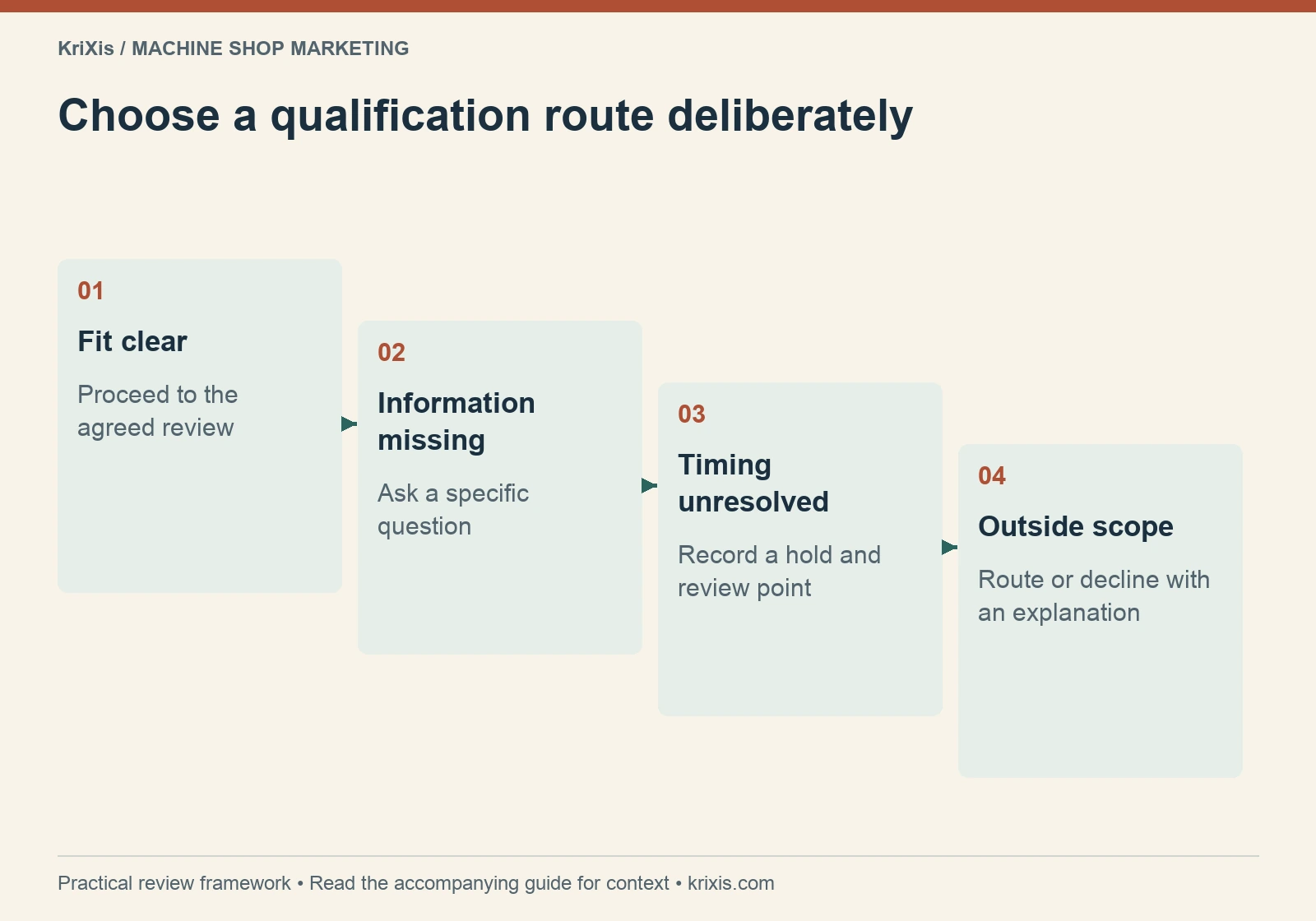
Choose a qualification route deliberately — fit clear, information missing, timing unresolved, outside scope
Use this sequence to organize the review described in the guide. View full-size infographic
Read this graphic as text
  • Fit clear: Proceed to the agreed review
  • Information missing: Ask a specific question
  • Timing unresolved: Record a hold and review point
  • Outside scope: Route or decline with an explanation

Frequently asked questions

Should we require a drawing before talking to a lead?

Require enough information for the next decision, not necessarily a complete drawing for the first conversation. Some early-stage buyers are validating a concept or supplier fit. If a drawing is essential to price or feasibility, explain that and offer a clear path to submit it securely. Do not quote a technical requirement you have not reviewed.

What if a promising customer scores below our threshold?

Use the score to flag the reason, then allow a documented human override. A strategic buyer may have an incomplete first RFQ but strong long-term fit. Assign a discovery step instead of pretending the project is quote-ready or discarding it.

How often should we change the scorecard?

Review it monthly during the pilot, then when your capacity, capabilities, customer mix, or win patterns change. Compare scored leads with actual quotes and awarded work. If the model rewards activity that does not produce good jobs, change the model.

Improve the information that arrives before qualification with the machine shop RFQ form design guide. It explains first-contact fields, drawing-sharing instructions, receipt messages and the handoff to your estimator.

Turn better inquiries into better work

More leads only help when your shop can recognize the right opportunities and respond well. Begin with hard capability gates, use a flexible score for viable RFQs, assign every next step, and learn from the outcome. That is how a lead generation program becomes a reliable path to the work your shop wants.

If you want to connect your website, search visibility, RFQ intake, and follow-up, talk with KriXis about your machine shop’s growth goals.

Next, connect qualification to commercial outcomes with our machine shop marketing ROI guide. Use the free RFQ scorecard and ROI worksheet to build a consistent reporting baseline.

Sources and further reading

  • NIST: Model-Based Enterprise Summit proceedings — manufacturing data authority and supplier handoffs.
  • CISA: Require Multifactor Authentication — protecting systems with sensitive business data.
  • Google Search Central: SEO Starter Guide — guidance for clear, useful search content.

Help buyers prepare before you qualify the inquiry. Share the machine shop RFQ preparation checklist to collect current revisions, quantities and open questions while keeping qualification and technical approval as separate decisions.

October 7, 2026/23 Comments/by Matthew Borza
https://www.krixis.com/wp-content/uploads/2026/10/machine-shop-rfq-lead-qualification-hero.webp 941 1672 Matthew Borza https://www.krixis.com/wp-content/uploads/2015/12/KriXis-Full-Logo-Trans-300x79.png Matthew Borza2026-10-07 07:08:462026-11-08 10:01:04How to Qualify Machine Shop Leads: An RFQ Scorecard and Follow-Up Playbook
Page 2 of 212

Categories

  • Digital Marketing
  • Machine Shop Marketing
  • Machine Shop Of The Week
  • Manufacturing Marketing
  • Personal Branding
  • small business digital marketing
  • small business web design
  • web design

Our Latest Posts

  • Stacks of turned steel flanges on a transport tray outside an industrial loading bay
    How to Find Manufacturing Customers for Your Machine ShopNovember 21, 2026 - 6:39 am
  • Blank kraft envelope and machined aluminum sample on a warm wooden workshop bench
    Machine Shop Sales Email Templates for a Useful First ConversationNovember 21, 2026 - 6:39 am
  • Disassembled red precision vise with its jaws and threaded screw laid out on a steel bench
    Machine Shop Quote Win/Loss AnalysisNovember 17, 2026 - 3:18 pm
  • Steel production fixtures moving through a green optical inspection gate
    RFQ Conversion Tracking for Machine Shops in GA4November 14, 2026 - 8:00 pm
  • Flanged sleeve, steel clevis and threaded insert in separate industrial sorting slots
    Google Ads Search Terms for Machine Shops: A Practical AuditNovember 12, 2026 - 8:02 am

Be The First To Read Our Posts

Matthew Borza – President

KriXis Consulting measures success using tangible data. This is our MBA mindset. Our constant growth is due to the utilization of evidence-based strategies to deliver what matters most, ROI.

Machine Shop Marketing © Copyright - KriXis Consulting
  • Link to X
  • Link to Facebook
  • Link to LinkedIn
  • Link to Pinterest
  • Link to Instagram
  • Services
  • RFQ Growth
  • Blog
  • Contact
  • Portal Sign In
Scroll to top Scroll to top Scroll to top

This site uses cookies. By continuing to browse the site, you are agreeing to our use of cookies.

Accept settingsHide notification onlySettings

Cookie and Privacy Settings


How we use cookies

We may request cookies to be set on your device. We use cookies to let us know when you visit our websites, how you interact with us, to enrich your user experience, and to customize your relationship with our website.

Click on the different category headings to find out more. You can also change some of your preferences. Note that blocking some types of cookies may impact your experience on our websites and the services we are able to offer.

Essential Website Cookies

These cookies are strictly necessary to provide you with services available through our website and to use some of its features.

Because these cookies are strictly necessary to deliver the website, refusing them will have impact how our site functions. You always can block or delete cookies by changing your browser settings and force blocking all cookies on this website. But this will always prompt you to accept/refuse cookies when revisiting our site.

We fully respect if you want to refuse cookies but to avoid asking you again and again kindly allow us to store a cookie for that. You are free to opt out any time or opt in for other cookies to get a better experience. If you refuse cookies we will remove all set cookies in our domain.

We provide you with a list of stored cookies on your computer in our domain so you can check what we stored. Due to security reasons we are not able to show or modify cookies from other domains. You can check these in your browser security settings.

Google Analytics Cookies

These cookies collect information that is used either in aggregate form to help us understand how our website is being used or how effective our marketing campaigns are, or to help us customize our website and application for you in order to enhance your experience.

If you do not want that we track your visit to our site you can disable tracking in your browser here:

Other external services

We also use different external services like Google Webfonts, Google Maps, and external Video providers. Since these providers may collect personal data like your IP address we allow you to block them here. Please be aware that this might heavily reduce the functionality and appearance of our site. Changes will take effect once you reload the page.

Google Webfont Settings:

Google Map Settings:

Google reCaptcha Settings:

Vimeo and Youtube video embeds:

Other cookies

The following cookies are also needed - You can choose if you want to allow them:

Accept settingsHide notification only