Krixis Consulting
  • Services
    • Manufacturing Marketing Agency
      • Machine Shop SEO
      • Machine Shop Website Design
      • Machine Shop Lead Generation
  • Blog
  • Contact
  • Menu Menu
  • Link to X
  • Link to Facebook
  • Link to LinkedIn
  • Link to Pinterest
  • Link to Instagram

Tag Archive for: digital marketing

Machine Shop Marketing

Conversion Rate Optimization for Machine Shops: An RFQ Guide

Updated October 7, 2026.

Conversion rate optimization, or CRO, means improving the proportion of relevant visitors who complete a useful action. For a machine shop, that action might be a qualified RFQ, a request for a technical discussion, or a buyer downloading a capability document before contacting sales.

The goal is to reduce avoidable friction while helping buyers assess fit. A higher form-submission rate is not automatically better if it fills an estimator’s inbox with unsuitable work.

Define the conversion and denominator

Choose a consistent definition before comparing results. A session-based form conversion rate is the number of sessions containing a successful submission divided by eligible sessions, multiplied by 100. A qualified inquiry rate uses the subset accepted by sales or estimating. Avoid mixing users, sessions, clicks, and raw submission counts in the same calculation.

For illustration, 10 qualifying sessions out of 500 eligible sessions is 2%. Those numbers are an example, not an industry benchmark. Exclude internal testing and obvious spam according to a documented rule.

Map the buyer’s path

Start with a real capability page and follow the process to a received inquiry. Can the buyer tell which materials and part sizes you handle? Is the RFQ link visible? Does the form explain required information? Does the confirmation tell them what happens next?

Ask an estimator and someone unfamiliar with the site to complete the same task using non-confidential test information. Record where each person hesitates. These observations often produce more useful changes than debating button colors.

Improve the information before shortening everything

Long content is not inherently a problem. Buyers may need tolerances, documentation requirements, production context, and inspection details to evaluate a supplier. Organize that information with headings and concise paragraphs, putting the most useful answers near the relevant action.

Remove repeated promotional claims and unclear wording. Add proof where it reduces uncertainty, such as an approved project example or a precise explanation of quality practices. Keep certifications current and clearly scoped.

Make forms usable and appropriate

Ask for the minimum information needed for the next decision. That may include contact details, process, material, quantity, timing, and a short description. Explain optional fields and provide helpful error messages. Support a secure alternative when a customer cannot share files through the public website.

Test form delivery, confirmation, and ownership. A successful on-screen message is not proof that the estimating team received the inquiry. Use a monitored test process and confirm the record reaches the intended inbox or CRM.

Connect measurement with qualification

Google Analytics provides a recommended generate_lead event. Configure measurement around successful completion rather than an unverified button click. Keep personal details and confidential drawing contents out of analytics event parameters.

Pair website measurement with the RFQ qualification scorecard. Record accepted, clarification-needed, and declined inquiries so the team can distinguish a usability improvement from a decline in lead quality.

Test according to the traffic available

A low-volume industrial website may not generate enough conversions for a quick, reliable A/B test. Start by fixing observable problems: broken fields, unclear instructions, missing capabilities, or slow pages. If you run an experiment, define its hypothesis, primary metric, audience, and decision rule before seeing results.

Do not declare a winner after a handful of submissions. Watch for changes in traffic source, seasonality, and project mix. Document uncertainty when the sample is too small to support a conclusion.

A useful monthly review

Review inquiry delivery, qualification rate, response time, and the questions buyers repeatedly ask. Select one improvement with a clear rationale and assign an owner. Keep a change log so future comparisons have context.

Use our SEO audit checklist to address discovery problems and the CRM guide to improve follow-through after the visitor becomes a lead.

October 23, 2017/0 Comments/by Matthew Borza
https://www.krixis.com/wp-content/uploads/2017/10/CRO-Color-Edited.gif 351 615 Matthew Borza https://krixis.com/wp-content/uploads/2015/12/KriXis-Full-Logo-Trans-300x79.png Matthew Borza2017-10-23 03:08:052026-10-07 10:17:46Conversion Rate Optimization for Machine Shops: An RFQ Guide
Digital Marketing, Machine Shop Marketing

Machine Shop Marketing Case Study: 2017 Results and 2026 Lessons

October 7, 2026 update: how to read this case study

This case study describes work and observations reported in May 2017 for Southeastern Manufacturing Enterprise and O & S Machine Company. The rankings, screenshots, project timelines, and visitor counts below are historical. They have not been re-measured for this update and should not be interpreted as current company performance or a promise of similar results.

The reported analytics period was November 1, 2016 through May 1, 2017. The original post reported 597 unique visitors for Southeastern Manufacturing Enterprise and 505 for O & S Machine Company. Visitor counts and search positions alone do not establish incremental revenue, profit, or the number of qualified RFQs generated. The article does not provide a controlled comparison or a complete sales-attribution record.

What still makes a useful foundation

A readable website, accurate capability information, useful location details, and a clear contact route remain sensible project priorities. The transferable lesson is to begin with the shop’s real starting point and build a measurable process. The exact schedule, platform list, and number of directories used in 2017 should not be copied as a current implementation recipe.

What to do differently today

Choose directories based on relevance and accuracy rather than a submission quota. Select social channels for a defined audience and sustainable publishing plan. The historical references to Google+ and other old platform choices describe the original project, not current recommendations.

Treat historical rankings as dated observations. Search results vary by query, location, and time. Do not double a search-volume estimate to account for other search engines without supporting data. Do not equate an analytics visitor with a potential order.

The original blanket discouragement of paid advertising is also too broad. A focused PPC test may be appropriate for some shops when capability fit, landing pages, budget limits, and qualified-lead measurement are clear.

Apply the lesson with current measurement

Record the baseline, the specific changes, and the period being reviewed. Connect inquiries to qualification, quotes, and outcomes in a CRM. Document customer concentration and project changes that might affect the comparison.

Use our SEO audit checklist to identify the next website improvements and the RFQ qualification scorecard to evaluate inquiry quality. The original account follows as a historical record.

Original 2017 case study

Owners and marketing directors are hounded weekly if not daily regarding digital marketing. We at KriXis Consulting decided more than a year ago to take a different approach; create a data-backed, industry-specific case study.

This post has been written with two goals in mind, to thoroughly explain a digital marketing process and provide realistic attainable benefits from the explained processes. We realize you may be unfamiliar with some terms in this post, to help we hyperlinked terms-of-art to pages with easy explanations for your convenience.

We wanted to find the perfect machine shop; a company that understood an online presence was needed, but was not actively making improvements.

Our desired shop met the following criteria:

  • Has an outdated or no website;
  • Absent from social media;
  • Sparse if any digital presence;
  • At least 10+ years in business.


Shop Selection


Over a year ago (currently May 2017) we sent an offer via email blast for a discounted website, design and build, and creation of a digital marketing foundation in return to allow us to create a case study. We selected two machine shops – Southeastern Manufacturing Enterprise, based in Franklin TN; and O & S Machine Company, from Latrobe PA. Both met all (4) criteria, and were located in competitive machining markets.


Southeastern Manufacturing Enterprise Initial Online Presence

Shop had dated and not responsive, not mobile-friendly, website (SEE screenshot below).


Southeastern Manufacturing Enterprise | Homepage | Old Website


Social media signals and profiles were not present and the website had zero back-links. However, due to having a website, SME was able to build some domain authority.


O & S Machine Initial Online Presence

This fifty year-old machine shop had no online presence at all.


Browser Not Found Sample


Both companies were given similar plans-of-action, processes and timelines, each are discussed in further detail below.


Timeline and Process


Due to both businesses having different starting points we tailored separate plans to ensure both were given a strong digital marketing foundation. However, each strategy followed a few basic principles: designing and building a responsive website, ensure focus of all major on-page SEO elements, create social media accounts, and correctly submit business listing citations.

At KriXis Consulting projects always kick-off with market research by MBAs utilizing a variety of tools, such as Google Keyword Planner and FreshKey, creating a clear marketing picture.

The two machine shops in this study were no exception to this rule. This tactic gives us insight into the volume of searches queried for specific terms or phrases, with results being based on monthly averages over 12-months, these can even be pinpointed to specific geographical areas. To simply put it, we uncover what potential customers are searching in your area, and make sure marketing efforts are geared towards those searches.

If that sounded confusing, don’t worry, it will all make sense when you see the plans in their entirety, followed by the results. Specific details for each company are listed below.


Southeastern Manufacturing Enterprise Marketing Plan


SME Responsive Website


We allotted 7-business days to conduct the research, present a mock-up layout, and build the new website.


Southeastern Manufacturing | Homepage | New Responsive Design


On-Page Keyword SEO Focus


  • Nashville TN Machine Shop
  • CNC Milling
  • Turning
  • Machine Building Services


Created Social Media Accounts


Completed within 30-days.

  • Facebook
  • Twitter
  • Pinterest
  • Tumblr
  • Google+


Business Listing Citations


Completed within 60-days.

  • Top 50 Directories


Kudzu Business Listing | Southeastern Manufacturing Enterprise

(Sample of correctly formatted business directory submission.)


Additional Blog


Within 90-days of project commencement we built SME a blog page, as well as produced an optimized article.


O & S Machine Company Marketing Plan


O & S Machine’s Responsive Website


We allotted 14-business days to conduct the research, present a mock-up layout, and build the new website. Extra time was provided due to no website existing prior to project.


Responsive Homepage | O&S Machine Company


On-Page Keyword SEO Focus


  • South Western PA Machine Shop
  • Pittsburgh Area Machining


Created Social Media Accounts


Completed within 30-days.

  • Facebook
  • Twitter
  • Google+


Business Listing Citations


Completed within 180-days.

  • Top 80 Directories


AboutUs Business Directory Submission | O&S Machine Company

(Sample of correctly formatted business directory submission.)


Current Standings (May 2017)


This is everyone’s favorite part, results that affect the bottom-line.


Search Engine Results


For each company we ran over 50 variations of common search phrases regarding services provided. We then selected (4) search terms using keywords for each shop’s geographical area, which averaged at least 50-100 searches per month; this provided a total of 200-2,000 opportunities for their machine shop to be found per month. These numbers only account for Google and their search partners; when considering Bing, Yahoo and Ask Jeeves, those numbers are easily doubled.

Feel free to test the following results for yourself.


SERPs | Southeastern Manufacturing Enterprise

Tennessee Machine Shop

  • Ranking: First Page, #10

Machine Building in TN

  • Ranking: First Page, #6

Franklin TN Machine Shop

  • Ranking: First Page, #3

CNC Machining in Franklin TN

  • Ranking First Page, #3


Google Search Engine Result | CNC Machining in Franklin TN


SERPs | O & S Machine Company


PA Machine Shop

  • Ranking: First Page, #1

Greater Pittsburgh Area Machining Services

  • Ranking: First Page, #1

Southwestern PA Machining

  • Ranking: First Page, #2

Pittsburgh Area Natural Gas Machining

  • Ranking: First Page, #1


Google Search Results | PA Machine Shop


Google Analytics Data


We added Google Analytics tracking to both websites. This software allows web admins to gather data ranging from the number of times a website was visited, geographic location of the visitors, how someone found a website (ex. search engine or directly typing in the web address), even exactly how the website is navigated during the visit. Not only does this information track marketing effort progress, but also allows admins to seek out bottlenecks preventing visitors from what is most important, making visitor into customer.

Below we added screenshots for both company’s data over a 6-month period, November 1, 2016 – May 1, 2017.


Google Analytics | Southeastern Manufacturing Enterprise
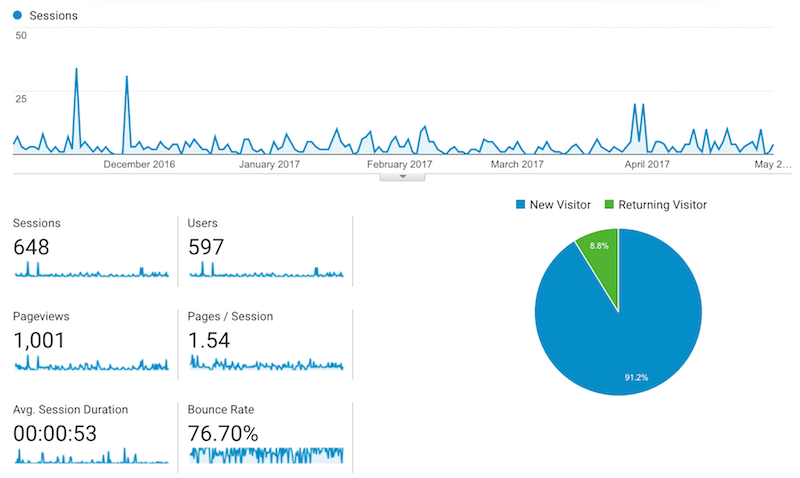
 

KriXis Consulting Google Analytics Data | Southeastern Manufacturing Enterprise


  • 597 unique visitors during a 6-month period.


Google Analytics | O & S Machine Company


Data From Google Analytics By KriXis Consulting | O&S Machine Company


  • 505 unique visitors during a 6-month period.


Case Study Overview


  • Two machine shops, in different locations and markets began with little to no online presence.
  • KriXis Consulting provided tailored plans to build a strong digital foundation.
  • Both companies generated awareness and business within a year time period, backed by data directly from Google.


We cannot stress enough that digital marketing is not an overnight success. You will not see immediate results unless you implement paid ad campaigns, which we highly discourage doing for the machining and manufacturing industry.

Additionally, it’s important to note both projects have been complete for almost a year, which provided the necessary time to have all aspects of the foundation indexed.

Our goal is long-term partnerships with clients that provide years of growth and online dominance. If you have any questions regarding what you have read or if you are interested in seeing what we can do for you, fill out the contact form below, or visit our contact page and it will be our pleasure to provide a free consultation. Thank you for taking the time to read this post, please share it via social media or with anyone whom you think it could benefit, if you’d like to learn more about our services or see more posts like this, all you need to do is click either link.


We Look Forward To Hearing From You!


May 13, 2017/1 Comment/by Matthew Borza
https://www.krixis.com/wp-content/uploads/2017/05/KriXis-Consulting-Case-Study-Digital-Marketing-Foundation-Main-1.png 538 600 Matthew Borza https://krixis.com/wp-content/uploads/2015/12/KriXis-Full-Logo-Trans-300x79.png Matthew Borza2017-05-13 03:06:122026-10-07 10:21:18Machine Shop Marketing Case Study: 2017 Results and 2026 Lessons
Digital Marketing, Machine Shop Marketing

Local SEO Video Overview: Updated Guide for Machine Shops

Updated October 7, 2026.

This page originally introduced a local SEO video in 2016. The historical recording reflects the tools and interfaces of that period. The written companion below provides the current practical framework for a machine shop reviewing regional visibility.

What local SEO should help a buyer do

A nearby buyer should be able to find accurate information about your shop, understand whether you handle the requested work, and reach the right contact. A map listing is one part of that experience; a useful website and a reliable response process complete it.

A buyer arranging a supplier visit may care about location and access. Someone seeking a production partner may care more about process, material, documentation, and quantity. Your pages should answer those questions clearly.

Keep the business identity accurate

Use the real business name and current contact details across the profile and website. Follow Google’s business representation guidelines, including eligibility and location requirements. Do not invent offices to appear in more places.

Review the listings that customers actually use. Correct outdated information and retain account ownership records so a future move or phone change can be handled efficiently.

Connect discovery with capability information

Send visitors to a relevant page that explains the services available. Keep regional information factual and avoid repetitive pages that merely exchange one city name for another.

Google’s local ranking guidance describes relevance, distance, and prominence as the main local ranking factors. A complete profile is useful, but it does not guarantee a particular position.

Give buyers a manageable next step

Make the inquiry route visible and explain what information to provide. Test the form and phone links on a mobile device, then verify that inquiries reach an assigned person. Use an approved method for confidential technical files.

Track whether inquiries fit the shop and progress to estimating. Review repeated questions and update the website where clearer information would help.

Continue with the detailed guides

  • Local SEO for machine shops explains the implementation priorities.
  • The machine shop website checklist helps improve buyer evaluation.
  • The CRM guide covers ownership and follow-up.
  • The RFQ qualification scorecard helps separate suitable work from missing information and poor fit.

Use this overview to orient the team, then choose one concrete correction to make first. Accurate information and a working inquiry path are sensible starting points before expanding into more content or directories.

Historical video: originally shared in 2016

This recording is retained for historical context. Use the updated written guidance above for current implementation priorities.

September 9, 2016/1 Comment/by Matthew Borza
https://www.krixis.com/wp-content/uploads/2016/09/Local-SEO-Overview-Video-KriXis-Consulting-e1473418872417.jpg 317 587 Matthew Borza https://krixis.com/wp-content/uploads/2015/12/KriXis-Full-Logo-Trans-300x79.png Matthew Borza2016-09-09 11:05:412026-10-07 10:22:29Local SEO Video Overview: Updated Guide for Machine Shops
Machine Shop Marketing, small business digital marketing

Local SEO for Machine Shops: A Practical Visibility Guide

Updated October 7, 2026.

Local SEO helps nearby buyers discover and evaluate your machine shop. It is especially relevant when customers need supplier visits, local pickup, repair work, or an accessible regional partner. A shop serving buyers nationally should combine local accuracy with substantial capability pages for the work it wants to win.

This update replaces the original directory-volume strategy and outdated platform references with a more focused approach. The useful question is whether a listing helps a real buyer find accurate information about your business.

Understand what affects local visibility

Google’s local ranking guidance identifies relevance, distance, and prominence as the main factors in local results. Complete information helps Google understand a business, but no agency can sell a guaranteed local position. Distance is not something you can solve by inserting more city names into your website.

Treat the profile, website, and sales process as connected parts of the buyer’s experience. A visible listing has limited value if it points to inaccurate capabilities or a contact form nobody monitors.

Start with an eligible, accurate Business Profile

Follow Google’s business representation guidelines. Use the real business name, accurate location information, appropriate categories, and current contact details. Do not invent offices, add marketing keywords to the business name, or use a virtual location to imply a staffed facility.

Verify hours, website links, and phone routing. Describe the services you actually provide. If visitors require an appointment or your facility has access restrictions, communicate that clearly through appropriate profile and website information.

Build useful location information on your website

Your location page should help a buyer understand where you operate and how to contact you. Include accurate service context, directions when relevant, and the capability information that matters to local customers.

Avoid dozens of near-identical city pages. If a separate regional page exists, it should contain information genuinely specific to that location or service situation. Shipping across a state does not mean the business operates a facility in every city.

Keep listings accurate where they matter

Review the directories and industry organizations your customers actually use. Correct duplicate or outdated listings, especially after a move or phone-number change. Prioritize accurate business identity and a working website destination.

The older article overstated the importance of identical phone punctuation and spacing. Readable formatting is fine; incorrect phone numbers, misleading addresses, and conflicting business identities are the practical problems to fix. Maintain a simple record of listing ownership and update dates.

Request genuine feedback

Ask customers for honest feedback after a meaningful interaction. Use a consistent request process and avoid incentives, fabricated reviews, or selectively asking only people expected to leave a positive rating. Respond professionally without revealing confidential project information.

Reviews can help prospective buyers understand communication and service. They do not replace technical supplier qualification or evidence that the shop can meet a specific requirement.

Give local visitors a clear next step

Explain how to request a quote and what information makes the conversation productive. For repair work, buyers may need a quick way to describe the problem. For production machining, material, quantity, drawings, and documentation requirements may be more relevant.

Use our RFQ qualification guide to organize intake. Ensure confidential or controlled technical information uses an approved transfer process.

Review outcomes each month

Check profile information, website contact paths, and new customer questions. Record whether local inquiries fit your capabilities and whether they progress to quotes. Separate job applications and unrelated calls from sales inquiries.

Combine this work with the machine shop SEO audit and website improvement guide. Local visibility is most useful when accurate discovery leads to an informed buyer conversation.

July 17, 2015/1 Comment/by Matthew Borza
https://www.krixis.com/wp-content/uploads/2015/07/local-seo.jpg 1379 2174 Matthew Borza https://krixis.com/wp-content/uploads/2015/12/KriXis-Full-Logo-Trans-300x79.png Matthew Borza2015-07-17 17:03:592026-10-07 10:18:02Local SEO for Machine Shops: A Practical Visibility Guide
Machine Shop Marketing, small business digital marketing

Small Business Email Marketing: A Practical B2B Update

Updated October 7, 2026.

Small business email marketing works best when recipients have a clear reason to hear from you. For a machine shop, useful messages might explain a verified capability, answer a recurring RFQ question, or share an approved manufacturing example. Sending more frequently does not compensate for an irrelevant message.

This update removes the original 2013–2014 ROI statistics and old software screenshots. Platform pricing and interfaces change, so choose a system based on your current needs and verify its terms before committing.

Define the audience and purpose

Separate customer service messages, individual quote follow-up, and subscription marketing. They serve different expectations and should have different workflows. A contact who submitted an RFQ should not automatically receive every promotional campaign without an appropriate basis and clear expectations.

Document where contacts came from and what they requested. Avoid buying a large list simply to make the audience look established. Give subscribers a clear description of the content and an easy way to stop receiving it.

Choose the system around your workflow

Evaluate contact management, suppression handling, reporting, user permissions, exports, and integration with your CRM. Check current contact limits, sending limits, and costs. Confirm that the business owns the account and can retrieve its data.

Begin with one manageable audience and one useful campaign type. Complex automations can wait until you have reliable data and someone responsible for reviewing the messages they send.

Configure sender authentication and delivery

Ask your email administrator or provider to verify your sending domain and authentication setup. Gmail’s sender guidelines describe authentication and unsubscribe requirements that vary with sending volume. Use those requirements and your provider’s current instructions rather than an old setup screenshot.

Monitor delivery failures and complaints. Remove invalid addresses and honor opt-outs across connected systems. Delivery reporting does not prove that a person read or understood a message.

Write one useful message at a time

Choose a specific reader question and answer it directly. A subject such as “What to include in a stainless turning RFQ” sets a clearer expectation than an exaggerated promise about savings. Keep the sender identity recognizable and the main action easy to find.

For a capability announcement, explain what changed, what types of projects it may support, and what still needs engineering review. Do not imply that a new machine guarantees lower prices or shorter lead times for every part.

Link to a relevant capability page or guide. The RFQ qualification article provides a useful model for explaining fit and missing information without promising an instant quote.

Review the mobile experience and confidentiality

Send a test to approved internal reviewers. Check links, text size, image descriptions, and the appearance when images are blocked. Ensure the message remains understandable without decorative graphics.

Get permission before including customer names, part photos, drawings, or results. Link to an approved resource rather than attaching sensitive production files to a marketing message. Have a human review automated drafts for accuracy and tone.

Measure replies and business progress

Review delivery failures, unsubscribes, meaningful clicks, replies, and qualified inquiries. Open tracking is an imperfect signal because email clients and privacy features affect it. Do not treat a reported open as proof of buying intent.

Use the CRM workflow to record relevant responses and next actions. Compare campaigns by audience and purpose; a small group of suitable buyers may be more valuable than a large unqualified audience.

Start with a simple review cycle

Publish at a frequency your audience expects and your team can sustain. There is no universal weekly schedule. After each campaign, record what was useful, what caused confusion, and what should change next time. Coordinate topics with your social content plan while keeping each channel’s audience expectations clear.

May 14, 2015/0 Comments/by Matthew Borza
https://www.krixis.com/wp-content/uploads/2015/05/data-tracking.jpg 300 450 Matthew Borza https://krixis.com/wp-content/uploads/2015/12/KriXis-Full-Logo-Trans-300x79.png Matthew Borza2015-05-14 22:06:492026-10-07 10:18:17Small Business Email Marketing: A Practical B2B Update

Categories

  • Digital Marketing
  • Machine Shop Marketing
  • Machine Shop Of The Week
  • Manufacturing Marketing
  • Personal Branding
  • small business digital marketing
  • small business web design
  • web design

Our Latest Posts

  • Estimator reviewing an engineering drawing and machined component at a machine shop; conceptual image
    How to Qualify Machine Shop Leads: An RFQ Scorecard and Follow-Up PlaybookOctober 7, 2026 - 7:08 am
  • Manufacturing estimator reviewing a CAD drawing and AI-assisted RFQ workflow at a CNC machine shop
    How Machine Shops Can Use AI to Respond to RFQs Faster—Without Risking Customer DataSeptember 29, 2026 - 5:56 am
  • Engineer reviewing a CAD drawing beside a CNC machining center
    Machine Shop SEO in 2026: A Practical RFQ Growth GuideSeptember 22, 2026 - 8:55 am
  • KriXis Consulting | 2020 SEO Trends | Blog Main Image
    Machine Shop SEO Trends: What Changed Since 2020October 23, 2020 - 4:28 pm
  • Michigan Machine Shop | Zero Tolerance | Blog Cover Image
    Zero Tolerance, LLC: 2018 Machine Shop InterviewNovember 14, 2018 - 7:48 am

Be The First To Read Our Posts

Matthew Borza – President

KriXis Consulting measures success using tangible data. This is our MBA mindset. Our constant growth is due to the utilization of evidence-based strategies to deliver what matters most, ROI.

Scroll to top Scroll to top Scroll to top

This site uses cookies. By continuing to browse the site, you are agreeing to our use of cookies.

Accept settingsHide notification onlySettings

Cookie and Privacy Settings


How we use cookies

We may request cookies to be set on your device. We use cookies to let us know when you visit our websites, how you interact with us, to enrich your user experience, and to customize your relationship with our website.

Click on the different category headings to find out more. You can also change some of your preferences. Note that blocking some types of cookies may impact your experience on our websites and the services we are able to offer.

Essential Website Cookies

These cookies are strictly necessary to provide you with services available through our website and to use some of its features.

Because these cookies are strictly necessary to deliver the website, refusing them will have impact how our site functions. You always can block or delete cookies by changing your browser settings and force blocking all cookies on this website. But this will always prompt you to accept/refuse cookies when revisiting our site.

We fully respect if you want to refuse cookies but to avoid asking you again and again kindly allow us to store a cookie for that. You are free to opt out any time or opt in for other cookies to get a better experience. If you refuse cookies we will remove all set cookies in our domain.

We provide you with a list of stored cookies on your computer in our domain so you can check what we stored. Due to security reasons we are not able to show or modify cookies from other domains. You can check these in your browser security settings.

Google Analytics Cookies

These cookies collect information that is used either in aggregate form to help us understand how our website is being used or how effective our marketing campaigns are, or to help us customize our website and application for you in order to enhance your experience.

If you do not want that we track your visit to our site you can disable tracking in your browser here:

Other external services

We also use different external services like Google Webfonts, Google Maps, and external Video providers. Since these providers may collect personal data like your IP address we allow you to block them here. Please be aware that this might heavily reduce the functionality and appearance of our site. Changes will take effect once you reload the page.

Google Webfont Settings:

Google Map Settings:

Google reCaptcha Settings:

Vimeo and Youtube video embeds:

Other cookies

The following cookies are also needed - You can choose if you want to allow them:

Accept settingsHide notification only